

More from +972 writers

Our newsletter features a nice roundup of the week's top stories. Click to register.

We won't spam you, and we won't share your info.
Analysis News

The case against Hamentashen

Eating Iranian ears would have been so much more fun – if it weren’t for sweet donut memories.

Ah, being Jewish, such a daily philosophical experience! The effort to remind ourselves constantly of the destruction of the temple brings out incessent poetry in our day to day: It’s in our prayers, it’s in our broken-glass weddings, it’s in that corner of the house the observant leave unpainted, it’s even in the cookies.

Take Hamentashen – or Oznei Haman in Hebrew, which literally means “Haman’s ears” – those triangular pastries named for the villain in Purim’s holiday tale. Yes, I know, your grandma used to bake them more delightful and more tender than Parisian macarons. Yes I know, that bakery down on Dizengoff stuffs them with real mascarpone mixed with solid gold and diamonds. Nonetheless, the leap from a holiday in which we eat sufganiot – those irresistible jelly filled donuts of Hanukkah – to one in which we eat a generally dry pastries, traditionally filled with poppy seeds (good when scattered on top of a challa, less appealing as a condensed mush) and named to evoke the severed, dirty ear of an ancient Persian anti-Semite… talk about falling from grace.

These aren’t my thoughts only. As the question went into an online debate on my Facebook page, my friend Cindy, a mother of four living the in the U.S., confirmed: “Prune filling + cookie = more disappointing than getting a toothbrush while trick-or-treating. If we want kids to continue celebrating Jewish holidays we need to come up with more competitive marketing. Christmas and Easter are kicking our asses. They have candy canes and chocolate bunnies, and we get poppy seed and apricot filling? Seriously?” Yup, the key to assimilation is triangle-shaped.

Now, it could be argued that in today’s climate, eating body parts of Iranians is a matter of national security, and that the Hamentashen are simply meant to train us for chewing on Iranian ears once we’ve won the approaching war, since it will leave the entire Middle East wrecked and there will be nothing else to eat.

Another failure, here, since these things look nothing like Iranian ears. Please observe the ear of Leila Hatami, star of Oscar nominated film “Nader and Simin, a Separation,” as it peeks under her headscarf.

Now compare it with the image used to illustrate the Wikipedia article “Hamentashen”.
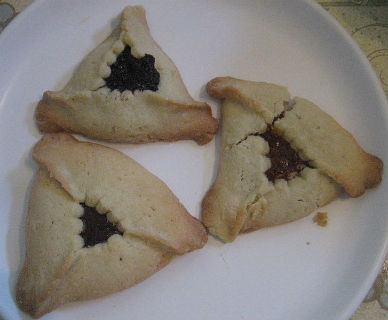
If anything, I feels as though it is our experience with sufganiot that equips us to consume members of the handsome Persian race, and please consider that they have been eating delicious baklavas and “Gooshefil” for centuries in preparation for eating us.

Of course, the idyll of jelly-filled sufganiot is broken several weeks before Purim with dried figs. The holiday of Tu Bishvat, comfortably situated in between Hanukkah and Purim, is typically celebrated by the eating of dried fruit. The historical excuse for this is as follows: In the Diaspora, Tu Bishvat is a celebration of the land of Israel, and Mediterranean fruit could historically only be delivered to colder countries in their dry form, so we’re stuck with them.

Now, say what you will about dried fruit, they don’t pretend to be yummy cookies. Hamentashen do, and this is unforgivable. The one convincing way to make sense of their appearance on our happiest holiday, is to regard them as a “memento mori” – a reminder of the destruction of Jerusalem. Otherwise, as proposed by +972′s own Haggai Matar, we may simply accept them as a way station on the road to matzos.

(Leila Hatami image taken from http://www.youtube.com/watch?v=_4JYDc5789U)

For additional original analysis and breaking news, visit +972 Magazine's Facebook page or follow us on Twitter. Our newsletter features a comprehensive round-up of the week's events. Sign up here.

View article: AAA
Share article
Print article
  • COMMENTS

    1. aristeides

      Fine, Yuval, don’t eat your hamentaschen, it’ll leave more for me.

      Reply to Comment
    2. 1

      I think that you are funy more than this title.

      Reply to Comment
    3. sh

      Ha, ha. Loved this, but it’s all based on a false premise Yuval. Tasch is a pocket not an ear, mohntaschen is a German delicacy that translates as poppyseed pockets, Hamohn/mantaschen are Haman’s pockets. Now we need a good Rashi explanation for why. It must have been those pesky Zionists who started with this ozen thing.

      Reply to Comment
    4. Thank you, SH, this is very interesting. I simply assumed that the Hebrew name was a translation of the Yiddish one. To be very honest, “Haman’s ears” is funnier, and this is the one thing I do like about them: their morbid, bizzare Hebrew name.

      Reply to Comment
    5. David

      Isn’t this piece based on the false premise that Hamantaschen are supposed to be the ears (or pockets) of “Iranians”?

      The hint is the word “Haman”.

      Reply to Comment
    6. sh

      @Yuval – “To be very honest, “Haman’s ears” is funnier, ”
      .
      Of course it is. But hear this: a hamantasch-hater myself (sweet poppy-seed, apart from its unappealing appearance and taste, feels like cold coffee-grounds in the mouth), I found a wonderful alternative, which is how I discovered that the ears come from the sephardim. My favorite pastry shop-owner prepares by hand delicious rose water-scented fried pastries once a year, only for Purim. Here’s their story:
      .
      “…Among the recipes in an anonymous thirteenth century Moorish cookbook from Andalusia was a deep-fried pastry called udhun (Arabic meaning “ear”), so named because the dish resembled that part of the human anatomy. ….. The fried pastry was typically filled with ground pistachios or almonds mixed with sugar and rosewater. In this vein, Isaac Abarbanel (born in Lisbon in 1437 and died in Venice in 1508) in his Biblical commentary in a discussion of the manna, noted, “The wafers are a flour food cooked in oil in the form of a water flask that are eaten with honey and it is like the wafers that they make from dough like the shape of ears, cooked in oil and dipped into honey, and we called them ozneim (ears).”
      http://gilmarks.com/wordpress/?p=118

      So the manna (man in Hebrew) becomes Ha-man and the mohn becomes Ho-mohn and we’ve stolen the name of another of our national noshes from the Arabs. There’ll be hell to pay!

      Reply to Comment
    7. Ploni

      Worse still a Dutch painter named Van Gogh confused Oznei Hamam with mslokkh manot and tried mshlokh ozni.

      Reply to Comment
    8. If you’re tiring of the racist overtones of “oznei haman,” I suggest reclaiming the goddess worship origins of Purim and it’s heroine Esther/Ishtar. Certainly it hasn’t escaped your attention that “hamentaschen” look less like ears than they do a certain part of the female anatomy…

      B’teyavon!

      Reply to Comment
    9. Piotr Berman

      This reminds me complaints about Christmas that “they took Saturn out of Saturnalia”.

      Reply to Comment
    10. sh

      Rabbi Brant Rosen, hormonetaschen then. Thanks – et bon appétit to you too!

      Reply to Comment

    LEAVE A COMMENT

    Name (Required)
    Mail (Required)
    Website
    Free text

© 2010 - 2013 +972 Magazine
Follow Us
Credits

+972 is an independent, blog-based web magazine. It was launched in August 2010, resulting from a merger of a number of popular English-language blogs dealing with life and politics in Israel and Palestine.

Website empowered by RSVP

Illustrations: Eran Menedl


theme_function.php-begin | 19.893584MBtheme_function.php-end | 21.751864MBmost_stuff_widget_begin | 23.199736MBmost_stuff_widget_end | 23.5564MBtwitter_widget_begin | 23.81628MBtwitter_widget_end | 23.81628MBtheme_footer_before_end | 23.81628MB