
More from +972 writers

Our newsletter features a nice roundup of the week's top stories. Click to register.

We won't spam you, and we won't share your info.
Analysis News

"We" speak Hebrew, "them" Arabic. Why negotiate in English?

Many have argued that the US is no longer a neutral broker between the Israelis and the Palestinians. I’ll take it one step further: is English even the appropriate mediating language?

William Shakespeare famously asked, “What’s in a name?” I (less famously) will ask, “What’s in a language?”

Today, I called the mobile provider Orange to argue about my bill. I was asked to provide them (again) with my email address. Me spelling it out went something like this…

Me: “R” for Roee, Romeo, like the Hebrew letter “raysh”
Orange agent: “M?”
Me (thinking to myself): “How the #$%W#$ did you get M from that?””
Me (actually saying): “No, R … for Roee, Romeo, Race, Ranch, Raysh.”

Sounds silly, but it reminds me of the miscommunications between the Israeli officials who travel to Washington and their American counterparts, a frustration that has been expressed by the latter. The Israelis are so insistent they speak English. But really, except perhaps for Pennsylvania-raised Netanyahu, what most are doing is speaking Hebrew with English words.

There’s a joke: an Israeli contractor bids for a building. He’s asked by the client, “How much?” The client says (in Hebrew, using English words), “Roof? One million.” The client thinks to himself, “Wow, if only the roof is a million, I can’t imagine how much the rest of the building will cost,” and walks away from the deal. (In Hebrew, gag means “roof,” but it also means “maximum” or “tops.”)

I wonder if peace would have been achieved years ago if Israel’s English-speaking diplomats would have just spoken Hebrew and used translators. At minimum, it might have spared years of misunderstandings.

A second anecdote: I heard a rumor that when you have US dollars in your Israeli checking account, and then withdraw them, they are first converted to Israeli shekels and then back to US dollars. Obviously, you lose a lot in the conversion. I wonder if, when the Israelis and the Palestinian negotiate via an English-speaking mediator, there’s some (lots?) of value lost, as well?

Language is clearly important. I have long argued that Israel’s schools should be fully bilingual, and that language should not be segregated. Considering that the schools themselves are segregated, the language discussion is a long way off the table. And … it’s not guaranteed to solve anything. In Belgium, the Flemish and Wallonians speak each other’s native tongues and they still can’t get along. But one would think that Israelis, living in the neighborhood that they do, would be keen to learn the language of those living in the region. I have suggested it to some here in Tel Aviv and I mostly received vehement opposition, though I am not sure why.
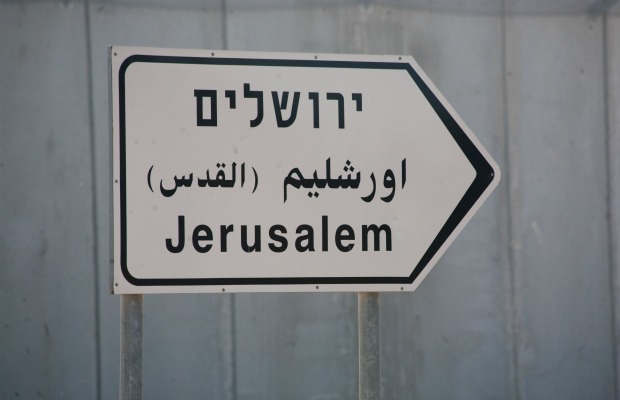
Sign post in Israel indicating the direction of Jerusalem in three languages (photo: izahorsky/flickr cc)

But nothing is uncomplicated in this region. Even the language of signs is controversial, as evident by the Arabic spelling of Jerusalem. In Arabic script, it phonetically reads: “Urshaleem,” almost like in Hebrew. The actual commonly used Arabic name for the city, Al Quds, appears in parenthetical notes (perhaps as a sort of conciliatory gesture). Interestingly, in English, the name is not written phonetically. Unless there’s a double-standard, in theory, it should be.

For additional original analysis and breaking news, visit +972 Magazine's Facebook page or follow us on Twitter. Our newsletter features a comprehensive round-up of the week's events. Sign up here.

View article: AAA
Share article
Print article
  • COMMENTS

    1. Ben Israel

      I agree completely that all Jewish students in Israel should be required to learn Arabic. The fact that this isn’t the case is due to the love-hate Israelis have with Europe—they drove us out or killed us, but we still have longings for them and their culture.

      As an indication of the mentality of the ruling elite in Israel, it should be noted that the speech given by winners of the Nobel Prize give it in their native language. When the Rabin-Peres-Arafat trio received theres, Arafat indeed gave his in Arabic. Peres and Rabin gave theirs in English which indicates to me that Peres and Rabin didn’t want to be considered “Israelis” (and even more so didn’t want to be considered Jews). However, their sad attempt at being “cosmpolitans” didn’t help them get through in the end to their “peace partner” who didn’t seem to appreciate their jettisoning their Jewish/Israeli identities.

      Reply to Comment
    2. Henry Weinstein

      “In Belgium, the Flemish and Wallonians speak each other’s native tongues”: not at all, only a tiny minority.
      And the Flemish separatists (i.e the majority of Flemish) totally refuse bilingual signs.
      Near death experience: go there and try to speak French with them!

      Reply to Comment
    3. Harry

      The “gag”/roof joke reminds me of a real-life incident:  An Arab teenager told me his buddy had a “rimon” with my name on it.  I misinterpreted it as a threat.  Fortunately, it was a pomegranate — not a hand grenade — and we all had a good laugh afterward!

      Reply to Comment
    4. Vickie

      Good catch, Roee. Language is probably a key barrier.
      I’ve always wondered why Israelis and Palestinians would use Western negotiators. You have two groups that have been consistently and deeply hated by the West for…oh, a couple of millenia. Why would you trust your worst enemy to broker peace? It’s a bad move.
      If Israelis and Palestinians sat down, palms on the table, and worked things out mano y mano, without interlopers, that actually might bring about a relative peace.

      Reply to Comment
    5. I think you may be onto something here…the misunderstandings that can result in mistranslation can be hilarious, or could in other instances be tragic. If nothing else, moving toward a position where the native language on each side of the table was given more weight/relevance would be I think a very smart/progressive thing to do…Of course I am sure there are world-class translators and interpreters involved in all these negotiations. But the central question you pose: Why the need to pass it all through English? is an interesting one, and one that I think bears consideration.

      After all. How well have we done, really, having them negotiate in English all these years? Perhaps it’s time to try something new!!!

      Reply to Comment
    6. Dan

      What seduces Americans is how smooth Netanyahu sounds in his native, idiomatic, accentless English. We tolerate all kinds of nonsense as long as it sounds like we do.

      Arafat, by contrast, sounded horrible when he gave interviews in English. The American Palestinian community used to tell him, “Abu ‘Ammar, for Pete’s sake, *shave*. And use an interpreter. You’ll sound better that way.”

      Reply to Comment
    7. Henry Weinstein

      I don’t think language is a key barrier: solving a conflict is a matter of good will vs bad will.
      Don’t you know evil’s favourite method of propagation is deception through (any) language?
      Tag: the Serpent who speaks to each of us in our brain.

      Reply to Comment

    LEAVE A COMMENT

    Name (Required)
    Mail (Required)
    Website
    Free text

© 2010 - 2013 +972 Magazine
Follow Us
Credits

+972 is an independent, blog-based web magazine. It was launched in August 2010, resulting from a merger of a number of popular English-language blogs dealing with life and politics in Israel and Palestine.

Website empowered by RSVP

Illustrations: Eran Menedl


theme_function.php-begin | 19.893544MBtheme_function.php-end | 21.7522MBmost_stuff_widget_begin | 23.373008MBmost_stuff_widget_end | 23.975648MBtwitter_widget_begin | 24.238184MBtwitter_widget_end | 24.238184MBtheme_footer_before_end | 24.2398MB