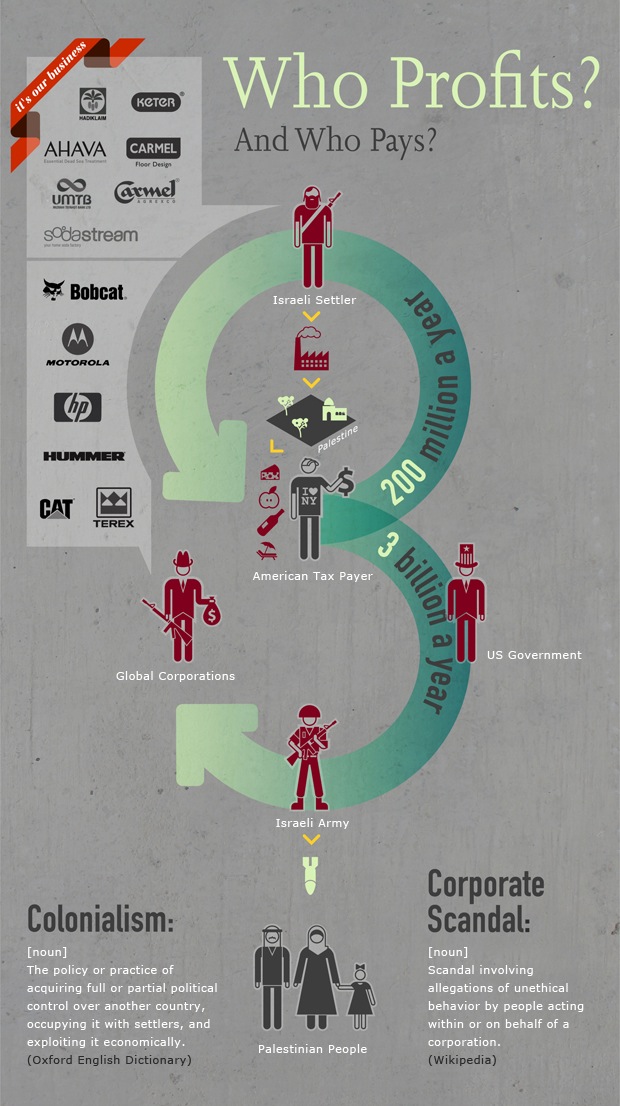
American tax dollars go a long way in sustaining West Bank settlements, the Israeli army and corporations profiting from the occupation. This illustration is the fifth in a series of infographics on the effect of the occupation on the Palestinian civilian population.
By Michal Vexler
Sources:
Who Profits
Why is the U.S. delaying $3 billion in military aid to Israel? (Hebrew – Globes)
U.S. approves $205 million in aid for Iron Dome (Hebrew – nrg)
A Conservative Estimate of Total Direct U.S. Aid to Israel: Almost $114 Billion (Washington Report on Middle East Affairs)
Exported Israeli settlement products (Innovative Minds)
—————————
Michal Vexler is a designer and an activist. This work – a part of a series of infographics regarding the effect of the occupation on the Palestinian civilian population – is presented here with her permission.
Previous posts in this series:
Visualizing Occupation: Palestinian Prisoners’ Day – the numbers
Visualizing Occupation: Ethnic cleansing
Visualizing Occupation: The right (or privilege) to protest?
Visualizing Occupation: Freedom of movement

For additional original analysis and breaking news, visit +972 Magazine's Facebook page or follow us on Twitter. Our newsletter features a comprehensive round-up of the week's events. Sign up here.


Richard Witty
I don’t consider the poster to be all that impressive, primarily because the settlement of the West Bank is NOT primarily the classical picture of economic colonialism. That is a strained and irrelevant basis of criticism.
The significance of the settlements is not economic. They don’t particularly exploit native labor to dominate resources in a parasitic manner.
The purpose of the settlements is to settle, and attempt to begin to dominate demographically, to re-constitute the borders of a self-governing state.
It is the same logic of the original Zionist effort, but now beyond need.
And, as an annexation strategy it is largely abandoned. There are a couple additional square miles of settled land per decade, definitely strategically placed.
They have not gone so far as to make a two-state impossible, so that the one-state is not inevitable, not necessary.
But, they do “succeed” in keeping Palestine not sovereign, and to the extent that dissenters adopt the logic that single state is the only solution, they collaborate in keeping Palestine not sovereign, very sad to say, in delaying completing the project.
Doubt is one thing. “I have doubts that the two-state will ever transpire”, is different from “I advocate for a single ‘democratic’ state”.
Akiva Eldar posted an article today describing the challenges to the Israeli government of Palestinian unification.
http://www.haaretz.com/news/features/the-specter-of-palestinian-unity-is-haunting-netanyahu.premium-1.435815
aristeides
This is a very incomplete picture of the situation. Missing are the real estate interests who profit from building for settlers on free confiscated land.
max
aristeides, you’re right. What’s also missing is the profiteering of PA leaders from the funds aimed to counter the occupation’s effects; that of the Palestinians working in the settlements; and that of the Americans working for the arms industry.
So let’s agree that it’s complex, there’s money, some contribute and some profit, and all of it around a political situation you disagree with
aristeides
Max – if you’re looking for a Gotcha Moment, I have no trouble acknowledging the fact of PA corruption.
Kolumn9
Yeah, this chart really has no bite. Why does the circle that includes the Israeli settler circle back to the American taxpayer? That doesn’t make any sense. Also, I agree with Richard Witty. The definition you use for colonialism just doesn’t apply here. This isn’t about occupying or exploiting. The appropriate definition should be that of settler colonialism where the economic considerations are almost irrelevant.
KLC
RE: “Why does the circle that includes the Israeli settler circle back to the American taxpayer? That doesn’t make any sense.”
Yes it does make sense. Billions of American tax dollars are sent to Israel every year to fund the illegal occupation of Palestine.
It’s welfare.
Mordechai ben Yosef
“Economic considerations almost irrelevant.” So land confiscation, water theft, mineral resources are not economic. I wonder what the Palestinians think? And its not colonialism because there is no exploitation of indigenous labor? Remember the colonialism of the Americas. The indigenous population was removed(destroyed) to make way for the unimpeded removal of wealth with the more productive exploitation of imported European and African labor.
Lubzi
Why is the Palestinian woman used for representing all Palestinian women wearing the hijab? What’s up with that?
M S
I think this does a good job of communicating some pretty complex ideas to a large number of people. Whether the definition of colonialism applies precisely or whether she should be depicted wearing the hijab or not is largely a side issue. This site is great overall.