

From Jenin to Mishmar Hagvul junction via a rat maze and a divided town. This is no country for the paranoid.
Come twilight, the driver and I arrive in the city of Jenin.
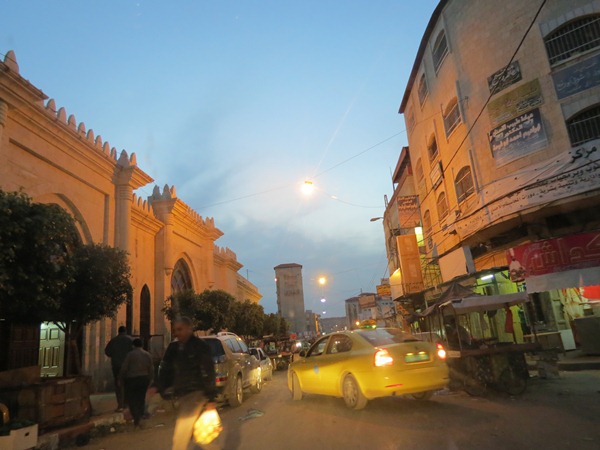
He drops me off by a hotel in the middle of Jenin’s market area. It’s about as basic as a gas station’s toilets, but I’ll be glad to sleep in some gas station’s toilets tonight, so long as no one asks me for ID.
The hotel warden does ask for my passport. I say that I left it in Ramallah and must head there first thing in the morning. He eventually surrenders and hands me the guest registry. I sign in as Gregory Richardson, with a made-up British passport number and slightly skewed birth date (one can never be too safe).
I soon head out, careful to stay away from uniformed policemen and hoping not to awaken the curiousity of plain-clothed ones (“muhabarat”). This is Area A, and if I’m caught here, a very long and possibly damaging ordeal will follow. I used up all my favors in Dura on the September Journey (where I also explain the concept of “areas”). My margin of error is gone.
Enough of that, though. Adrenaline is a fine drug, and this is a pretty, albeit certainly dirty town to stroll through. As I wander around, street-vendor kebab in hand, I stumble into what looks like an interesting spot. Cinema Jenin.
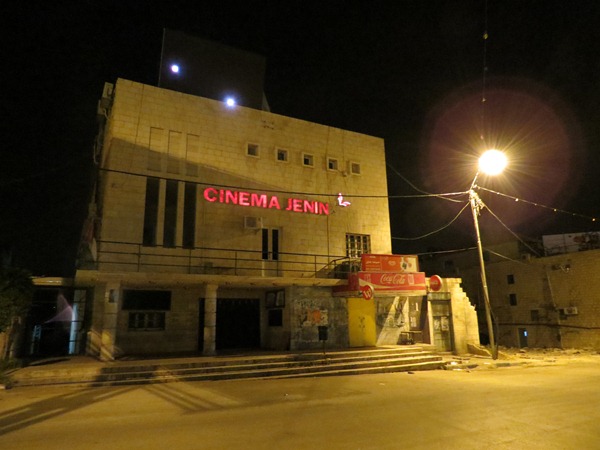
Behind the cinema is a pretty garden with an Argileh cafe, full of English chatter. I was expecting to be very lonely in this city, but destiny provided fellow travelers. Soon I step over and present myself to Ifran from Norway and Kathryn from Germany.
Neither is really a traveler. Ifran is serving as an observer in a small village in the Jordan valley, from which he also blogs. Kathryn volunteers with youths in Jenin itself. Soon we are joined by Rebecca, a German sound technician, who on a previous visit installed the cinema’s sound system.
The cinema’s renovation was conceived by German filmmaker Marcus Vetter in 2009 and the sound system donated by Pink Floyd’s own Roger Waters. According to Kathryn, audiences are currently thin and the film selection disappointing, but the place is still very lovely, and I am comfortable enough in this environment to gingerly come out of the closet as an Israeli.
There’s a bottle of wine back in my hotel room which I intended to give Danielle, then forgot it in my bag and carried it all over the Bedouin wilderness to this mercilessly dry town. I bring this up with the happy bunch and they suggest we uncork it on the roof of their guesthouse.
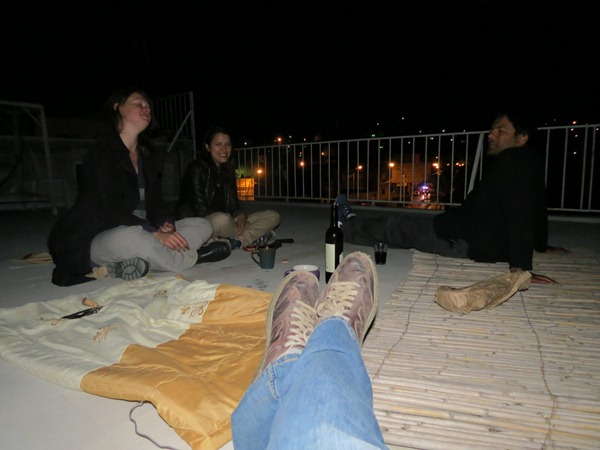
I love the internationals who come to Palestine to do good deeds, and won’t let anyone talk trash about them, not even themselves. Irfan talks about conflict exploiters of various sorts. He says he’s heard that Kabul is now the second biggest party city on earth after Las Vegas. He talks of what he himself does to maintain a sense of profoundness.
Of course Palestine is an “easy” conflict zone, free of child soldiers and cholera. Of course it’s “sexy,” since world media does take an interest. Of course aid dependence is a problem and all too often the outsiders bring a fish and leave the fishing pole at home, but this remains a place that needs help, and so long as we are the reason it needs help, how can we say anything against those who provide it?
We do, anyway. Israelis feel betrayed by a world that stopped sending us blond kibbutz volunteers and began to send criticism and support for those we imprison. As we speak, a Danish national is getting stitched in the lips after being severly beaten up by an IDF Lieutenant colonel who rammed his M-16 in the young man’s face. The Dane was participating in a peaceful protest bike ride, the Lt. Col was taking part in an occupation, if both are hypocrites, I forgive the former.
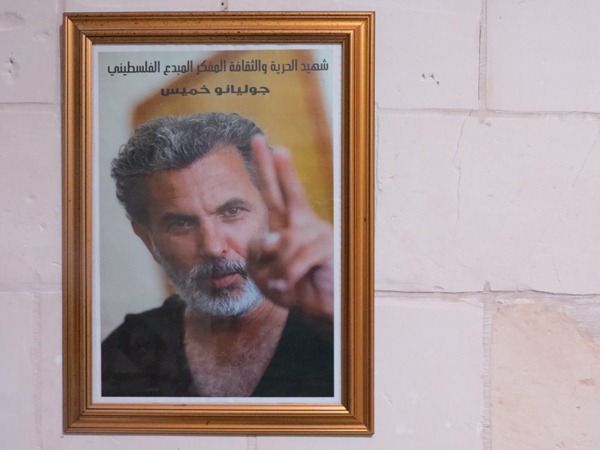
A picture hanging in the guesthouse’s foyer commemorates a local who also tried to bring change. Juliano Mer Hamis, half Israeli, half Palestinian, creator of the Freedom Theater, which provided hope for the children of the Jenin refugee camp. One year ago he became the victim of a cold-blooded assassination, when a masked Palestinian gunman shot him in front of the theatre. This is no country for the good-hearted.
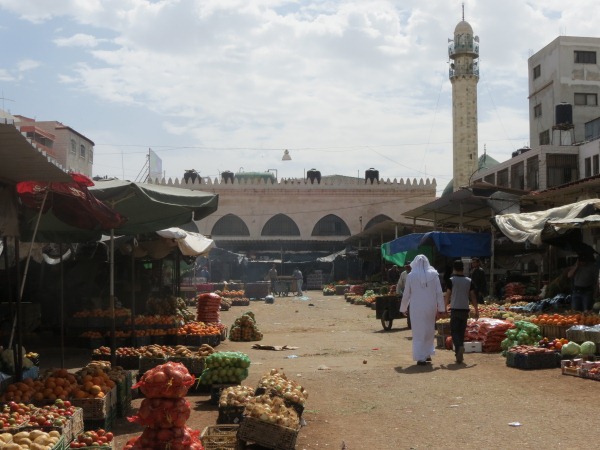
In the morning I wake up to Jenin’s rustic market.
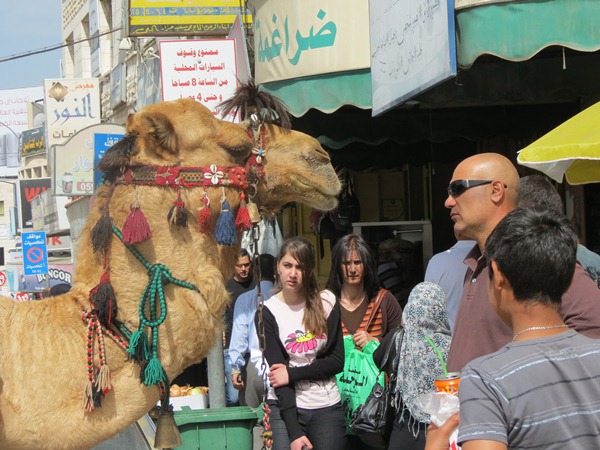
Beyond it is the bustle of the modern city. It is human-sized and fun to explore.
I decide not to visit the Freedom Theatre, for fear of being a “conflict tourist,” but somehow my feet do take me to the refugee camp. Like other camps, it has turned over the decades into a dense, DIY slum, where in some places the entire environment is made up of pure concrete.
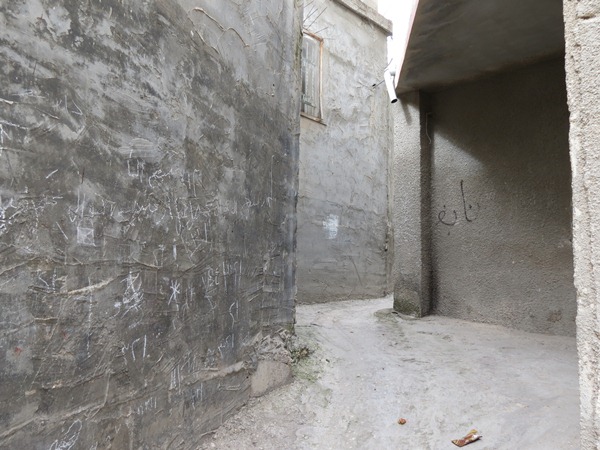
This camp has much harsher history than others. On April 2, 2002, IDF forces entered it, prepared to stomp out all resistance. An order came to demolish every house where militants might be present, and at least one neighborhood was entirely flattened. Differing accounts on the extremely violent events and high death toll have not yet been reconciled, but all the eye needs do is look.
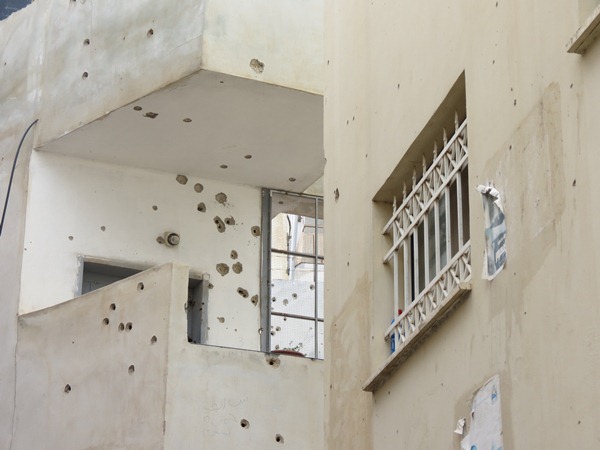
In one alleyway, an old woman points to the photo of her martyred son, Fadi, which hangs above her doorway. In the photo, Fadi is holding a machine gun. He may have been killed by a close relative of mine who fought here. He may have killed. This is no country for young men. I avoid asking questions and go on to the top of the hill to catch some air.
From here, Afula is visible, so peaceful and mundane, with migrating storks flying all around it.
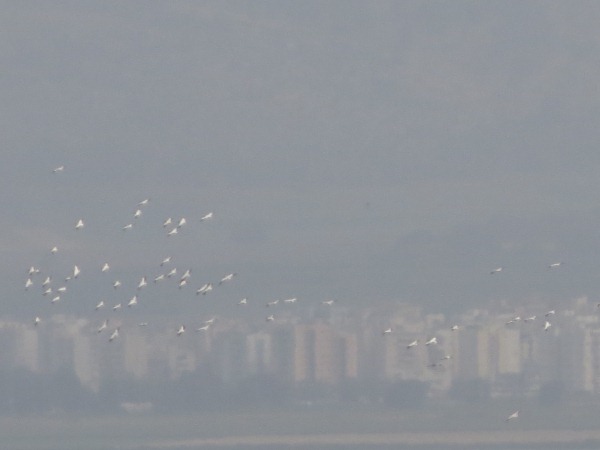
I should start thinking of getting back to that side of the line. The fence is solid around these parts and the checkpoint separating the two cities is dangerous: If I go there, I incriminate myself for having visited Area A. I must find another gate and hope that it is more forgiving. Upon returning downtown, I catch a service minibus heading for Barta’a, a town to the west.
Barta’a is a divided town. Half of it is in Israel proper, the other – in the West Bank. Unlike Ghajar, which is similarly split, but lays entirely north of the border fence, effectively inside Lebanon, Barta’a was kept to the west of the fence, effectively within Israel.
Since Barta’aites travel frequently to Jenin, I imagine that public transportation is allowed through rather fluidly. That is embarrassingly naive of me, since my destination is across the fence. Conversation with other passengers reveals that no passage to there is possible without proper travel documents, and that the ordeal is often lengthy.
I decide to jump off at a crossroads before the checkpoint, and seek my luck further south. Before reaching that crossroads, we pass the settlement of Mevo Dotan. There the service must go through a serious checkpoint, complete with a soldier who aims his gun at every vehicle that passes.
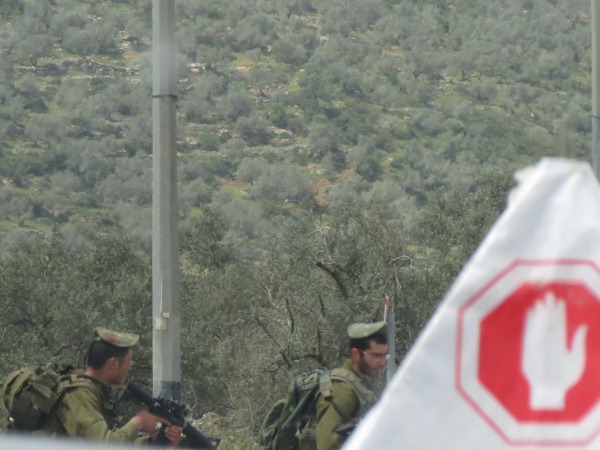
I remove my hat, to avoid drawing attention, and gaze at the floor of the minibus. They wave us through. What a miracle! Signs in Hebrew appear around us and the road’s condition improves drastically. This road also services the settlement, which means I am allowed to be here. An impenetrable fence still stands between me and the world, but all should be well soon. I descend at said junction and hitchhike south.
Soon a Palestinian man gives me a lift, but as we zoom past another settlement, Hermesh, I notice concrete cubes on the road and a huge red sign forbidding entry of Israelis. We are reentering Area A.
“Stop!” I plead.
The driver is uncomfortable stopping next to a settlement. Military watchtowers observe the entire road in their eyeless manner, and here they would be particularly observant. This is no country for the paranoid. Having already presented myself as a Brit, I now stutter an improvised explanation: “I immigrated to Israel and received the passport, so they don’t let me go here. I must leave now, but thank you.”
He stops.
If I walk to the settlement and catch a lift from there, all will be well, but the driver, Ali, is too friendly to allow that. “Where do you need to go?” he asks.
“Israel,” I confess, then ask: “How do these settlers go there?”
“By way of Barta’a,” he says, “Hold on, I’ll take you there. The sun is crazy today.”
So he drives me to Barta’a crossing, and thankfully, drops me off some distance from it so the attendants don’t notice me stepping out of a Palestinian car. Still, as I expected, no one is allowed to cross here on foot. Being a pedestrian, I am suspicious and am summoned for a thorough search of my belongings and an interrogation.
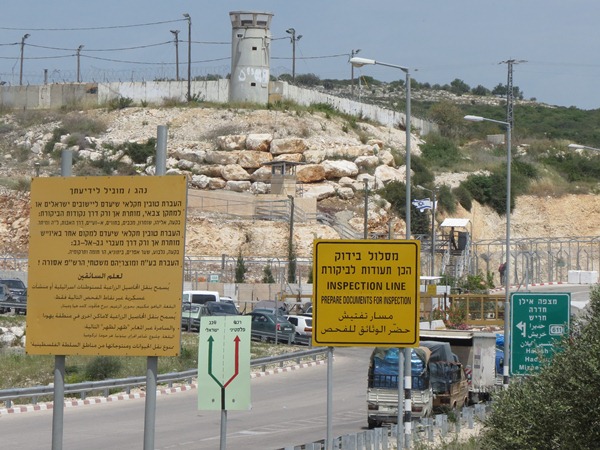
It’s quite an interrogation. The attendants ask me what my girlfriend studies and what my sisters do for a living. I pretend to be from Suburban Ramat Gan (Since Tel Avivians are leftists, and leftists are traitors), and say that I entered the area this morning by the same gate after staying the night in Danielle’s mother’s house in nearby Pardes Hanna.
“And your girlfriend doesn’t mind that you stay at the houses of mothers of female friends?”
And all the while, they don’t notice that two incriminating water bottles from Jenin are sticking out of the tight pockets of my backpack, with their labels showing.
This is becoming ridiculous, and what makes it worse is the fact that these aren’t soldiers or Shin Bet agents. The fence crossings have been outsourced to a private security firm. Here the firm’s civilian employees are keeping seven Palestinian men behind bars. I can see them clearly from the bench on which my interrogation takes place. I can also see cages full of attack dogs, their gates facing the gravel road adjoining the fence. This is a place of violence and humiliation, and somebody is making a lot of money from that.
Finally they are convinced that I pose little threat to national security. I am free to go, and go I do, directly to Barta’a town.
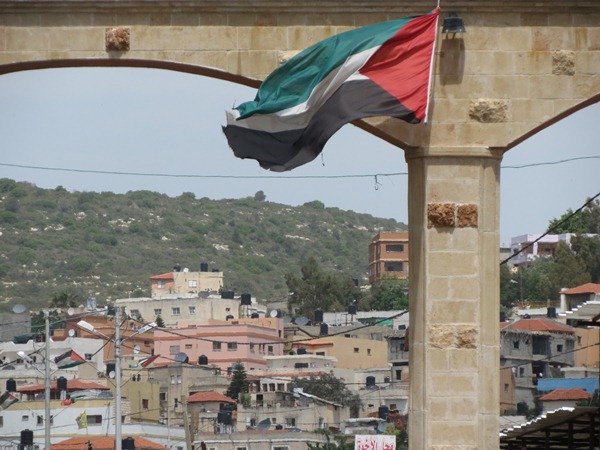
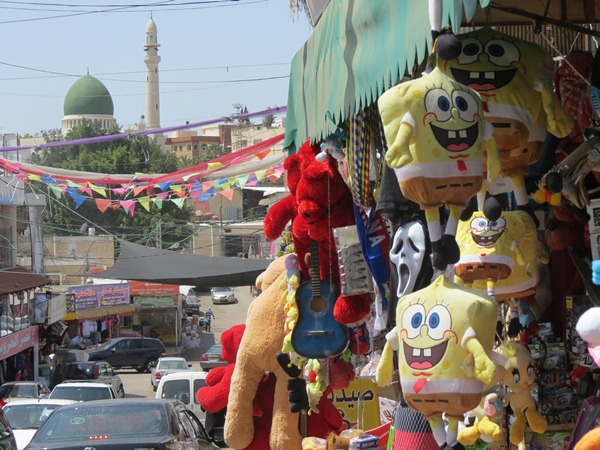
Divided towns are haunting. I can never get over it. In the photo below, Spongebob is in Palestine, while the mosque is in Israel. The Green Line itself is a small dirty ditch full of trash. It isn’t even visible from the main street, which goes across it. The residents of eastern Barta’a have permission to visit the west of town, but not to go any further into Israel. They are caught between a fence to the east and an invisible wall to the west.
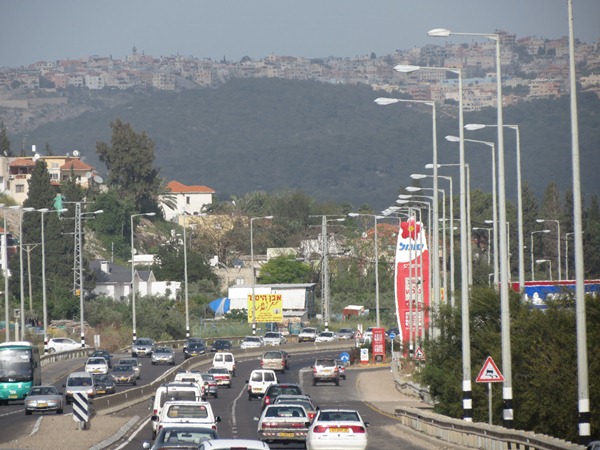
Upon arriving in west Barta’a. I am home, but I still feel trapped. Something about running though a rat maze just takes all the fun out of the day. Besides, Ali was right, it is very hot. I take more than an hour to chill at a Barta’a cafeteria, before heading down the hills to the massive Tel Aviv-Afula road, over which the city of Umm Al-Fahm looms.
This large Palestinian city is now in Israel, but reactionary political leader and current foreign minister Avigdor Lieberman proposes fixing the lines and disengaging from it. In other words, Lieberman proposes exiling the people of an entire city and its suburbs, along with the city and the suburbs. This is no country for believers in equality and justice.
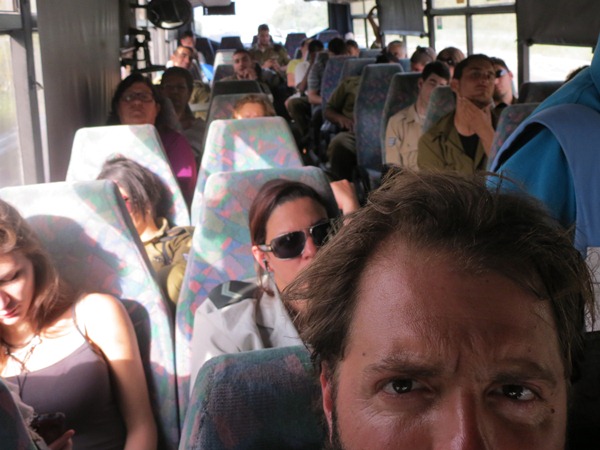
Here I take a bus, feeling trapped and overheated and nauseous. The bus is full of soldiers and girls in tank tops. It’s as though Israel were an actress hired to play the opposite of Palestine.
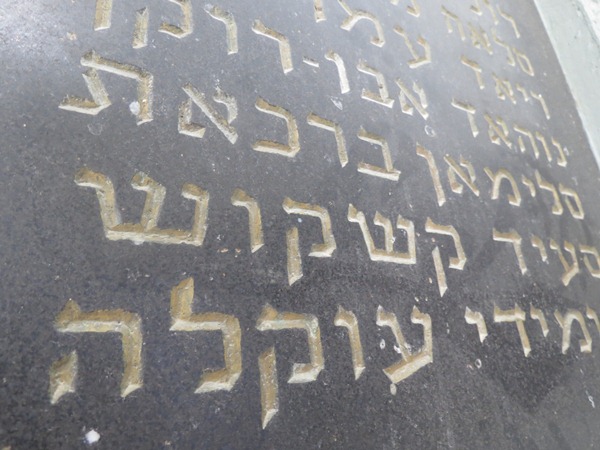
I don’t go much further. Soon the Green Line curves to the south and I must follow it. At the junction where the bus drops me off stands a large monument dedicated to fallen policemen of the Border Police.
The Border Police, effectively a branch of the army, to which 18 year olds are recruited, is the occupation. The recruits often belong to the least privileged, least educated classes in society, and are sent to maintain control over civilian populations.
I am disheartened by how many of the names inscribed on marble are Arabic names, such as the ones appearing in this photo below: Nuhad Abu Rukan, Sliman Barkat, Said Kashkush and Numidi Ukla. I assume that they are all Druze, I know that them and their friends: Ethiopians, Mizrachi working class kids and others, were all trapped: trapped in their backgrounds, trapped in the checkpoints like I was, only for days on end, likely trapped in their own hatred and prejudice for the people they were helping occupy. They were trapped in this damned country’s hunger for ugly history, and then, one day, they were freed.
_______________________________________
The Round Trip thus far!
View Larger Map
Thanks for reading and taking part in the adventure. All writing on this site is done voluntarily, so if any of you would like to pitch in directly for my travel expenses, please click here or on the “donate” button at the top of this page to do so. I’m deeply grateful to those who already donated. Thank you so much! This project would be impossible if not for you.
Relive the first two journeys:
The September Journey
The Christmas Journey

For additional original analysis and breaking news, visit +972 Magazine's Facebook page or follow us on Twitter. Our newsletter features a comprehensive round-up of the week's events. Sign up here.


XYZ
It makes no sense to call Juliano Mer-Khamis “half-Palestinian and half-Israeli”. Both his parents were Israeli citizens after 1948 and both were citizens of the Palestinian mandate before 1948. Thus he is either fully Israeli or fully Palestinian. What he definitely was was half Jewish and half Arab (I believe his father was born a Christian but being a Communist he did not identify with any particular religion).
yaniv
thanks for another great post. happy trails!
AYLA
Despite the beautiful intensity and tension of this piece, my favorite part is the one that made me laugh; the security guards asking: “And your girlfriend doesn’t mind that you stay at the houses of mothers of female friends?” a) The mother? Really? b) That is *so* Israeli! And even if someone can convince me that this quality of highly personal question/judgment is somehow in the name of security, you get it equally in banks, job interviews, and government offices.
Thanks to Ali, who spared you, Yuval, some sun and didn’t flinch when you said you had Israeli citizenship; I’ve been told anonymously that we’re the worst kind of Israeli citizens–we American and British immigrants–but I’ve never, ever been treated as an enemy, or even as less than a friend, by any Palestinian here. In person, people judge you by your character, and actions. You trusted Ali, he trusted you.
*
Meanwhile, would someone please earmark a donation to The Round Trip for sunscreen for our favorite journeyer?
Vicky
I’ve loved reading this series, Yuval. The best part of your approach is the way you don’t seem to plan much, but just wander in and write about whatever happens. Thanks.
the other joe
The border police (or IDF or someone) once asked me where my Grandfather was born. Which was hard to answer because he died in the 1960s and I never met him.
Rodrigo
Your father would be disappointed that you entered area A again.
.
Also, in regards to Lieberman’s ideas on the triangle, since when is redrawing political lines on a map considered expulsion? I really think you are using the term here incorrectly.
Dhalgren
“The Dane was participating in a peaceful protest bike ride, the Lt. Col was taking part in an occupation, if both are hypocrites, I forgive the former.”
Of course, that is how I should have put it in a digressive debate I ended up in in the comments on that post. This is no country for abstract logical critiques.
You are like the anti-Yeats, Yuval. Unlike Yeats, who says:
Once out of nature I shall never take
My bodily form from any natural thing…
Your account has taken the bodily form of every natural thing. It is not the bird singing from the gilded branch but the sensual music of “whatever is begotten, born, and dies.” Forget Byzantium. Life in these lands is too immediate to spend time sailing there. Keep walking among human beings who ask questions, help strangers, share dreams and good wine, and fight for their futures in many more ways than the kind that leads to epitaphs. And keep writing, of course…
aristeides
Rodrigo is right. It’s not expulsion, it’s ethnic cleansing. Terminology matters.
Rodrigo
Aresteides, nope that doesn’t apply either according to its definition.
A
Aristeides, it’s neither. It’s finding the weak spot in the two state solution (and it’s two states to two people slogan): there are two people here, not three. The green line is just a line. If we want to split the country in half, let’s split in in a way that will make two maximally homogenous states. Lieberman is a racist, but a smart one. Now, I don’t want to live in a homogenous state, nor do I think building a very tall wall in wadi Ara will make the problem go away: we are here together and need to learn to live with each other.
A
@AYLA (i repl y here for your last comment in chapter 9)
I totally agree with you. I used to do these small scale traveling more, when I was a bit younger, especially when I lived in Jerusalem and Haifa – the most normal and the most abnormal cities in Israel. I still envy and admire Yuval for his courage for such travels, and especially his capacity to connect to peoples and places, and communicate his experience and feelings in such an open and honest way..
BTW, I used to post here under ASAF, but out of pure laziness I switched to A, and stayed with it since..
aristeides
Ethnic cleansing is the best name for it. It’s a way for Israel to cleanse the Arabs from within its borders – not by moving the Arabs but by moving the borders. Maximizing homogeneity is precisely ethnic cleansing.
Rodrigo
Aristeides, now you are trying to redefine terms. I dare you to actually look up what ethnic cleansing means in a dictionary to back your definition up.
.
Partitioning the land according to the self-identities of conflicting populations is considered a reasonable form of conflict resolution, including within the context of the Israeli-Palestinian conflict. Lieberman is a racist but pretending that his platform calls for ‘ethnic cleansing’ or ‘expulsion’ is just factually incorrect.
max
“Maximizing homogeneity is precisely ethnic cleansing” is not equal to “ethnic cleansing is precisely Maximizing homogeneity”
But it’s a nice try
AYLA
A(saf)–thanks for the comment, especially your comment to @Aristeides. I agree. And generally, I find that over-used rhetoric and labels get us stuck in arguments about what things are and aren’t and which wrongdoing is worse or better, which is achieving less than nothing for anyone in the real world. I think it was in the 70′s in the U.S. that it became a big insult to tell people: Go take a hike. Yuval’s thread seems like the perfect place for that kind of response.
aristeides
Rodrigo – Lieberman’s partition plan is neither “partitioning the land according to the self-identities of conflicting populations” or “a reasonable form of conflict resolution.”
.
This is because it is imposed on one of the populations by the other, by force, with no consideration of the actual self-identity of the weaker population but instead the identity imposed by the stronger population according to its own, prejudiced, standards.
.
And this is why it is not conflict resolution, because the sides to the conflict do not have – can not have – equal input into the resolution’s form. Which is why it is ethnic cleansing, because it is ethnic separation imposed by force.
XYZ
A’s twisting himself into Progressive knots is quite amusing. Have to condemn Israel no matter what she does. For example, another Progressive wrote a piece here condeming Israel for building the light-rail project in Jerusalem in such a way that it runs through both Arab and Jewish neighborhoods, saying that this is meant to prevent the necessary division of the city. A commentor then pointed out that had the light-rail NOT been run through Arab neighborhoods, the same writer would have no doubt condemned Israel for apartheid and neglecting the Arab part of the city.
Same with “A” here. One would think that the Israeli Arabs would WELCOME the chance to have their towns and villages included in the Palestinian state because, according to A and the other Progressives here, Israeli Arabs live in grinding poverty, suffer from apartheid and other racist humiliation and here they are being offered a chance to live under the rule of their brother HAMAS or FATAH people who love them and view them as brothers. But no, the Progressives have to start screaming, as usual about “racism”. If Israel wants to keep the Arabs they are racist, and if they want to transfer sovereignity of those areas , they are still racists. Then A has to invent a new crime which we can’t call it “transfer” so we call it ethnic cleansing even though no one is cleansed, no one is moved, no one suffers anything, other than having to live in what is yet another corrupt, repressive Arab state, and which the Israeli Arabs quite understandably don’t want to do.
“A” also would tell us that the Palestinian demand that all Jews be removed from their side of the Green Line is NOT racism because “they don’t belong there” even though Jews lived in those areas before 1948, in fact, before any Arabs even came to live in the country centuries ago.
So to summarize…to have Israel want Arabs to live under Arab rule is racism, but to have Arabs insist Jews be expelled bodily from their territory is NOT racism, it is Progressive.
Rodrigo
Aresteides, last time I checked Lieberman’s partition plan was to trade the settlement land for the areas with a large Arab population. The population itself seems to largely identify itself as Palestinian and the move was to be part of a comprehensive peace agreement between Israel and the self-declared and internationally recognized representatives of the Palestinians – the PLO.
.
You are redefining the terms and lying about the facts of the matter. Lieberman’s plan was to for the partition to be part of a comprehensive deal for a two state solution between Israel and the Palestinians. Feel free to look it up if you want, but I assure you that you are simply wrong here on the facts and terminology.
A
XYZ, nice of you to use me as a caricature “progressive”, but I would prefer you READING my comments first. I said that while I don’t like the idea of moving Arab citizens of Israel to The future Palestine, it is NOT racism, and NOT ethnic cleansing, but a legitimate proposal that actually uncovers the weakness in the “two states to two people” agenda (the proposer of this plan IS racist though). BTW, the comment about the light rail trajectory being condemned no matter what was mine, so please use another name for your next role play game.
XYZ
“A”, please forgive me, I wasn’t referring to you but to Aristeides. Apologies.
mya guarnieri
i’ve been impressed with the series, but i was particularly impressed with this piece. really, really nice work, yuval! best, mya
aristeides
X might have been referring to Aristeides, but not to anything Aristeides actually wrote.
.
Rodrigo – nothing you say demonstrates that Lieberman’s plan is either “partitioning the land according to the self-identities of conflicting populations” or “a reasonable form of conflict resolution.”
.
You seem to be willfulling ignoring the fact that this is an IMPOSED solution to a purely Israeli problem called “too many Arabs.” And it’s imposed on the Arabs against their will and without their consent. There is a thing called a vote, but you and Lieberman seem unaware of it. No, the plan is to redraw the boundaries solely to the benefit of Israel’s racist preoccupations and landgrabbing aspirations.
.
You also ignore the fact that the PLO is NOT the legal representative of the Arabs in question, who happen to be citizens of Israel – a fact that Israel wants to alter without their consent. The PLO/PA/Fatah/whatever have no right to negotiate on their behalf and collaborate in Israel’s ethnic cleansing program.
the other joe
@Aristedes – are you saying that the Palestinian Liberation Organisation is not the “sole legitimate representative of the Palestinian people” in the occupied Palestinian Territories, inside Israel and in the diaspora? That’s dangerous talk that is..
aristeides
Other – I’m saying it’s not the sole legitimate representative of individual persons of Palestinian descent. Individual Palestinian-Americans who live in Detroit are legitimately represented by John Conyers, who ought to do a better job at it.
the other joe
A – I don’t disagree, but many many Palestinians would.
aristeides
Other – the real question is whether Israeli citizens of Palestinian descent agree that the PLO has the right to dispose of them in this manner. I suspect that many of them do not.
Rodrigo
Aresteides, if we are going to discuss democracy, then the majority of the citizens of Israel do have the right to redefine their own borders within the context of negotiated settlement with the Arabs. Arab Israelis do not have veto rights. In addition, the majority of Israeli Arabs seem to consider themselves Palestinians and elect representatives who consider themselves Palestinians, some of whom have served in the past with the PLO. The PLO certainly considers itself a representative of ALL Palestinians, including those with Israeli citizenship and claims to negotiate on the behalf of ALL of them.
.
In either case, with or without the consent of the Arabs living in areas to be transferred to a Palestinian state, the move doesn’t classify as either of the two terms you applied incorrectly if carried out within the context of a negotiated solution that will provide them with Palestinian citizenship. You are simply wrong here regardless of the issue of consent.
max
aristeides, “Israeli citizens of Palestinian descent” – I assume you mean “Israeli citizens of Arab descent”, as all British Mandate’s inhabitants were Palestinians, and I doubt that you refer to the Jews amongst them
aristeides
Max – you and Rodrigo can play the Correct Nomenclature game, I’m not interested. It’s clear whom the term denotes.
.
Rodrigo – You can keep saying, “You’re wrong,” but as long as you don’t disprove my points, you mean nothing. Repeating yourself is no substitute for argument.
Rodrigo
Aristeides, I have provided you with all the information and challenged you to provide support for your own definitions. You have failed to challenge my facts or provide support for your own. Instead you ignore the information I provide and choose to play at redefining the terms under discussion according to your own whims. I don’t have to prove anything. I have already done it. Your inability to provide a cohesive counter argument has already demonstrated that you are wrong.
aristeides
You keep on believing that, Rod
max
aristeides, no one asked the people of HK what they want, no one asked the inhabitants of Alaska and Louisiana, and when the Brits refer to the people of Falkland it’s because it fits their political motivation;
where do you get your ideas from?
the other joe
@Max, let me ask you a question. Several centuries ago, French Huguenot religious refugees fled France and settled in England. At the same time, large numbers of other religious refugees fled persecution to North America. If I am the descendent of one of those groups, would you say that I have a right to return to my ancestral lands (ignore for the moment free movement in the EU etc). How far back should any right to the land go? What about my distant relatives who were forced from their land by the Vikings more than a thousand years ago?
.
Even if it was accepted that I had a claim on the land, would those who lived there have no rights to self determination? Where are you getting your ideas from? On what basis are you claiming this to be right?
max
#TOJ, I don’t have an answer to your questions. I don’t know that there is – or could / should be – a rule-based answer.
I also don’t see the relevance to my comment, which simply shows – without stating my opinion, which I didn’t yet finalize – that asking the inhabitants isn’t the norm.
Do you have an answer to your question? Is 2,000 years too much and 60 years still good? Did I ever refer to a ‘right of return’ as a legal claim?
In short, again: what’s the relevance of your question to the topic at hand and to my post?
the other joe
@Max – no you don’t have to, I just thought it might help comprehension. To me, the idea that a group that has a thousand year old land claim has more right to determine the location of a group who have been there for generations is unjust. Just because the groups you mention were not asked seems to me to be irrelevant to this issue and the justice of the situation.
the other joe
Moreover, to give a minority group full citizen rights but then later to remove them seems unjust, no?
max
TOJ, “the idea that a group …” – I agree, but as this point isn’t part of my reasoning, I don’t see how to relates to my argumentation…
.
“to give a minority group full citizen rights…” – I agree again, but – as the norm shows us – this is the practice. I guess one could justify it by means of the Good for More People. I’m glad I don’t have to make such decisions.
the other joe
Hmm. so you’re saying it is unjust but necessary..?
max
No. I do say that it’s unjust but I don’t say that it’s necessary. What I say is that justice isn’t what drives the world, never has and never will. I’d further say that justice is contextual, and time is an important dimension of this context.
Yet further, I say that sticking to ‘justice’ will not solve the Israeli-Palestinian, the Tibet, or the India-Pakistan conflicts… though blatantly unjust – within a context – is a sure way to propagate such conflicts.
.
But let me make a rush proposition: if a peace treaty between Israel and Palestine would depend on re-aligning some borders, including re-assigning the nationality of a ‘reasonable’ number of people, I’d probably be in favor of it (conceptually, as I won’t be affected)
aristeides
Max – I get my ideas from history, mostly. Which informs me that, certainly, borders have moved throughout history and populations have been, though less frequently, shifted. So ethnic cleansing, though a new term, is an older practice.
.
But so what? It’s still ethnic cleansing. It’s still injustice and a violation of the right of self-determination of the peoples involved.
.
The only question is – why you seem to have a problem accepting this fact.
the other joe
@Max – it seems like you’re saying that Justice is simply whatever the strong, or those in power, or those with the biggest and most powerful guns, say it is. Might is right.
.
And I say pugwash.
max
@aristeides, I think that the discussion will be better served if you don’t ‘expand’ my clear posts with your baseless interpretation: I haven’t referred to ‘shifting’ population or anything that can reasonably be referred to as ‘ethnic cleansing’. I only referred to redrawing borders.
aristeides
Well, Max, you were replying to me, and I was talking about ethnic cleansing. Obviously, then, your posts have no relevancy, and what is clear about them is that you have no interest in dialogue.
max
@aristeides, you wrote “No, the plan is to redraw the boundaries solely to the benefit of Israel’s racist preoccupations and landgrabbing aspirations”, nothing about ethnic cleansing.
But, if you refer to “redraw the boundaries” as ethnic cleansing then we indeed talk different languages
the other joe
@Max – I’m sorry to sound argumentative, but if you redrew boundaries a) against the wishes of the inhabitants b) in the process disenfranchising full citizens and c) condemning them to significantly worse standards of living – what would you call it if not ethnic cleansing?
aristeides
Max – that’s what I’m calling it when boundaries are redrawn in order to alter the population within the boundaries to exclude an ethnic group. The population within the boundaries becomes more Arabenrein, that is the purpose, and that is ethnic cleansing.
max
TOJ, I’d call it unfair and unjust. By applying the term to events that happen relatively frequently without much complaints, you’re diluting it and diminishing the attention deserved by the cases falling under – in my experience – the common usage: uprooting people from their homes.
In fact, I suspect that the usage of this term in this context intends to bring up the emotional stress associated with the ‘real’ thing, hiding the significant difference.
Damn, just checked WP and I’m right. Go figure.
Henry Weinstein
The pic in the bus: great pic, Yuval. Wonder how it looks in black & white.
Anyway this pic is emblematic. This serie goes far beyond travelin’ writing: straight to the bone.
On this pic you just look like my Dad, the few times I dared to ask him what happened to him. Before us, in Burgundy.
Reminds me a pic sent to me by an Iranian friend just a few days ago. Taken in her fly back to Tehran, Khomeiny airport. In her pic everybody looks tense, like you. An image taken undercover, no trace of the photographer.
Leen
For the little debate everyone is having about Ethnic Cleansing,
Ethnic cleansing is defined to be the removal of the population out of force because of their ethnic or religious identification. If there was a referendum held in areas that were to be transferred and the majority said yes, then it does not constitute as ethnic cleansing, if the population was to be transferred forcibly then it is ethnic cleansing. Population transfer is also a war crime under the 4th geneva convention.