
Who leans to the left and who moves to the right? which paper supports Netanyahu and who goes after him? a short guide to the subtleties of the Hebrew press
Newspapers in Israel have always been of great importance. One of the first things early Zionists did in Palestine was to create their own Hebrew papers. Every major political faction had its own publication, usually a national daily. Even today, with the decline of printed journalism, papers are still widely read, especially among opinion makers.
The Hebrew papers raise issues and frame political questions; Knesset members often quote news items and op-eds during Knesset debates, and Knesset committees conduct debates on issues exposed by the printed media. It is worth noting that Israel has never had strong local daily papers, so the printed media always tended to deal with national questions of diplomacy, politics and security, and less with local issues such as crime and local policies. So if you want to understand Israeli society and Israeli politics, you need to understand Hebrew printed media.
The old party papers died over the last two decades or so, and today’s papers don’t have a certain partisan affiliation. Papers in Israel usually don’t endorse candidates or parties, but they do have a political line. In the cases of Haaretz and Yisrael Hayom this line is very clear. With Maariv – and especially with Yedioth – it tends to be more subtle, and has changed over the years.
Here is a short guide to the political lines taken by Israel’s newspapers these days. Remember that these assessments are subjective as well, and reflect my own views and knowledge. Disclaimer: I worked for Maariv and for Yedioth’s internet division in the past, and in the past six months I have written a few stories for Haaretz.
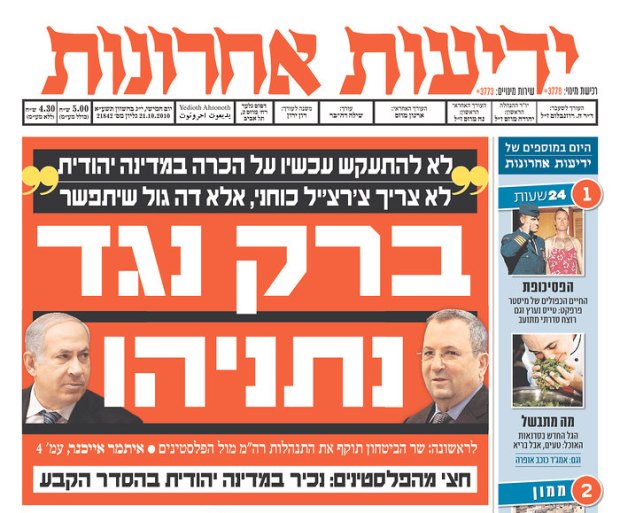
Yedioth Ahronoth
Market Share* (June 2010): 35 percent on weekdays, 43.7 on weekends.
Internet site: Ynet (English edition here).
Politics: After years of dominating the printed media market, Israel’s leading tabloid has met a fierce rival – the free paper Yisrael Hayom, launched three years ago by gambling billionaire Sheldon Adelson. Many people believe that this is the reason for the sharp anti-Netanyahu tone Yedioth has taken over the past year. The paper is constantly publishing articles attacking the Prime Minister, his staff and even his wife. Star pundit Nahum Barnea is especially hostile to Netanyahu; in fact, I think there is only one columnist in Yedioth – Hanoch Daum – who is an open Netanyahu supporter and a proxy to the Netanyahu family.
Leaving Netanyahu aside, Yedioth is a fairly centrist paper. It tends to be conservative on military and security issues, but more open than other tabloids when it comes to dealing with civil rights issues. The campaign the paper launched against the State Prosecution and the Supreme Court for their intervention in policy issues and nominations of high ranking officials seems to have calmed down recently.
I think people outside Israel don’t pay enough attention to Yedioth. For years, the paper was known for its ability to capture the voice of the average middle class Israeli. The front page story of the papers’ weekend magazine always presented “the man of the moment”, or the story that would be discussed during the following week. Yedioth is not as strong today – but it is still the most important media organization in Israel. Yedioth’s internet site (Ynet) is by far the most popular news site in Israel.
Yair Lapid, channel 2 anchorman and a possible candidate in the next elections, has a widely read column in Yedioth.
The bottom line for Yedioth Ahronoth: Conservative on security and Supreme Court; critical of the government and Netanyahu himself; slightly more liberal than the two other tabloids.
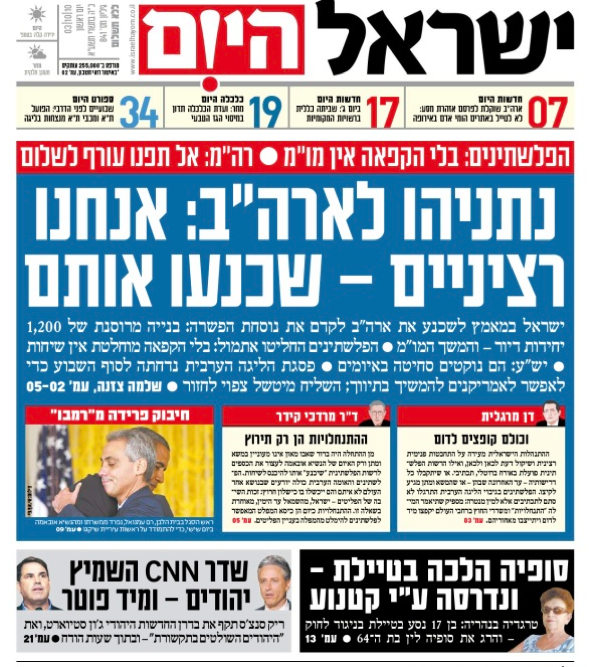
Yisrael Hayom
Market Share (June 2010): 35 percent on weekdays, 25.7 on weekends.
Internet site: Yisrael Hayom (Hebrew, printed edition only).
Politics: According to most estimates, Sheldon Adelson’s free tabloid, which is circulated in 250,000 copies, is losing money. But Adelson’s intention in launching the paper was not to gain profits, but political influence.
Adelson’s paper is edited by a former proxy to Netanyahu, Amos Regev. Under Regev, Israel Hayom is extremely supportive of the Prime Minister, constantly pushing stories that present Netanyahu and his family in a positive way. Recently, the paper is taking on an even more nationalistic editorial line.
[A more detailed post about the ties between Yisrael Hayom and Netanyahu can be found here.]
Yisrael Hayom is very hostile to the Palestinians; it tends to emphasize security threats and to present a favorable coverage of some of the new Knesset bills which are aimed against the Arab minority, Arabs members of Knesset and leftwing NGO’s (though one could find in it from time to time an occasional op-ed expressing different views).
Yisrael Hayom is supportive of the State Prosecution and the Supreme Court, but only on corruption issues, not civil rights ones.
Yisrael Hayom doesn’t have its own publishing house, so the paper has outsourced its printing and distribution to Haaretz. There are rumors that this move saved Haaretz from bankruptcy.
The bottom line for Yisrael Hayom: Conservative on security, diplomacy and civil rights; highly supportive of Netanyahu.
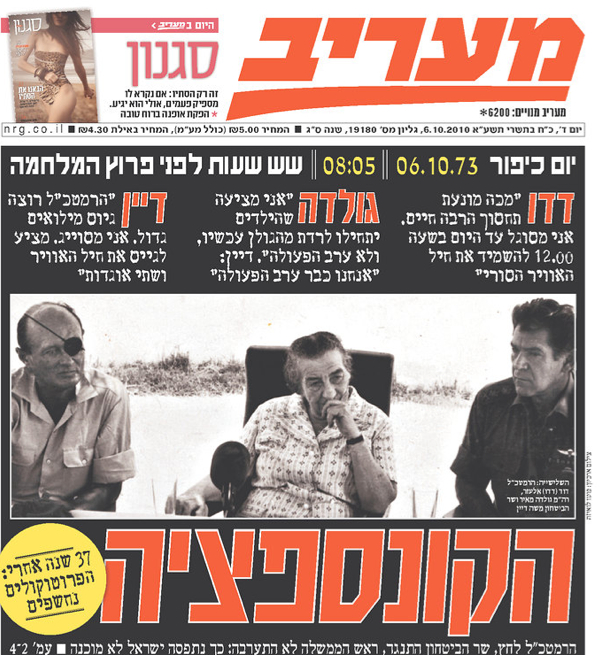
Maariv
Market Share (June 2010): 12.5 percent on weekdays, 16.1 on weekends.
Internet site: nrg (Hebrew only).
Politics: for years, Maariv was Yedioth’s greatest enemy (when I moved from Ynet to Maariv in 2003, I was told by one of the senior editors that I would never write for Yedioth again), but now both papers join hands in the battle against Yisrael Hayom.
Maariv ran into financial difficulties more than six years ago, and since then it has been changing its editors and CEO’s frequently. A new team of editors (Yoav Zur and Yoav Golan), and a new co-publisher (businessman Zachi Rachiv) seem to have stabilized the paper a bit recently.
Under its new editors, Maariv has taken a sharp turn to the right. The paper’s subtle criticism of Netanyahu could be a bit misleading. Maariv keeps a very nationalistic and conservative line. It was Maariv that launched the campaign against the New Israel Fund by publishing the Im Tirzu reports. The paper is extremely hostile to the Arab population and to human rights organizations, and recently, it shows a hospitable attitude to the settlement project (a recent double spread all but invited people to live in Tapuach, a settlement formally known as the stronghold of Kahane supporters). Among Israeli papers, Maariv is the most supportive of Avigdor Lieberman’s policies, and it usually presents a somewhat favorable coverage of the bills Israel Beitenu is trying to pass in the Knesset.
Rumors have it that it was a conscious decision by Maariv’s editors and managing board to take an editorial line that would exploit the current nationalistic trends in the Israeli society. The promotion of conservative contributors such as Kalman Livskind and Ben-Dror Yemini support this theory. Yemini is known for his campaigning against “lefty” influence in the Israel academia and media. He has repeatedly called to hold state funds from critical movies and from artists and professors who are “anti-Israeli”. Last week he published a double spread attacking Haaretz journalist Gidon Levi for an interview he gave to the Independent.
The bottom line for Maariv: Highly conservative on security; anti-civil rights, anti-Supreme Court; slightly critical of Netanyahu and Defense Minister Ehud Barak.
UPDATE: Maariv was bought by Israeli tycoon Nochy Dankner, and is currently (fall 2011) edited by Nir Chefetz, former spokesperson for PM Binyamin Netanyahuu.

Haaretz
Market Share (June 2010): 6.4 percent on weekdays, 7.4 on weekends.
Internet site: Haaretz (English site here).
Politics: Haaretz was Israel’s liberal paper for many years, and one could claim that it’s the only paper committed to supporting civil rights and promoting democratic values. By Israeli standards, Haaretz is very critical of the IDF, thought in the past few years the paper was criticized for pushing Palestinians’ civil right issues into its back pages. Many leftwing activists and politicians are also dismayed by the liberal line Haaretz tends to take on economical issues.
Haaretz’s editorial line is very critical of Netanyahu and Lieberman, though some important contributors, such as Ari Shavit and Yoel Marcus are less clear on the issue. Haaretz journalist Amira Hass is especially known for her work on Palestinian rights issues.
Haaretz’ circulation is not substantial – it’s almost similar to that of the unimportant free tabloid Israel Post – but it is widely read and discussed by public opinion makers, politicians, diplomats and the international press, so it has a more substantial weight than its numbers. Nevertheless, it’s important to remember that very few Israelis actually read Haaretz.
The bottom line for Haaretz: liberal on security, civil rights and economy; supportive of the Supreme Court; very critical of Netanyahu’s government.
———————————
(*) Maariv and Israel Hayom are the only daily papers in Israel to disclose their circulation figures. The common way to measure papers’ share of the market – and the one used to determine advertising prices – is through the TGI poll, conducted twice a year by the independent company TNS-Telegal. The figures in this post relate to the June 2010 poll.