

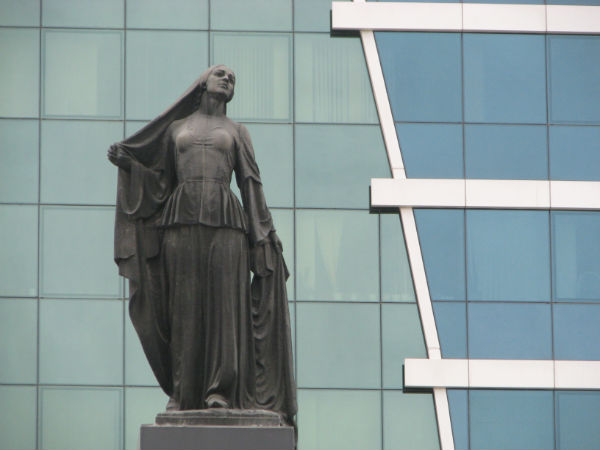
The monument to women's liberation in central Baku displays a woman removing her headscarf. Is she still Muslim? In the Azeri sense, she is.
“I’m not a feminist” says Elmira, and takes a sip from her pint of Turkish beer. “I mean, I do believe that women should have all the rights, but not that men should be weakened.”
We’re at the Otto, a bar in downtown Baku that caters mostly to foreigners. Elmira, though an alumnus of the city’s Russian school, a poet in the English language and an altogether cosmopolitan sort, is not a foreigner. Feminist or not, she’s an Azeri involved in women’s organizations.
The Otto is located a mere 300 miles from Iran, and a similar distance from Chechnya, which has become religiously polarized in recent decades due to the war. Azerbaijan itself has for years been engaged in a bitter war with its Christian neighbor to the west, Armenia. One would have expected such polarization to take place here.
This does not seem to be the case. Elmira’s friend Jamila joins the feminist jab and recommends that I go and visit the monument to the liberated woman, which stands outside Nizami metro station at the heart of the city.
I go there the following day and find myself astonished. In the midst of a Muslim city, atop a tall pedestal, is the likeness of a woman pulling off her headcover and exposing a braid. She does no do so angrily, but confidently.
Mosques like temples
Here is art faithfully imitating life. Ninety-nine percent of Azeris are Muslim. Eighty-five percent of them are Shiite, yet hijabs are extremely uncommon on Azeri streets, and not only in the capital. In four other towns I visited: Ganja, Qazah, Shemkir, and Surakhani (which inspired its own, less euphoric post) I only saw them worn by members of the older generation, and that, more often than not, in a loose manner, more as a statement of identity than a strict practice.
We grow up with such fixed concepts of Muslim societies, that shaking them off is akin to pulling off a scarf from our own heads. When traveling into Azerbaijan, I passed an Ottoman-styled mosque on the Georgian side of the border and immediately felt adrenaline pour into my veins. We were approaching a Muslim land, “hostile territory” without doubt.
The first hint that a change of paradigm may be in order came with the first mosque on across the border. It looked nothing like the Georgian one. Mosques in rural Azerbaijan have no minarets. They are large country houses with delightful ornate facades, and somehow reminded me of village Buddhist temples in parts of east Asia.
This is west Asia, where Islam has a tradition of tolerance. Jews and Muslims lived for ages in true harmony in the various “stans,” a harmony that ended simply because most Jews immigrated elsewhere. Wherever I presented myself as an Israeli (and I always did) sincere warmth ensued, combined with plenty of curiosity. These people assumed nothing about me, and within a few days I learned to assume nothing about them.
Only a piece of cloth
I refuse to think of Azeris as inauthentically Muslims or semi-Muslims. Even following 73 years of secular Soviet rule They are Muslim and proud. Rashad, a young photojournalist I met, drinks no alcohol despite being perfectly modern and urban. In his family’s house a tapestry of Mecca adores the living room. It’s simply that the idea of Islam is healthy and relaxed.
Elmira is Muslim in the same way that I am Jewish. “Religion is more like tradition in this country,” she explained to me, and pointed out that it goes along with other traditions, such as the Zaraostrian holiday of Novruz. “There is an unspoken respect for people who make namaz or went to Mecca. Muslim tradition is very important here, but nobody takes you to mosques forcibly,”
In a land such as this, we can redefine our understanding of this religion and see it in a different light. I’m not terribly fond of organized religion in general, so even this different light doesn’t make me a greater lover of Islam than I am of other faiths, but seeing that it can be compatible with progress and does not necessarily advocate isolationism is encouraging and heart-warming.
The bronze lady at Nizami station is freeing herself of Islamist oppression, not of Islam itself. The truly spiritual know that Allah is not to be found in a piece of cloth. Symbols such as the headscarf only count for so much and can also be misleading. On one Azeri train an old lady demanded to know why I wear a full beard, an uncommon sight in this country. I asked an English speaking passenger in our compartment why she seems so bothered by it.
“She’s worried that you are an Al Qaeda terrorist,” he replied.

For additional original analysis and breaking news, visit +972 Magazine's Facebook page or follow us on Twitter. Our newsletter features a comprehensive round-up of the week's events. Sign up here.


Prestwick
An absolutely fantastic article. I had a similar experience in Bosnia. People never assumed anything about you and vice versa. It was very liberating!
Ben Israel
Important to keep some things in mind. Azerbaijan is on the fringe of the Muslim world. It is coming out of 7 decades of atheist Communist rule. The kind of Islam one sees there is not going to be a good indicator of what one sees in the heartland of the Muslim world which are the Arab countries, out of which Islam first came to the world, and the powerful Muslim states to the east, such as Iran and Pakistan. Recall that Pakistan was created specifically to be a “Muslim” state.
According to an article I read by someone who was born, raised and educated as a Muslim, Islam, as it is practiced, exists on three levels. The first is the private, pious level which consists of personal obligations such as to pray daily, to give the “zakat” charity tax, to observe the Ramadan fast days and to make the Haj to Mecca.
The second level is what the writer called “social Islam”. This is implementation of sharia law in the Muslim society which regulates personal status such as marriage and divorce, legal disputes between Muslims, etc. If a nation/state follows sharia law, someone who is born into or converts to Islam can not change their religion to another. The marriage of a Muslim woman to a non-Muslim man is not recognized. This also includes the system of polygamy and Muslim divorce laws. Also the laws of the Ramadan fast must be enforced which prohibits eating during daylight hours which means restaurants must be closed during those hourse, even if owned by non-Muslims. Of course, there are Muslim states where sharia law is not enforced at all or only partially, but the Arab states of the Middle East do so to a greater degree than does Azerbaijan.
Finally, there is the third level of Islam which is the “political level”. This means that the rulers must consult Islamic scholars on all issues, this regulates the relationship between Muslims and non-Muslims on both an internal and external level (i.e. state-to-state) and whether the Muslim state is working to bring about the world-wide domination of Islam which is promised to the Muslim by its basic sources.
According to the ideology of the Muslim Brotherhood in Egypt, extpressed by among others, Sayid Qutb, the reason that Islam is not dominant in the world today as it should be and the fact that at dhimmi Jewish state managed to implant itself in the heart of the Dar al-Islam (realm of Islam-the Middle East) is because Muslims became influenced by secular Western ideas regarding the separation of religion and state. Muslims who fell victim to this corrupt thinking feel that only the first level of private observance and devotion should be observned, the second and third levels are viewed as “obsolete”. The fact that the Arab/Muslim world is so far behind the West economically and socially and the fact that the Arabs/Muslims have failed to eradicate Israel is a sign of divine punishment for rejecting the second and third levels of Islam. It is incumbent on good Muslims, according to this thinking, to bring about a revolution by bringing Sharia law into force in Muslim countries and to have the Muslims states run their internal and external relations on the basis of Muslim values and to related to non-Muslim dhimmis as they should be dealt with by Muslims. Only then will the Muslims be able have their societies advance and rid themselves of the Zionist invaders who use the “peace process” to spread their own secular, materialist, consumerist values (e.g. Bernard Avishai’s “Hebrew Republic” which seeks to turn Israeli Muslim Arabs into secular “Hebrews”) which are anathema to conservative Muslim societies in which respect for elders, sexual restraint and modesty and different roles for women are traditionally honored.
Thus, I believe it is erroneous to think that Azerbaijan can serve as a model for the Muslims in the rest of the world. This “westernized-moderate” Islam is going against a very strong ideological tradition that is making a comeback, particularly in the heart of the Arab/Muslim world (e.g. Egypt, Jordan, Iraq).
Arlosoroff
Ben Israel, perhaps youve missed the point a little.
I dont think the author claims that Azerbaijan must “serve as a model for the Muslims in the rest of the world” as you put it, but rather, that the nuances of Islams manifestations on the Earth dictates to us that we must rid ourselves of our fear of Islam as an inherently oppressive system. Islam is determined by those whose interpretations of it are put into rhysical reality..the Islam of Indonesia and of Malaysia are two other examples.
As he says of the statue “she is ridding herself of islams oppression, not of islam itself.”
we can do the same to our Judaism, and we must.
Nadine
The author is living in his own orientalist fantasy. I hate to sound like a post structural hippy, but just by reading the authors other articles the words of Edward Said becomes truer and truer to my ears.
Arlosoroff
Sorry but i disagree. In my reading the author has offered a far more nuanced perspective then that dicatated by the would be over simplified east-west dichotomy your referring to.
Just the opposite in fact…
and im not sure why you disregard post-structuralism as “hippy”?
Perhaps you could say a little more Nadine?
Gil
While Ben Israel has a point and in realistic terms he is probably right that Azerbaijan does not represent the entire Muslim world, it also does not stand alone and is a part of a growing movement in that world. There are shifts and currents in both directions. The Turkish nation was for a long time unique in that it separated Islam religion from state, and officially it still does while its government approach seems to be tilting towards traditional Islam. OTOH we see changes in the entire Middle East in which corrupt establishments are changed/ removed, and there is at least some indication that the shift is not toward Shariaa law but to a state that takes a responsible approach towards the citizens, from an economic standpoint (i.e. fare distribution of resources) and from a political standpoint (more freedom). Azerbaijan of course followed a different path, but it can be a model for those changing states toward more separation of state from religion. And this should be a flag to all religions – if they are to survive they have to adapt to a world where state IS NOT a religious entity, and where women’s equal rights are respected.
QLineOrientalist
If an article like this make the words of that silly diatribe Orientalism ring in her ears, maybe Nadine should say *less*.
I never thought of post-structuralists as hippies. I always thought of them as dreary commissars or Orwellian thought police.
Readers of this article might be interested in an article of mine I’m now going to shamelessly flog here:
http://iran.qlineorientalist.com/Articles/MNDIran/MNDIran.html