
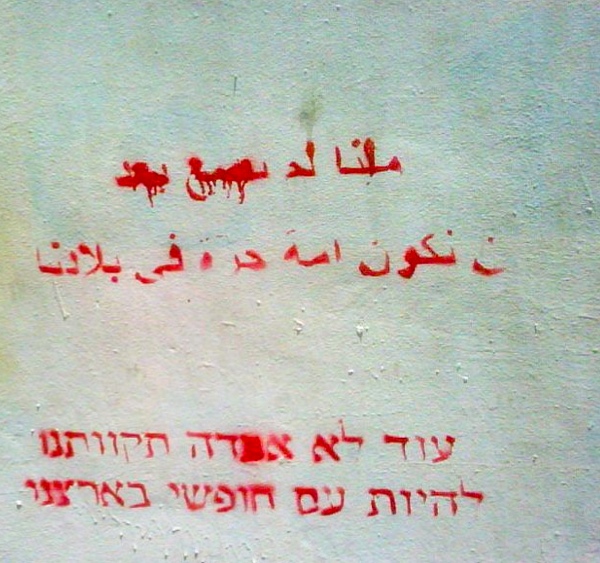
After 62 years, the Ministry of Education has finally decided to introduce Arabic language studies starting from the fifth grade. The new initiative will allow students at 170 public schools in northern Israel to learn the second official language in Israel starting from a relatively young age.
Today, students are obligated to study Arabic during junior high school but then it becomes optional during high school days. Students can choose to continue studying Arabic, French, Russian or Amharic as a second language at the latter stage. The new suggested program will require Arabic studies during elementary school which is usually around the age of 10 or 11, creating a continuous flow from age 10/11 until the age of 14/15 . It’s a pity this will be the case only in the northern district, but I suppose this is a good start.
During my post high school days, mainly in my practical engineering school, I was constantly surprised to discover that very few of my Jewish classmates understood or spoke Arabic. Those who had some knowledge, acquired it during their military service, either at the check points or while serving in army intelligence units. Others knew only basic pathetic sentences from their junior high school days. It sure felt like someone is missing the point out there – what a pity.
I had an argument with a friend from Ramallah about Hebrew language studies in their high schools. I fail to understand this illiteracy of opposing such studies. The first and one of the most important bases for mutual understanding and building bridges is simply learning the other’s language. I am not asking everyone to master both languages, although it is not that hard, but basic knowledge, I believe, is elementary – “even” starting at elementary school.
I would recommend, for the Israeli citizens amongst my readers, to start exploring your neighbor’s language. It would create a great starting point for interaction with your neighbors, classmates or who knows; maybe you will end up working at an office with an Arab.
Issa Edward Boursheh is a graduate student at Tel Aviv University.
Cross-posted from the blog 20:40.