

Prime Minister Binyamin Netanyahu announced yesterday his intention to legalize dozens of tiny settlement outposts in the West Bank, which were built over the last decade, without formal authorization by the Israeli government, reports Haaretz. At the same time, he declared his intention to dismantle “immediately” all the outposts built on private Palestinian land. According to the report, only three outposts with several hundred families will be affected, even though the number of outposts built on private land is much higher.
It should surprise few that the announcement is just another smokescreen – a fraud, really – that is meant to protect the settlement enterprise from legal and international pressures bearing on it.
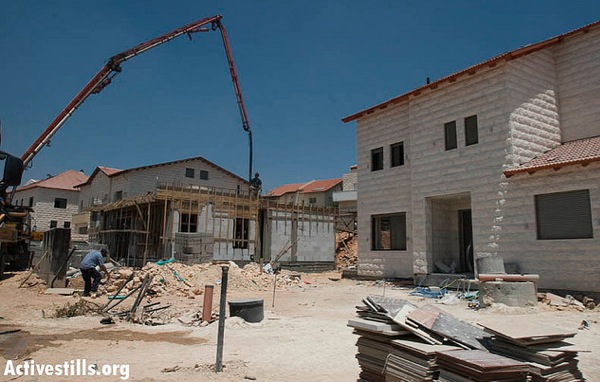
Netanyahu’s announcement that he would have only three outposts dismantled is actually a major step backward. Previous Israeli prime ministers committed several times to dismantling all outposts, as per the Road Map and various other agreements. Previous heads of government repeatedly announced they were about to execute this decision – but none of these promises was ever carried out. Of over a hundred outposts, only nine homes in Amona were dramatically demolished, after the courts left the government no choice. And the bulk of Amona itself remains standing to this day.
Last year’s 10-month settlement freeze applied only to ‘legal’ settlements; the freeze was not enforced in the outposts, which are illegal according to Israeli law (although all settlements are illegal according to international law); there, building continued as usual. The legalization of outposts built on state land will presumably include the legalization of all this construction as well. If it were not already clear that the freeze was a sham, now Netanyahu has managed to violate it retroactively.
It is important to remember, too, that the term “state land” is highly misleading when applied to the West Bank. A lot of private Palestinian land was declared to be state land by IDF lawyers, utilizing questionably legal ruses. Although public land, according to international law, is to be used for the benefit of the occupied population, Palestinians are allowed nowhere near it. These lands have been almost exclusively reserved for the construction of the settlements. The unauthorized outposts built on this “state land”, which Netanyahu now intends to legalize, are often built intentionally to block access to Palestinian private land, even those plots which are still recognized by the Israeli authorities as such. All of this is ignored.
The prime minister said yesterday, “We need to do things that will placate the international community so that we can protect the settlements.” That is exactly what he is doing. By declaring his intention to dismantle three illegal outposts, he is making a show of responding to demands not just from the international community, but also from the Israeli courts.
The legal strategy adopted by the current government – brazenly claiming it will implement the law whenever and however it likes – has not found favor with the justices. In recent months, high court judges have harshly criticized the government on this issue, signaling on several occasions that they would issue a time-bound order to demolish outposts, and even parts of authorized settlements that were built on private land. Netanyahu’s decision reflects a reversion to tactics employed previous governments: making hollow promises that will never be fulfilled in order to give the courts an excuse to avoid this explosive issue, while they wait for an eviction that never happens. Only now this tactic is packaged with a decision to legalize vast amounts of recent construction, adding dozens of new authorized settlements to the current stock.
Although Netanyahu is unlikely to evict all or even most construction on private land, it is quite possible that he intends to choose one site and create an evacuation spectacle. The forced evacuation of Amona, for example, was a huge and dramatic media show. Images of mounted riot control police charging defiant teenage settlers, and thousands of police officers and soldiers mobilized, made a strong impression on the Israeli public, with many analysts raising the dreaded specter of civil war. These evacuations provided an excellent excuse to avoid the evacuation issue at home, while presenting the government as courageous and relieving pressures from foreign governments.
In fact, it is not necessary to evict the settlers from the illegal outposts. As in most cases, turning off the money tap is much more effective than violent confrontations. The truth is that the government, for all its protestations, supports the outposts. The regional councils, as well as other organizations and public bodies financed by the government, divert funds to sustain the outposts, providing fuel for their electricity generators and trailers to live in. Since this is an illegal activity, all the government has to do is stop the transfer of funds. There are other legal means to avoid confrontations and media spectacles, too. But this government is not looking for a way to tackle the problem of the settlements – they are looking for ways to protect and extend it.



March 1, 2011
5:25 pm
“We need to do things that will placate the law enforcement community so we can protect the criminals.”
March 2, 2011
1:42 am
One correction, Roi, the settlements are NOT “illegal” under international law. There are opinions in both directions. The US stopped saying they are illegal after Jimmy Carter made that claim and he was shown it was not at all clear. But, in the end, what difference does it make? The question is ultimately political.
March 2, 2011
2:42 am
Ben – To the best of my knowledge, the view that the settlements are legal is a distinctly minority view among scholars. It is not endorsed by any international body, or by any state accept Israel, and even the US is at best agnostic on this issue.
Furthermore, even if you read, for example, Israel’s position on the issue as stated on the MFA website, you can see that it is based on at least two factual assertions which are patently false:
a. That the building of the settlements has not caused the displacement of Palestinians.
b. That the movement of settlers into the OPT is voluntary, in the sense that it does not amount to a “transfer” of population by the government of Israel. Considering the various inducements provided to settlers, and the fact that Israel built the homes for many if not all of them, it is absurd to argue Israel has not “transfered” its population to the OPT.
Also, the settlements violate the whole premise of international law in regards to control of territory. This body of law recognizes only two possible statuses of any given territory: either it is a part of a sovereign state, in which case everyone born there is a citizen of that state; or it is under the custodianship of a foreign state, in which case the custodian (occupier, mandate-holder, etc.)must manage this territory to the benefit of its inhabitants. The whole settlement enterprise is based on using the resources of the West Bank to the exclusive benefit of Israel’s own citizens.
To sum up – I stand by my assertion.
March 2, 2011
3:37 am
Let’s say that you could prove to me that the settlements are illegal. So what? No one is in a position to enforce the matter. The Israeli legal Establishment has NOT ruled that the settlements are illegal and they represent the sovereign body in charge of the territories. But let’s say that I could convince you that the settlements are legal. Would that make any difference to you? Of course not. So the whole question is irrelevant. As I said, the whole thing is ultimately political. Even MERETZ says they are in favor of keeping at least some of the settlement blocs. If they are illegal, how could they be in favor of keeping illegal settlements, even if the Palestinians should agree? Thus, even the political Left realizes the question is political.
March 2, 2011
5:31 am
Ben Israel, I’d say your opinion on the issue is political, but as to the status of settlements & land use, that’s a legal issue. Saying that legality is just unmediated opinion is lazy. If I rob someone in the street, or drive over the speed limit, no amount of subjectivity will get me out of it. It’s not a magistrate or judge’s mere view that I broke the law: I did. Have your opinion of the law, argue for it, but don’t confuse that with the law itself.
Given, politics informs the creation of law and sometimes distorts it’s implementation, but that categorically doesn’t mean law folds into abject relativity.
Oh, God, I’ve just realised I’ve got drawn into one of those perennial Mid-East topics that not only go nowhere, but have little to do with the article – which was actually quite good Roi. Ta.
March 2, 2011
7:50 am
Carl-
I am aware of what you are saying. I think the matter comes up if private land were taken illegally to build, then there would be a problem. However, the settlements are built on Jewish-owned land or state land. Israel spent much effort defining what land qualified for this category. I am also aware that there are private Arab individuals who claim that state land used for settlements was actually their own private land. This is a matter for the courts to determine.
March 2, 2011
8:57 am
Aw I hate to say this, but I’m agreeing with you Ben. As far as the legality goes, that’s for the courts to decide and the lawyers to contest: both nationally and internationally. We can then all make our opinions on the law itself as regards the sense and ethics of it.
On the latter I suspect we’re poles away Ben, but rather than waste our fingertips in a vain attempt to breach each others’ defences, let’s have a collective gasp at this rare agreement. Hurrah!
Hey, I’m on a roll. I might even chance the car-crash which is the Ha’aretz comment system … .. . No, no I’m not actually drunk, am I. Maybe this evening then.
March 2, 2011
1:41 pm
“the settlements are built on Jewish-owned land or state land.”..really? That’s new to me. Not even Israel was created on more than 6/7 percent of Jewish-owned land and so that’s a great announcement to the world. It is very funny to me how is it possible to live in such a self-created perception. All the States of the world recognized Israel only inside the Green Line. All the rest are only autistic considerations. Settlements are just a crime against millions of human being and only a person that never spent 1 day among the Palestinians in the OPT can write that the settlements are legal. Ben Israel I hope that next life you will be born in Ni’ilin: let’s see then if you keep this solipsistic approach.
March 2, 2011
4:39 pm
Roi, very good article.
One question:
“The truth is that the government, for all its protestations, supports the outposts. The regional councils, as well as other organizations and public bodies financed by the government, divert funds to sustain the outposts, providing fuel for their electricity generators and trailers to live in.”
Is there documentation supporting this statement?
Thank you
March 3, 2011
3:06 am
Ben – according to information provided by Israel’s own authorities, 40% of the settlement’s areas is on private Palestinian land:
http://www.washingtonpost.com/wp-dyn/content/article/2006/11/21/AR2006112100482.html
Raph-
Here is just one link (in Hebrew), showing 4 million NIS (over a million dollars) invested in just two illegal outposts on private Palestinian land, in 2003 alone, by Israel’s Housing Ministry:
http://www.mevaker.gov.il/serve/showHtml.asp?bookid=404&id=157&contentid=7510&parentcid=7504&frompage=398
That, of course, is just the tip of the iceberg. Take 4 million NIS in one year, for just two outposts, and multiply it by as much as 100 outposts, over a decade, and you get what probably amounts to hundreds of millions of dollars of financing by the Israeli state.
March 8, 2011
5:21 am
[...] (Israeli term for settlements lacking official recognition) built on private Palestinian land (but not confiscated lands) by the end of 2011. Nobody would be blamed for disbelieving the claim. The different attitude of [...]