

More from +972 writers

Our newsletter features a nice roundup of the week's top stories. Click to register.

We won't spam you, and we won't share your info.
Analysis News

Israeli NGO loses lease because of racism

CORRECTION: Due to a serious miscommunication, I mistakenly reported that the ARDC had moved to Jerusalem. Nic Schlagman of the ARDC confirms that the ARDC  did lose a lease due to the religious edict mentioned below and that the organization has had “a lot of problems trying to relocate our shelters for the same reason.” They have not, however, moved to Jerusalem; their offices are currently closed for a week as they move to Tel Aviv’s Central Bus Station.

My deepest apologies for the error.

I met with Yohannes Bayu yesterday, the founder and director of the African Refugee Development Center, an local NGO that aims to assist the 30,000-45,000 asylum seekers in Israel. I’d been accustomed to meeting at the ARDC’s office in South Tel Aviv, the heart of Israel’s foreign community. But, yesterday, we met at a coffee shop in Jerusalem as the ARDC is currently moving. And, due to racism, the ARDC lost a lease they’d signed for a new Tel Aviv office.
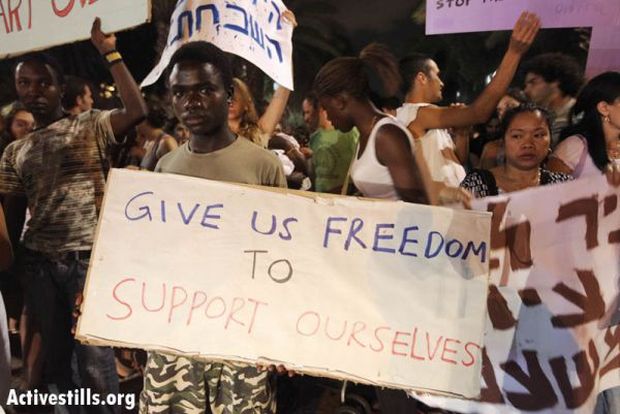
An African refugee at a protest in 2009 (photo: flickr/Activestills)

In July of 2010, 25 South Tel Aviv rabbis signed the “Edict Forbidding the Rental of Apartments to Infiltrators,” forbidding Jewish Israelis from renting to undocumented migrant workers and African refugees–a group the government and now the public refer to as “infiltrators.”

After the ARDC decided to lower overhead costs, they began looking for a new office. They found one in South Tel Aviv, signed the lease, and packed up–only to have the landlord back out at the last minute. Bayu understood from the landlord that the cancellation was related to the religious edict and the racism in the neighborhood. “He said, ‘I’m sorry, but I can’t rent to you [and your organization],’” Bayu, a Christian Ethiopian, recalls.

Since the 2010 edict, a number of refugees in South Tel Aviv have reportedly seen their leases cancelled or have encountered landlords that refuse to rent to them. Several right-wing demonstrations against African asylum seekers have been held in the area in the past year and a half. The most recent took place earlier this month and was led by Israeli settlers from the West Bank and East Jerusalem, including Knesset Member Michael Ben Ari (National Union) and extreme right-wing activist Baruch Marzel, a former member of the outlawed Kach party.

According to Bayu, the state of Israel has recognized less than 200 refugees since 1948. Bayu is among them.

The first African refugees arrived in Israel in the late 1980s and early 1990s. A slow trickle of asylum seekers continued since then but the pace stepped up dramatically and visibly in the mid-2000s due to the conflict in Sudan. While Israel does not process refugees request for asylum, nor does it give the group work visas, the state tacitly acknowledges their status by not deporting them.

For additional original analysis and breaking news, visit +972 Magazine's Facebook page or follow us on Twitter. Our newsletter features a comprehensive round-up of the week's events. Sign up here.

View article: AAA
Share article
Print article
  • COMMENTS

    1. Aaron

      There was recently a lot of coverage of resistance in Beit Shemesh to the haredi takeover (partly about the spitting incident, but more generally about the takeover). One commenter here described how he left Beit Shemesh partly because of the haredim. Most of us would not want to live in a neighborhood that has been taken over by haredim. That is not necessarily an anti-haredi sentiment.
      §
      In case it isn’t obvious how this comment relates to the topic, consider that it’s all about preserving the character of one’s neighborhood community. In fact, it’s about preserving the very *existence* of one’s community. That desire is not necessarily a sign of anti-haredi bigotry in Beit Shemesh, nor of racism in south Tel Aviv.

      Reply to Comment
    2. Aaron

      I’ll add that there’s been lots of not exactly sympathetic coverage of Jewish settlement as well. Yes, there are a million differences between that and south Tel Aviv and Beit Shemesh. But the essence of the resistance is the same in all cases: preserving the existence of one’s community. To amend what I said above: That is not necessarily a sign of anti-haredi bigotry in Beit Shemesh, nor of racism in south Tel Aviv, nor of anti-Semitism in east Jerusalem.

      Reply to Comment
    3. jim

      ‘Preserving one’s community’ has been the cover story for some of the biggest atrocities in history, and was certainly one of the ‘justifications’ for the Shoah.

      One seriously has to question whether a community is worth preserving if it can only be preserved with intolerance and racial discrimination.

      Reply to Comment
    4. Carl

      Aaron, if ‘preserving your community’ involves preserving the right to shout whore at those you deem are defiling it, have one gender enforce segregation on the other, preserve its colour, or perhaps its ethnic purity, that’s preserving a community which has no pace in a decent world. It’s a black and white issue. Yes there are grey areas, but if you need the black and white ones explaining to you I despair, I really do.

      Reply to Comment
    5. Aaron

      Sure, “preserving our community” was used as a justification for the shoah. It was also used as a justification for Arab resistance to Zionist settlement, and for Jewish resistance to non-Jewish Africans taking over the neighborhood.
      §
      Besides the difference in degree here – gas chambers versus not renting out apartments – the difference is that the Jews were already *in* Germany, whereas the Jews are not already in all of east Jerusalem, nor are the haredim already in your and my neighborhoods. Because the Jews were already in Germany, the Germans were morally obligated to find a decent and humane way to deal with the situation, like it or not.
      §
      I agree that there are some, very, very few, communities so evil that they “have no place in a decent world.” In my opinion, none of the communities I’ve named – the seculars in whatever neighborhoods they live in, the haredim in their neighborhoods, the Jews in some areas of south Tel Aviv, the Arabs in east Jerusalem – none of those communities is so evil that it doesn’t deserve to exist. And these communities *will* cease to exist if they allow large numbers of outsiders to move in.

      Reply to Comment
    6. Carl

      Spot in Aaron. I mean, my area is totally white and we all want to preserve that. Thing is I’ve noticed a few less-than-pasty faces passing through the area of late. Now don’t get me wrong, I’m no bigot. I won’t spit at them or scream abuse in their faces. No, I’m just going to put a sign up asking for them to ‘respectfully’ walk on the non-white side of the street. Maybe I could dish out calamine lotion at the top of the street and get them to white-up as they pass through? Well they don’t live here already so I owe them nothing, right? Oh, hang on, this line of argument is leading somewhere bad isn’t it… .. .

      ‘Preserving character’ is good, unless the characteristic being preserved is bad. So racist would be a bad one to preserve, as would misogynist, and so on, and so on. There. That’s cleared things up, hasn’t it.

      Reply to Comment
    7. Woody

      Unfortunately this article is not even factually correct. Firstly, the title implies that racism forced the ARDC to move sometime recently, when it facts Maya is referring to something from 2010. This is confusing to many since the ARDC *just moved offices*. However, the previous landlord was not a racist and the current move has to do with costs. Secondly, even if we consider the incident in 2010 when a landlord (who is racist) backed out of a lease agreement, the ARDC was never “forced to move”. The simply didn’t leave their previous offices. As someone who works in the refugee community and lives in Neve Sha’anan, I’m not trying to detract from the impacts of racism on the community here. I would only like to add these comments so +972 doesn’t embarrass themselves with sensationalism when they are a legitimately needed voice on the “Left”.

      Reply to Comment
    8. hi woody, thanks for your comment and it’s great to know that you are involved with the refugee community. i think that the timeline in my article was a little unclear, so i fixed that. however, you are incorrect in your assessment that the ARDC did not just move offices. as mentioned above, i met with yohannes bayu on thursday. he was unable to meet on wednesday as the ARDC was busy relocating from tel aviv to jerusalem. so, yeah, i’d say the expression “just moved” is pretty darn accurate. ;)
      you are correct in that they moved last year to lower overhead costs. i mentioned that in my original version as well as this corrected version.

      Reply to Comment
    9. Aaron

      Haredim demand that people dress modestly when going through *their* neighborhood. That doesn’t seem too much to ask. You can always make an absurd “where do you draw the line” argument.
      §
      Some of the arguments you guys are making are very American, which isn’t surprising. Pro-settler Americans say things like, “If Jews have the right to live in Miami, why don’t they have the right to live in Hebron?” Or else they call Arabs “anti-Semitic” if they resist Jewish settlement. In this article, the same argument is implicitly used against Jews (“racism”) rather than against Arabs.
      §
      Imagine Jews were “Judaizing” a traditional Arab neighborhood in Jaffa. Would the Arab residents fighting against that be “racists” (or “anti-Semites”)? Would they be trying to preserve the “racist” character of their Arab community by resisting the influx of Jews? Should they just let the Jews destroy the traditional community, and either raise their children as Arabs in a now-Jewish neighborhood or go live somewhere else?

      Reply to Comment
    10. mya guarnieri

      Carl and Aaron,

      I’m sorry, but “preserving character” is often used an excuse for racism. Yes, that is the case in South Tel Aviv. Further, I’m not sure you guys really want us to start unpacking the character of South Tel Aviv… significant portions of which, before 48, were part of Palestinian Jaffa. What is now Kfar Shalem and Kiryat Shalom were Salame. You can see old Arab houses in various places in South Tel Aviv and there is an old graveyard between Kiryat Shalom and Shapira. Do you really want to go there?

      Aaron, your remark about the arguments being “American” was interesting to me… it’s an attempt at playing the “native” who will tell those “outsiders” how things really are. It’s a classic hasbara tactic.

      Question: why is American money good enough for Israel but “American” opinions (whatever that means) aren’t?

      I suppose that’s a little off-topic. Let’s save that discussion for another post. ;)

      Best,
      Mya

      Reply to Comment
    11. ARDC has not relocated to Jeruaslem, the office has been closed for a week. We are currently moving offices and will open this week in the New Central Bus Station near SuperPharm.

      Check out our newsletter or website http://www.ardc-israel.org for more info.

      We did get let down by a landlord in the manner mentioned in this article and have a lot of problems trying to relocate our shelters for the same reason.

      Reply to Comment
    12. Aaron

      Mya: Yes, I really do want to go there, to the fact that many Jewish neighborhoods were once Arab neighborhoods, before the Arabs were driven out. So let’s go:
      §
      In general, there’s no justification for Jews taking over Arab communities and land, whether that occurred in 1912 or 2012 or anytime in between. That means, no justification for the Zionist project which started over a century ago. There are exceptional circumstances that justify specific cases – Jews fleeing Nazi persecution, etc. – but no overall justification. War is one such special circumstance which justifies *some* things that would otherwise be unjust.
      §
      I assume that Salame was taken over in 1948 or before. Whatever injustices were involved then, it’s rightfully Jewish now after more than half a century. Similarly with Jewish communities that were destroyed in 1948 or before and which are now rightfully Arab.
      §
      I shouldn’t have played the “American” card, and of course just because ideas are American doesn’t mean they’re wrong. Just as a historical fact, though, I think the specifically *anti-racist* arguments for the right to settlement, whether of Jews in the territories or of Africans in south Tel Aviv, are American. One virtually never sees them applied consistently.
      §
      I’m sure many of the Jews whose neighborhoods are threatened are “racist,” by your definition. But that’s not why they’re resisting. They’re probably not “racist” against Ruritarians, but if Ruritarians were to start moving to their neighborhood in large numbers, the residents would almost certainly resist, no matter how nice and gracious the Ruritarians turned out to be.

      Reply to Comment
    13. Carl

      Slightly worried something may have got lost as my comment winged its way across the Interweb Mya. For the sake of clarity, I was being sarcastic.

      Reply to Comment
    14. mya guarnieri

      “rightfully” jewish, aaron? נו, באמת?

      Reply to Comment
    15. Charles

      Hi,
      I am an American living in Tel Aviv and volunteering with refugees and I liked the article, but I also think Aaron has a valid point. To my (perhaps naive) opinion, it does seem like the desire of a community to maintain its character (whether its certain Jewish communities wanting to keep Africans out or its certain Arab communities wanting to keep Jews out); while I think that discouraging integration is the wrong way to go, I can definitely understand why many communities shy away from it.

      I do think it is important, though, to distinguish between the causes for mistrust of others. In my hometown of Washington DC, for instance, for decades the city was predominantly African-American/Black, but has recently (in the past decade or so) experienced an influx of whites. Many DC residents opposed this because it has pushed many of the old residents out (the came with more buying power which pushed up housing costs which, in turn, forced many blacks to move to suburban areas…what gentrification did not do, however, was help the city address many of the social or economic problems facing its lower income residents).

      My only reason for bringing this up, I guess, is that I think that not all arguments for keeping out “the other” are exactly equivalent. If they aren’t, where should we be allowed to draw the line?

      Reply to Comment
    16. Aaron

      Mya, do you mean you weren’t bothered by my reference to “rightfully Arab” neighborhoods? If that term bothers you like “rightfully Jewish,” then are Arab property owners in east Jerusalem morally obligated to sell and rent to Jews?

      Reply to Comment
    17. Aaron

      Carl, I agree that every case is unique, but I think there are some general principles behind all of them. “Where do we draw the line” is a difficult question, but it seems we haven’t even gotten to that here. The general belief seems to be that it’s immoral to do *anything* to keep one’s neighborhood Arab or Jewish or secular or whatever.
      §
      One difference between gentrification in Israel and America, by the way, is that in Israel poor people more typically own their apartments. In America, rising property values mean rising rents – not good for the poor people who live there. In Israeli gentrification, rising property values mean rising wealth for the poor people. That’s how it seems to me, anyway, but I’m open to correction by someone who knows better. As always, though, it’s for the residents themselves to decide what’s good for their community.

      Reply to Comment
    18. mya guarnieri

      aaron, as someone who has actually reported on the issues of gentrification in israel and has spent a good bit of time interviewing the lower socioeconomic strata, i can tell you, without reservation or hesitation, that you’re totally mistaken. the poor people here are not getting rich from gentrification. many are renters who are facing eviction and homelessness because the state is putting business interests ahead of the people. if they do own, the market is too expensive for them to sell and then get back into.
      hellooooooo, there were protests this summer about the housing issue…

      Reply to Comment
    19. mya guarnieri

      aaron, as for “rightfully” jewish areas… i’m sorry, you can’t come in, expel 700,000-800,000 members of the indigenous population and then claim that the area is “rightfully” jewish. again, large portions of south tel aviv were palestinian before 48. they are not “rightfully” jewish.

      Reply to Comment
    20. Aaron

      Thanks for the correction on gentrification. This will probably be my last comment on this thread. I’m glad that we apparently agree on some things, especially that Arabs have the right to resist Jews taking over their communities.

      Reply to Comment
    21. Click here to load previous comments

    LEAVE A COMMENT

    Name (Required)
    Mail (Required)
    Website
    Free text

© 2010 - 2013 +972 Magazine
Follow Us
Credits

+972 is an independent, blog-based web magazine. It was launched in August 2010, resulting from a merger of a number of popular English-language blogs dealing with life and politics in Israel and Palestine.

Website empowered by RSVP

Illustrations: Eran Menedl


theme_function.php-begin | 19.890984MBtheme_function.php-end | 21.749216MBmost_stuff_widget_begin | 23.47812MBmost_stuff_widget_end | 23.885848MBtwitter_widget_begin | 24.097896MBtwitter_widget_end | 24.097896MBtheme_footer_before_end | 24.097896MB