
Israeli authorities are attempting to impose new censored textbooks in Palestinian schools in East Jerusalem. Jalal Abukhater provides a sample of the changes and argues that censorship of Palestinian heritage and history is illegal, ineffective and dangerous. Students and parents are mounting protests.
By Jalal Abukhater
While the mainstream media has been dominated by big stories, others are not getting enough attention. For example, Israel’s Jerusalem Education Administration (JEA) recently decided to enforce the use of new, censored textbooks in all private schools in East Jerusalem. The JEA is a joint body of the Jerusalem municipality and the Israeli Ministry of Education. At present, public Palestinian schools in East Jerusalem administrated by the JEA are already forced to use Israel-issued censored textbooks, and the JEA is trying to force private schools to use them too, despite the fact that it has no authority over them.
The decision was an initiative of Knesset Member Alex Miller from Yisrael Beiteinu, who is also head of the Knesset’s education committee. Miller stated (Hebrew) that in East Jerusalem “the whole curriculum should and must be Israeli.”
At the start of the 2011-2012 academic year, students and parents protested against the decision to impose the new censored curricula upon their schools. Students and parents have threatened to escalate their protests if the JEA keeps up its pressure and have said they will not attend the schools if the school administrations comply with the JEA decision. This action by the Israeli Education Ministry is completely illegal under international law, which considers East Jerusalem to be occupied territory; as such the move is yet another direct violation of the Fourth Geneva Convention and the International Covenant on Economic, Social and Cultural Rights, specifically Article 13 of the ICESCR. The move aims to deform Palestinian identity; the changes in the textbooks are dangerous and cannot be ignored.
I have obtained a copy of a report that highlights the modifications made by the JEA to the Palestinian textbooks that have been used since the signing of the Oslo Peace Accords in 1993. The report lists most of the changes made to textbooks used from first to tenth grade.
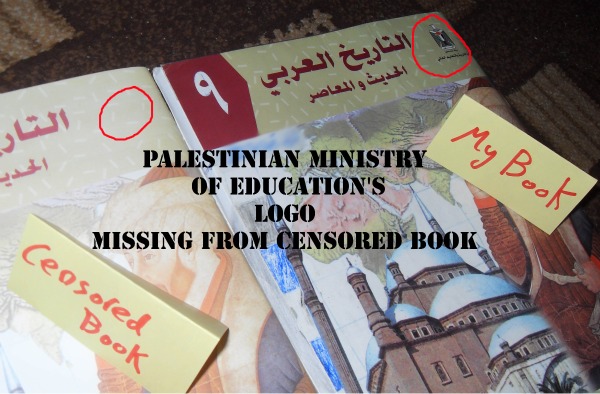
1. The logo of the Palestinian Authority that has been printed on all book covers has been removed and replaced with the logo of Jerusalem Municipality.
2. In the censored textbooks, every mention and picture of a Palestinian flag has been removed, even in the coloring books for six-year olds.
3. Also in the first grade textbooks, a story about a female prisoner returning home, and a poem about the “dawn of freedom” were deleted from the censored versions.
4. All mention of the terms Nakba (meaning “catastrophe,” referring to Palestinian dispersion/exodus in 1948) and Palestinian right of return have been removed, including poems by exiled Palestinian poets expressing their longing for their beautiful homeland. Poems and songs about the beauty of Palestinian landscapes or poems that mention Israeli checkpoints have also been deleted.
5. Earlier history – from hundreds of years ago – is being equally censored. In the fourth-grade textbook, a story about Saladin and the Battle of Hattin was deleted from existence for no apparent reason. Similarly a story about the Siege of Acre during the Napoleonic invasion has been deleted.
6. In fact, all mentions of the city of Acre have been removed including a poem which calls Acre “the bride of the sea” and a story about students visiting the city for the first time. Additionally, all mentions of Jerusalem as “Al Quds” have been removed; a story in the second-grade textbook about a field trip to the Old City of Jerusalem has also been removed.
7. Any mention of Israel as an occupying force or East Jerusalem as an occupied city have been removed. This aims to assert Israeli control over occupied Palestinian lands behind the 1967 armistice lines. Furthermore, Palestinians inside Israel are not referred to as Palestinians anymore, anywhere.
8. Stories, songs, and poems about of the first and second Palestinian uprisings have all been deleted. Here is a sample the report cites from a deleted song that the JEA accuses of inciting to violence, translated: “Jerusalem is waiting for the dark occupation to wither away and for the bright day of freedom to arrive.” This is the only part of the song cited in the report.
9. In the geography textbooks of eight-grade students, the issue of pollution in the Palestinian environment addresses the waste sewage water dumped by settlements in the West Bank onto Palestinian villages; this whole lesson has been deleted. Also in all geography textbooks, facts about the Palestinian water crisis – such as in the Jordan Valley where roughly 8,000 settlers receive 20 times more water than almost 2.5 million Palestinians living in the West Bank – are entirely deleted, in the newly censored textbooks.
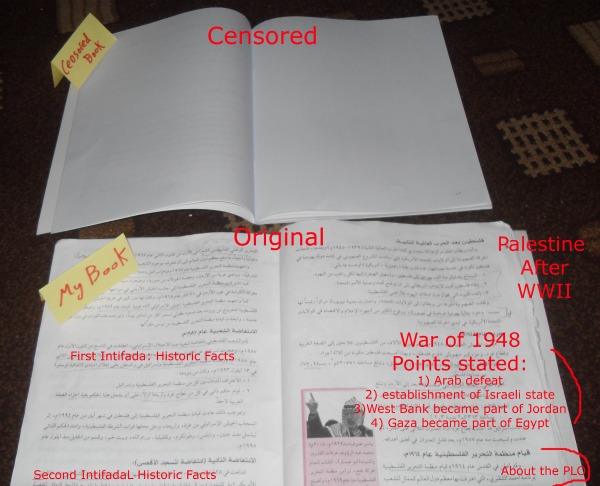
10. In ninth and tenth grade history textbooks, almost the whole book has been deleted. Whole units that address the Palestinian issue from the time of the Balfour declaration (1917) until the Nakba (1948) have been deleted, leaving blank white pages for students to stare at.
David Ben-Gurion once said in a conversation with Nahum Goldman: “That is natural: we have taken their country […] Why should they accept that? They may perhaps forget in one or two generations’ time, but for the moment there is no chance.”
We have not forgotten, and we will never be forced to forget.
This issue is dangerous beyond description, and such illegal acts must not be allowed to pass unnoticed. People must act quickly and support the schools that have refused to deal with such misleading textbooks. The JEA has now threatened to cut funding to those schools, which are in need of support.
Everyone has the right to preserve his or her identity, heritage and history. All people have the right to receive proper education at schools they attend; no one deserves to receive censored, politicized propaganda that aims to control the minds of young people in any way. We will not be forced to forget nor will we be forced into ignorance about our own identity.
Jalal Abukhater is a resident of East Jerusalem, and a high school senior attending school in Ramallah. You can follow him on twitter @JalalAK_jojo



October 22, 2011
11:35 pm
Hi, apologies – the comment about the event with Israelis and Palestinians and censorship on both sides was mine, I was accidentally logged in as 972. @ DirectRob – your point is factually true of course but i’m not sure how it changes the problem. The goal is not to reach MAC (mutually assured censorship) but that neither side would resort to this destructive approach to education and life. Yes, that starts with both sides admitting they do it, and as Ayla writes, there is indeed far more mutuality in the conflict dynamics and psychology than many people realize, while of course there is no symmetry in physical force. but the conflict psychology can be at least as important as the physical reality.
Beyond that, i’d like to completely back Ami’s editorial judgment re: comments. When these threads descend into infantile accusations and name calling, you’re just wasting everyone’s time and driving off substantive readers – please get back to the issues.
October 22, 2011
11:59 pm
@Dahlia: This article had nothing to do with Palestinian students not having any information about Israel in their textbooks or Israeli students not having information about Palestine in theirs.
.
It is about how the Israeli government is taking already published Palestinian textbooks meant for Palestinian student and literally erasing everything about them that challenges your country’s national mythology. There is no comparable analogy to this on the Palestinian side.
October 23, 2011
1:12 am
Ben Israel,
There is a marked difference between you and (some of) the others who post comments on this site. You seem to take the words of others seriously, to the extent of sometimes appearing somewhat hurt. If more people would or could do that, of whatever persuasion, I think we would all be better off.
———————–
Are you racist from what I’ve seen? Not really. But you passionately involved in what amounts to racial conflict in words. There is an “us,” “them,” and the rules are that one need be no better than the opponent. I think this an error to all the learning which kept Judaism alive for centuries. I may well not like everything mouthed by the Prophets, but I am pretty sure that they were unconcerned with the moral stance of other peoples. Now, I’m for no people corporate. But you are and, well, most people are too. But I see no reason to compare yourself with “the other side.” Within a few blocks of my abode I am fairly confident there are unpleasant things happening. And I don’t want to imitate them. If you want to nuture Israel, develop, within you, your own standards; grow them. You will, in this way, astound your opponents.
——————–
I’ve never seen the need to beat down one’s enemy in words. Rather, I am much convinced that solutions to social and political problems will come from people who think not exactly like me. I need them, want them, to do what I cannot even envision. I do not believe corporate Israel needs to follow its present path; but I do believe it is the easiest path to follow, for we have made oursleves to afraid to do anything else.
October 23, 2011
1:59 am
@ Sinjim, No the article is not about that. I am raising it because it is related and important, not as an accusation against the article but to expand on it. Let’s not think with blinders on. It seems to me that if palestinians adopt the most pernicious tactics of israel and internalize them then they are doing the job for the occupiers and the occupation has won in the deepest, darkest way. i’d advocate fighting imposed ignorance with knowledge and learning. the hideous notion of censorship, the stifling of ideas, will prove a mortal wound to israeli livelihood, ultimately. I do not wish this on palestinians.
October 23, 2011
3:14 am
whoosh. how to keep this short enough; so many important comments to respond to. Thanks, everyone. Part One:
***
I miss Deir Yassin. I trust she’ll find her way back. Her argumentative tactics are not problematic because they are impolite; they are problematic because she bullies people off the playground. And I’m not even thinking of Allesandra, actually. SinJim–regarding Allesandra, the Italian, I believed her when she said that many of her closest friends and community were Arab, and that she was troubled by their racist block when it came to Jews. She seems to live in awareness of the shadow of jews deported from her town in the 40′s. She was commenting to thank us, Arabs and Jews alike, on this site, for giving her access to a more challenging and open dialogue, and she was commenting that while 972 posts about Jewish racism against Arabs,she doesn’t see Arab sites doing this. You are right, she make a comment, that you quoted, that was unfairly overly general about Arabs based on her experience, but she was also thanking 972 for broadening that experience. It would have been very fair for anyone to challenge the overly general statement she made, and to tell her that it offended them.
***
that said, per @Ben Israel’s comment, I agree: Deir is among those who responds in amazingly callous ways to Jewish suffering, such as in Roee’s post about his innocent FRIEND who was killed at Hebrew University. She had an important point to make but did not make that point explicit, and did not even acknowledge that Roee lost a friend. That should not get her banned from a site. But it is not fair to say that Ben Israel is any more, well, anything.
***
This conflict is very, very personal to all of us. Yes, also to me, as a Jew, as a human. We need to acknowledge each other’s humanity, and it would help if we started by speaking from our own humanity. @Sinjim–you speak really well here. If you spoke as your grandparents’ grandchild, you’d move people more. I’m a firm believer in the power of hearing each other’s stories. Also, I do not think anything you are saying sounds petty, and I agree, everything here is a symptom of a larger dynamic–that’s why it matters.
October 23, 2011
3:24 am
I’m cheating on length. In fairness, I have a lot to respond to directly, here, and don’t want to leave anything unanswered.
. Part Two:
. Will post link on this thread, hopefully by end of day today.
***
@Palestinian–I absolutely want every Palestinian who wants to return, to return. I also want one state, so we can all live together, so we can know each other, so we can share cultural histories on this land, so we can access our own and each other’s holy sites, etc. Whether there are two states or one, Palestinians won’t be able to return to every same square of land. If anyone should understand the pain of your exile, and the impossibility of exact return, it should be Jews. But I’ve said this before, and I’ll say it again: I don’t want my right if you don’t have yours.
***
the most important right of return we all have, all of us, is return to our Selves. I love Greg Pollack’s comment, as per usual.
***
I’m working on a blog post (for my own blog; will post link, here) about why I feel I do have a right to be here. I’m writing it because it is a very challenging and important question, and I’m trying to answer it, for myself. I think that Ben Israel will be surprised to hear how much it does have to do with the Torah. But everyone else, please don’t judge until you’ve read. I can’t submit it to +972 because, shockingly, it’s too long
***
please let me know if I forgot to respond to something. Dahlia, thank you for your challenging and incisive observations.
October 23, 2011
3:56 am
@Ben Israel–I was really troubled to see what you wrote, yesterday, about not believing certain social issues, such as the water rights problems for Palestinians and Israel’s responsibility. That Israel controls Palestinians’ water, and that Palestinians have a water shortage, is objectively true. Within that truth is dissertations of data and everyone using numbers differently to suit their arguments and all kinds of details about which everyone can argue, but the basic problem is inarguable. Since Israel got control over the Golan in 1967, Israel has been upstream on the Jordan river, and that gives Israel control. It is among the issues that puts Israel and the Territories in a Parental-Child relationship, which is bad for everyone. A plan was put in place in Oslo, as you suggested a long time ago on another post, but it was among those annexed to be worked out over five years, and it never was, at least in part because of the 2000 intifada. I took a whole class on this subject, for novel research (I’m living in the community of BGU’s Desert Research Center, where a lot of this policy research is done). The details exhaust me, but they’re out there. BI–I don’t get into this kind of thing with the objective to criticize or demonize Israel. I get into it to take responsibility as an Israeli, and as a human. If I want to live in a place where my existence is not part of a conflict, I have to move to another place. Though, I do look forward to making a different kind of contribution, via literature; this kind of debate wears me down, because I hate living in ‘us’ and ‘them’, and there’s no way to address these issues with out those distinctions. Anyway, please: Water. read about water. It was there, even before creation. It gets us into a lot of conflicts. and if anything is going to get us out of ours, it, too, will be water.
October 23, 2011
4:10 am
I personally am very sympathetic to Palestinians’ experience, and desire that it improve.
I regard the combination of a single-state with the emphasis on what I call a “maximalist” definition of right of return as a suppression of democracy, not an affirmation.
I use the term pendulum swing to describe the response of “I don’t care what affect it has on Israeli self-determination – majority Jewish, Jewish in character” to respond to the institutionalization of “I don’t care what affect Zionism has on Palestinian viability and culture.”
Its the “I don’t care” part that is the problem.
And, I disagree with strongly with Ayla’s hope for a single state, as I don’t believe that it optimizes self-determination, that it in fact imposes on majorities, as the majorities consistently convey a desire for national definition of sovereignty.
The selection of jurisdiction is a selection, not a necessity.
The geographic range of jurisdiction has changed radically over the past century and a half, and currently, and does not match any party’s assertion of what is authoritative.
For example, Gaza was not part of the British mandate for Palestine, while Jordan, Syria and Iraq were.
That is not the jurisdiction requested to comprise a single state.
To go back to 1917 or 1922, a century after the fact, is stressing logic.
Democracy is a present phenomenon, not a past one. It is current people that self-govern, not past.
One cannot govern from the grave, but only from current need, viability, and plausible reconciliation.
One-person one-vote in defined borders on the basis of the green line, not moving borders, not a one-way heart valve for residence, not a fantasy of a single state.
October 23, 2011
4:37 am
@Ben Israel–p.s. you raised an important question about why this post is about East Jerusalem and not Israel Proper. East Jerusalem is in the worst position–they aren’t in the Palestinian Territories, and they aren’t in Israel and don’t experience the imperfect but superior rights of those who are. I have several friends from there who had never once met an Israeli Jew out of uniform until they came to grad school in Israel. In Jerusalem! This is a mad world we live in! The question you raise is important to me because you’re asking a bigger question: how should this conflict be taught, generally. I would say that it will be ideal–and this ideal is not so unrealistic–when everyone on this land is learning all the simultaneously true histories. I grew up in the U.S. in a school system that was basically half black, half white, and we sat together and studied our slavery and more recent civil rights history, and talked about it, together. It was hard. The conflict here is NOT PARALLEL to the U.S. civil rights history, and everyone here has a claim to victimhood (sigh), but the ideal of containing difficult histories, together, is a good model. Sadly, at the moment, we’re going in the opposite direction. Hopefully, the result will be an awakening. This post has been shared nearly 400 times so far. Is that a record?
October 23, 2011
4:45 am
Tp all who are still confused: the occupation is a racist enterprise. There are Jews and Palestinians living in the West Bank, for example, but they are treated differently based on their ethnicities, hence the racism. Anyone who supports the occupation or the rest of Israel’s treatment of the Palestinian people is necessarily aiding and abetting racism. I don’t believe deleting comments or banning people is particularly effective, but the people who run this site set the policy, not me. If racism is not allowed, then there should be no exceptions.
.
And Ayla, Alessandra quite clearly stated that all Arabs, not just her supposed friends, hate Jews and that those who are commenting here who don’t hate Jews — while great — are not representative of Arab public opinion, which again is uniformly hateful towards Jews. Deir, in fact, did call her out, and Alessandra played whiny victim of her “bullying.” No one else spoke up, certainly not the mods who are so offended by rather mild swear words.
.
As for the rest of what you say, no, I would never share stories of what happened to my family in the Nakba in an online space that hosts neo-Kahanists. This may come as a shock to all, but I have no desire to subject myself to their feedback on this subject.
October 23, 2011
4:56 am
@Dahlia: Yes, there’s benefit for Palestinian students to understand Israel as it’ll help them understand how to overcome the oppression they struggle against. However, and this point is absolutely essential, Palestinians are the victims of an unrelenting effort to erase their cultural presence in their homeland. What you’re doing is faulting them for not taking the time in their schools — which are among the prime institutional transmitters of said culture — to teach their children about the perpetrator of that ethnocide. If you Israelis are honest with yourselves, you would know there is no way on this Earth that any people in the Palestinians’ position would do otherwise.
.
It’s possible to have a Palestinian school curriculum that teaches children about the Israeli people, and perhaps one day it will be reality. But not in a climate of occupation, dispossession, and state-sanctioned vigilante violence. Not in a climate where Israel passes laws forbidding their schools from teaching anything about what your political forefathers did to their grandparents. Not in a climate where your government defaces textbooks in order to prevent them from learning their own history.
.
You may continue dismissing this position as anti-intellectual. Certainly as a Jewish citizen of Israel, you are granted enough privilege to view it this way. For Palestinians, however, the calculus is, after all is said and done, about self-preservation and resistance to capitulation.
October 23, 2011
4:59 am
@sinjim – 1) swear words, mild or not, are swear words nonetheless. They are particularly “un-mild” when a moderator asks to stop using them, but the usage continues.
.
Speaking for myself, I am not offended by Deir’s language – but others might be. Hence the comment policy, which she blatantly violated, despite numerous warnings.
.
As for other cases of comment deletion, may i remind you three things: a) we are all volunteers, who don’t catch everything. We have day jobs. But we try.
.
b) let’s remember that I, along with a few other founding members, founded +972 specifically so voices like Jalal’s can be heard. I think it’s a shame that instead of focusing the discussion on his excellent post, you would rather invest your energy on comment moderation, which, if I had to do it again – I would.
.
c) I have said before, and I’ll tell you again, I have personally deleted both Palestinian and Hasbara trolls on this site, and banned them completely. Since I get comments such as yours from Hasbara trolls as well, as if I’m targeting them out too – I presume I and others on the site are doing something right.
October 23, 2011
5:47 am
@RichardNYC–didn’t see your note to me near the beginning. Not meaning to make Nabka equivalent to Holocaust–I actually don’t believe in comparing any two tragedies; each is different. Certainly, those two are different in many important ways. Still, they happened, not coincidentally, around the same time (survivors of both still live), and both live large in both populations. Anyway, the parallel I was drawing was about having traumatic history removed from your own text books, in the place in which that tragedy took place, and continues to play out.
***
@Palestinian–I was looking back to see why you questioned my belief in your RTR, and I think it’s because of my question to you about the 67 borders. I was trying to understand if our presence here is an occupation no matter what changes, or what would need to happen for us to still be here and not be occupiers, to you. I think that’s off topic for this post, though it’s obviously connected, but I wanted to clear that up.
@Simjim–I’m not sure why you would think I would be surprised that you wouldn’t want to share personal, family tragedy here and subject yourself to comments. Of course I do.
October 23, 2011
6:26 am
@Ami: I have been visiting this site since shortly after it was put up on the web and regularly see the types of comments that are allowed. That I chose this particular post to make my complaint rather than another one is not a waste of my energies, since as I said, the systemic moderation failures are a symptom of the problems of English-language (Zionist) discourse on the subject of Palestine and Israel in general.
.
The “if both sides are complaining, I must be doing something right” logic is almost always without merit. Rather than equate my complaints with those who you term “Hasbara trolls,” perhaps you could ask yourself why you moderated Deir’s comments but ignored RichardNYC’s racist reply to Larry, for example. If the hows and whys of its offensiveness are unclear, I am more than happy to explain.
October 23, 2011
6:36 am
@sinjim: I’ll go back and check richard’s comment. if i find it to be a violation, i’ll warn him as i did deir.
.
You are free to disagree with my logic about both sides complaining, and I am free to disagree and say that my work does have merit. (the key word in your comment is “almost”).
.
This is the last I will comment on comment moderation here on +972 in Jalal’s post.
.
Thank you.
October 23, 2011
7:40 am
@Sinjim @Alya
maybe I have to express myself in a better way. I’ve seen you quoted me and a I realized that my limited English written ability is creating misunderstandings (plus all my grammar errors).
When I said “arabs hate every Jews even if they do not know any”, I was probably too naive for the average people writing on this website. It’s clear i do not know all the Arabs in the world (nobody does, it’s impossible), but all those I know (and I knew) in Italy, Morocco, France, England, Tunisia, Lebanon, and some Palestinians too, were really speaking very heavy words against Israel and Jews. Specifically Morocco friends (here in Italy and in Morocco) speak clearly the same language of all pro Palestine propaganda. The fact that most surprises me was when I asked some of them (again, I know they cannot be representatives of all Arab world) if they were sad about the victims of Abruzzo earthquake in Italy (having some of them the Italian nationality), yes they are, but are much more moved by everything’s happening in Gaza. Ok, it is not a political analysis mine, but it is a widespread feeling. We say in Italian that ci sono due pesi e due misure (it means 2 different ways to weight things). That’s what I meant to say. I’d be very happy to know it is not true what I’ve said. and I’m trying, with those friends who are more open, to discuss the matter with a wider view. Again I wrote that there are some very right wing Jewish sectors in Italy that are doing the same dirty campaign. That’s a matter of fact. And finally, I’m talking about Italy and my limited experience. there is not only USA and Israel in the world, remember we have an opinion too.
October 23, 2011
8:04 am
@sinjm: you wrote “her racist lies”.
I think there was no racism in what i said. to me racism is something else. yes, I was not precise, I should have been writing “all the arabs I know hate Jews even if they do not know them” (and that never met one, both in their homeland in Morocco because most of the Jews flew away in the ’50-’60 – and most of the immigrants here in Italy were babies at that time – both in Italy because there is a very small jewish minority here, mostly concentrated in big towns like Milano and Roma). So don’t call me racist, because I’m not. I’ve just wrote what I have experienced. and that i do not like this attitude. to be more clear: I work very hard every day with every people I meet to change the language and prejudices against the big Muslim community in Italy. there is a lot of prejudice, and mainly ignorance about it. as I’m dealing daily with it, you have no right to call me racist. You, as Deir, do not know me. so don’t judge me as i do no judge you and your posts.
October 23, 2011
8:29 am
Dahlia,
Before answering you I had to read a bit more. I guess view of the Palestinian intellectuals you met confirms the view of the Unesco report:
.
“There is considerably more evidence that sensitive issues are ‘ducked’ and omitted from the curriculum than there is evidence of incitement.”
.
It does not surprise me that in the text book after the self censorship and the Israeli censor only blank pages are left. So in a sense I think you are right. The fact that recent history and recent geography is too hot to clearly write about in Palestinian text books is part of the same problem.
.
For everyone interested in more context:
http://ddp-ext.worldbank.org/EdStats/ISRgmrpap10.pdf
http://unesdoc.unesco.org/images/0015/001515/151551e.pdf
October 23, 2011
12:20 pm
@Alessandra: I never once called you a racist, but I did say that your comments were racist. That’s not the same thing. I won’t judge your character, but as a commenter here, I have every right to judge your comments and respond appropriately.
.
You’re the one who came in here with your “I’m new to this and I don’t speak English very well” act and then followed that up with the astounding claim that all Arabs hate Jews, and provided anecdotal evidence that this is true for every single Arab you know. But even putting all that aside, for the sake of argument, let’s accept your claim that all the Moroccans you know are virulent anti-Semites. How would you describe the act of then making a gross generalization about all Arabs based on this “fact”?
October 23, 2011
12:41 pm
Ok. you’re right, one should never generalize. perfect. I got the message. and i also think it is a waste of time trying to explain again and again what I meant, giving other details or examples. also it is not interesting for any of us. I’m sorry I interrupted your conversation. continuate pure a parlarvi addosso! ciao
October 23, 2011
2:15 pm
@SINJIM
Please don’t try to accuse people of racism because they’ve noted racism against Jews (Holocaust revisionism etc.) You’re just making it clearer that you view “racism” as a useful slogan and not a moral problem.
October 23, 2011
2:17 pm
@AYLA
“Not meaning to make Nabka equivalent to Holocaust–I actually don’t believe in comparing any two tragedies; each is different.”
–>Except that you compared them directly. Please dispense with the doublespeak.
October 23, 2011
3:07 pm
@RichardNYC–I just spelled out exactly what, to me, was parallel in my argument and what wasn’t. I did so because upon reading your comment, I went back to read mine, and could see why someone might interpret it as you did, so in response, I cleared it up. You can disagree regarding what I said is actally parallel, but to continue to read it the way you did originally suggests, again, that you have a real problem listening.
*
All–I said I’d be posting a blog post here, but I’ve realized throughout the day that I need to talk less at this time. Maybe another time.
*
@Sinjim– somewhere here–I am not able to find it now–I remember you saying something about how these comments were not for/about me learning about the conflict. Something like/about this? Sorry If I’m remembering incorrectly. My memory of this made me want to respond by saying: I am here to learn, and I believe it would be ideal if we all were. The more we understand about different experiences and perspectives, the more compassionate we become. I am here to learn from everyone. None of us carries the whole truth alone; for anything approximating truth, we need each other.
October 23, 2011
8:09 pm
@AYLA
“but to continue to read it the way you did originally suggests, again, that you have a real problem listening.”
–>No, I simply recognize that once said, over and over again, “Nakba=Holocaust” has a corrosive effect on reality, and that qualifying this kind of statement ex post doesn’t change its initial effect. There’s a reason BDS repeats the same slogans over and over again. Its a propaganda tactic: (1) find a message (2) repeat it as much as possible until people start to believe it.
October 23, 2011
9:44 pm
You are remembering incorrectly. I never made claims about carrying the whole truth. You were claiming that Deir bullied people, while refusing to recognize that the racism she was responding to was in reality bullying. You were also saying then as you’re saying now how much you value learning from all people. My response was that there is no value in having “educational conversations” with anti-Palestinian racists, who will just spout their racism and Nakba denial.
.
You are speaking from a place of privilege which is automatically granted to you by Israel because you are Jewish. I was just providing a Palestinian counter to your opinions. I certainly never stated that any of the stuff you attributed to me.
October 24, 2011
6:30 am
@Simjim–oh, I never thought you said you had the whole truth! I was making a point about truth–and how we need each other to approximate it–in response to the other points you made, as best as I could remember them.
*
Okay–now I more understand what you meant about “educational conversations”. So, per your points: Yes, I understand how offensive it is for someone to deny Nabka to someone whose grandparents fell victim to it.
*
I do not seek to be educated by Ben Israel, or anyone with his ideology, except to understand what that ideology is so that we know what we’re up against. On that particular point about 1948, sadly, Ben Israel does not stand alone, or even represent an extreme view. I am sad to say that on that one point, he represents the Israeli normative understanding. Therefore, it is very important for his view to be in this discussion (in general), because without it, our discussion is not sufficiently challenging in terms of understanding what we’re up against when we think about how to overcome it.
*
I understand completely why Deir was upset. That’s why I said I wished it hadn’t been that discussion that did her in. But in fairness to the moderators, she treated a lot of people that way over things that were not offensive (and I’m not talking about Alessandra–I think she ended that discussion wisely! I’m talking about other people I’ve seen disappear in the past). Also, I miss Deir, here.
*
What can we all do to turn the time we spend here, and the energy we spend here, into an effort to do something to change the situation?
*
You are certainly right about my place of privilege. I take that as a responsibility.
October 24, 2011
9:14 am
@sinjim, i certainly understand your point if you are viewing education as endorsement. Or if you view learning as an intellectual pursuit for people of leisure. I do not believe in either. Education and knowledge are the only genuine weapons of any struggle, unless you believe in violence. I do not. When the occupation is over as it inevitably will be (all regimes of force are destined to crumble) you will have to build your own society. It should be built on integrity in the pursuit of truth. But I’m going to stop because it’s really not for me to moralize – i say this only b/c i’m devastated that we fail to do this in israel and b/c i know both sides will be better off, individually and together, if they face reality whether or not we like it. we’ll probably come up with more feasible solutions, too.
October 25, 2011
4:06 am
Just an observation but if the Palestinian residents all participated in the Jerusalem municipality and mayoral elections they’d radically alter the reality of the city. I understand the principle against participating but I believe in means to principled ends are more valuable than just standing on principle. What could be a better demonstration of the “united capital” of Israel than half the eligible electorate voting in a nationalist Palestinian council (and maybe mayor too)? Then the struggle with the book censorship can take on a whole new and powerful dimension in the conflict for Palestinian rights. I would be quite interested in reading Palestinian views on this.
October 25, 2011
7:31 am
@PHILOS Palestinian residents of Jerusalem aren’t given Israeli citizenship, they hold Jerusalem ID. Therefore Palestinian Jerusalemites cannot participate in the Settler/colonial municipality of Jerusalem.
October 25, 2011
8:21 am
Jalal, I must correct you. Palestinian Jerusalemite’s are considered “permanent residents” under Israeli law, which entitles them the right to vote in local municipal elections
http://www.btselem.org/jerusalem/legal_status
So I’d welcome more views on this issue. The “hasbarists” have taught me the phrase, “lawfare”, with regards to the Palestinians pursuing their rights via legitimate legal channels; here’s another avenue for the Palestinians to force Israel into an awkward position. Accept the election results (at least half the municipal council will be Palestinian, if not the mayor as well) or annul them and impose a governor. Well, that’s how I’d imagine it playing out anyway
October 25, 2011
9:44 am
@Philos: Do you really think that Palestinians in Jerusalem are losing their rights because they don’t vote? Let’s remember those with citizenship vote in Israeli elections and they are still shut out of the governing process. What makes you think Jerusalem politicians, who are already more extremist than average, would behave any different?
October 25, 2011
12:57 pm
Sinjim, I hate to be contrary but Palestinian Israeli voter turnout has been on a declining trend (http://www.idi.org.il/sites/english/ResearchAndPrograms/elections09/Pages/ArabVoterTurnout.aspx) and their voting patterns have been fractured along party affiliation lines. The Palestinian Israelis vote for a variety of parties ranging from Balad to Labour and even Kadima (surprisingly enough). This fractured voting pattern is reflected in the composition of the Knesset. Also voting in national elections tends to have less systemic effect than in local elections especially because in Israel no single party can form a solid majority.
However, in Jerusalem the voter turnout among the Palestinian residents has been negligible for years (indeed, if the chart I posted above included these residents than overall Arab voter turnout would be lower on average). If the Palestinians of Jerusalem, for example, voted for one party and one candidate that would have a radical effect on the balance of power within the municipality. If you want an example of how radical a municipal administration can be then I suggest looking up Rudy Guiliani in NYC; he achieved things that no President of the USA could comparably achieve. That’s the nature of the beast. I mean it’s certainly an idea I think Palestinian’s in Jerusalem should seriously consider.
October 25, 2011
3:22 pm
Yes, Palestinians don’t vote all alike, just like Israeli Jews don’t vote all alike. They’re human beings, after all. And even if you discount present voting patterns, the fact is that Palestinians used to vote in Knesset elections in comparable numbers to Israeli Jews. That participation in elections is decreasing demonstrates just how frustrated they are with the unresponsiveness of the political system.
.
Your Giuliani example doesn’t hold water, imo. He was able to accomplish what he wanted because he won a majority in NYC. The Palestinians in East Jerusalem cannot do that as Israel has flooded the city with settlers, making them only a third of the population in the area administered by West Jerusalem.
.
Your argument is no different than those who said that people should go out and vote under Mubarak’s regime. In the end, it didn’t matter because the system was designed so that no one else could achieve power. The same is true in East Jerusalem. The entire system there is rigged against Palestinian political participation.
.
What is needed is not a get-out-the-vote effort, but rather a massive civil disobedience campaign that would bring the West Jerusalem government to its racist knees.