
The approval of the ‘Prawer Plan’ concerning Bedouins in the Negev desert demonstrates that Israel’s principle of divide and rule, which has been perfected in the West Bank and Gaza, also applies to citizens of Israel living inside 1948 boundaries.
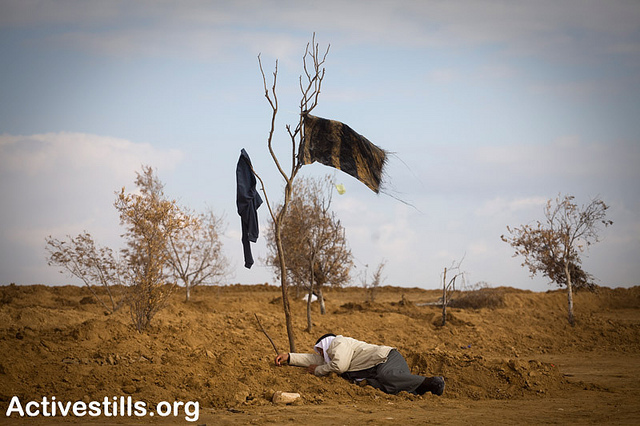
Bedouin resident in the village of Al Arakib after it was destroyed by Israeli forces (Photo: Activestills)
Perhaps the most violent component of Israel’s control over non-Jewish inhabitants since the founding of the state has been the (unequal) distribution and allocation of resources. In Area C of the West Bank, the area designated for full Israeli military and civilian control by the Oslo accords which makes up the majority of land in the occupied territories, Israel has demonstrated its ability to control the Palestinians of the West Bank through the allocation of resources such as water, electricity and building permits. In the West Bank village of Susya, for example, Palestinians are forced to purchase water at rates close to 10 times higher than an Israeli living in Tel Aviv. Their wells are destroyed by Israel’s civilian administration due to lack of permits which are almost impossible to obtain and many living structures are deemed illegally built and subject to demolition.
The deprivation of resources leaves Palestinians helpless in the face of bureaucratic measures which even Kafka could not have imagined. The point of this system is clear, make Palestinian life in area C villages so unbearable that they their only option is to move into cities in Area A, under Palestinian Authority control. The unclaimed land is then expropriated by Israel using out of date Ottoman laws. This amounts to an effective use of the classic colonial practice of divide and rule given the fragmented nature of Area A cities in the West Bank and the settlements which form almost natural barrier between them.
Interestingly, this is not just happening to West Bank Palestinians. Something similar is taking place to non-Jewish citizens inside Israeli territory. This morning, Israel authorized the controversial “Prawer Plan” concerning the resettlement of Bedouins in the Negev Desert.
Authored by Ehud Prawer, head of the Policy Planning Department at the Prime Minister’s Office, the report contradicts an earlier report on how to resolve settlement issues in the Negev desert. The first report, penned by former Justice Eliezer Goldberg, demanded that Israel make every attempt to respect Bedouins living in the Negev, noting in particular the need to allow them to remain in their villages and homes.
The Prawer report, which has been criticized by the Israeli civil liberties outfit, the Association of Civil Rights in Israel, has proposed that as many as 30,000 Bedouins be removed from their homes and villages, against their will and for little reason. Removal has been approved by the government according to a report in today’s edition of Haaretz (Hebrew).
The decision to evacuate as many as 30,000 Bedouins and relocate them to large Bedouin towns such as Rahat, Khura and Ksayfe with some financial compensation has been called by some a “declaration of war on the Bedouin.” It is actually a long time coming if the experience of the Bedouin village of al Arakib is any indication. The village has been destroyed almost 30 times by Israel in an effort to make way for a new Jewish National Fund forest in its place.
During the height of the hopeful J14 tent protests this summer, demands for better Bedouin rights could be heard filling conversations even in the heart of Tel Aviv’s Rothschild boulevard tent encampment. However, hope has taken a backseat in recent days as many of the tent protesters’ demands for Bedouin rights have been dropped, ignored or simply disappeared.
Israel policies of divide and rule, based on classical colonial principles, are not limited to its occupied populations. The adoption of the Prawer plan by the Israeli government has shown that Israel uses this mechanism of control to subjugate all non-Jewish inhabitants under its control from the Jordan River to the Mediterranean Sea regardless of the status of their citizenship.



September 13, 2011
2:04 am
@Deïr Yassin
your last response is out of relevance of what I have said…and your answers are so “intelegent” because you are so smart and brainy!
September 13, 2011
3:41 am
@BenIsrael–language matters. When you say “The Bedouin Problem”, imagine if it were “The Jewish Problem”. We all know what language was used for that solution… I’m sure you didn’t mean anything that violent, but if you always imagine how something would sound to you, it helps to see the affect our language has. That said, I will say this: It is true that nomadic lifestyles are being challenged outside of Israel as well, including in Africa. I feel the same way I do about the issue here when the issue comes up elsewhere: I find it heartbreaking, and environmentally devastating as well. On one hand, I would say that the reasons Israel wants to settle her nomadic population is not ENTIRELY about wanting Jews to over-populate Arabs per square dunam of land, though I’m pretty sure that’s the primary motivation, here. But we, as Jews in Israel, have a responsibility to be MORE sensitive, not LESS, to indigenous populations and lifestyles, as well as to immigrant lifestyles (we’ve made similar mistakes with Ethiopian Jews immigrating — forcing them into an Ashkenazi Box that drains the spirit right out of their families and communities, rather than learning from them and respecting them — people who were living strictly by the Torah for so many centuries, without Rabbi interference). We need to be more sensitive here than any other place on earth, not less. And @DEIR, if you’re still reading: I’ve decided to respond to something you’re addressing, even though you’ve done so so disrespectfully. I hear that you feel that any jew who immigrates to Israel is the enemy. Although I’m guessing that you and I agree about most issues concerning Palestinian rights and injustices against Palestinians, I don’t believe that jews do not belong here (though of course I don’t believe it is OUR land over yours, and I am not here with any kind of jewish agenda). I believe that to right the wrongs, jews do not have to leave; we all have to live here together with open hearts. I also believe we’re the same people, and that things have gone tragically awry, and that you and I, DEIR, are in a position to do something about that, because we are talking to each other. And I believe that we have to start from here, now, in the present. We can’t go back and correct each wrong. We can listen to each other about the past, and carry each other’s stories, and grieve and express remorse, and then we need to move forward. It is now September, 2011, an auspicious month and time. What are we going to do? Are you just going to hate me, and make me the enemy for being a jew living in the Negev? Are you going to decide that I have taken a Palestinian’s place by being here, when in fact there is room for all of us? Or are we going to join forces to do something powerful, for our yet unborn children?
September 13, 2011
10:40 pm
Ben Israel, do you think because something is perceived as a problem in an Arab country that that legitimates Israeli action of a similar approach and attitude. One should notice that the Bedouin issue in the Negev is not the subject of very much criticism internationally or in the intra- and inter-Arab sphere. Why? Because what “comes around” will go around in this issue. Such criticism will lead to similar criticism of similar policies in their countries.
Are the Bedouin Palestinians? The more Israel pursues these sorts of policies against them the more likely are they to become more and more Palestinian-identified. Why do all this to them? There are always reasons, but weren’t there always legitimate reasons to persecute the Jews as well?
This is a group which was always ambivalent about the struggle against Israel and many of them did serve in the Army. This is likely to be less and less of them in the future which is not in the interest of the State, which depends on their tracking abilities to maintain the security of its frontiers. There is nothing to be lost, except prime real estate, by recognizing their unrecognized villages and towns and everything for the State and its people, Jewish and Arab, to gain.
September 14, 2011
1:17 pm
look at yossi gurvits’ post about prawer here. it was posted yesterday in j14 site in it’s hebrew verse, so apparently it’s still an issue.
October 6, 2011
3:53 pm
[...] Israel approves plan to uproot 30,000 Bedouins | September 11, 2011| 972Magazine [...]
October 10, 2011
2:20 pm
[...] Israel approves plan to uproot 30,000 Bedouins | September 11, 2011| 972Magazine [...]
October 10, 2011
3:19 pm
[...] Israel approves plan to uproot 30,000 Bedouins | September 11, 2011| 972Magazine [...]
November 23, 2011
2:56 pm
Has anybody ever seen this “settlement”? If you drove by it would appear to be a auto junk yard. A conglomeration of flimsy jury rigged shacks that are not fit for habitation by farm animals much less humans. The Israeli government on many occasions has offered these people the same type of living arrangements as other citizens of Israel.They have constantly refused that housing claiming their way of life would be compromised.
For them their way of life as lived in the 18th and 19tcenturyry is in fact over.The national boundaries of modern states will not allow these people to wander back and forth across those lines. Jordan, Israel and other countries in the region are putting a brake on those activities.
The real question is are these people willing to come into the 21st century,get educated Incorporated into modern society, give up smuggling,grazing across national boundaries and partaking of modernity. If not they will be relegated to a very dim future.
While its a romantic notion of the Bedu riding like the wind and living a “free life” out on the desert its now a total fairy tale, believed in by many people in the west who saw films on the nobility of the nomadic way of life.
April 23, 2012
2:36 pm
[...] [...]
April 23, 2012
2:38 pm
[...] [...]