

Israeli police and army mount a massive operation to stop Israelis from reaching the special Friday protest, marking seven years of popular and joint struggle in Bil’in
In the beginning there were engineers, soldiers and bulldozers. It was after the International Court of Law in The Hague had already barred construction of The Separation Wall within the West Bank, and before the Israeli High Court of Justice found the Wall’s route in Bil’in illegal. It was after someone somewhere decided that more than 2,000 dunams of the village’s agricultural lands were to be annexed to Israel by force, and before countless people would be arrested and injured, and two killed. The engineers marked which trees to uproot, and the villagers removed the marks. The soldiers came to disperse the demonstrations, and the demonstrators tied themselves to the olive trees. The bulldozers started tearing the land, and the activists stood in their way. Day after day. A battle for every tree and every yard.
Seven years have passed since the first engineers, soldiers and bulldozers appeared in Bil’in. Seven years since the local Popular Committee against the Wall and the Settlements was founded, drawing from the experience of villages such as Mes’kha, Bidu and Budrus. Seven years since the Israelis and internationals were first invited to join in on the popular struggle. In the years that passed a fence was erected, causing incredible damage, and recently torn down in favor of a new wall, in a route which gives the village back some of its lands – but not all of them. The village has gained international attention and has become an example of a people’s unarmed struggle for liberation – a struggle which goes on to this day.
Targeting Israeli solidarity
To celebrate the struggle’s anniversary, the popular committee issued a special call, inviting Palestinians, Israelis and internationals to join together and raise the flag once more – focusing on the demand to release Khader Adnan on the 62nd day of hunger strike, as well as prompting Palestinians everywhere to join the popular struggle against the occupation.
In the past, events such as this would cause the army to react with extreme measures of oppression against the village – night-time raids, arrests, curfews, etc. However, in recent years it seems that the greater part of Israel’s attempt to crush the annual special demonstrations has been aimed mostly at Israelis. This was also the case yesterday, as mass police and army forces were deployed to the Ni’lin checkpoint in order to intercept the bus and the cars on their way from Tel Aviv. Upon being recognized as activists (usually five in a car, none of them religious, hence probably not going to the nearby settlements), the Israelis had their IDs taken and registered, and were warned not to proceed to Bil’in through alternative roads, as the entire region has been declared a closed military zone.
This was but one part of a well coordinated operation: all roads leaving highway 443 into Palestinian villages were blocked and guarded with riot police. A bus leaving Jerusalem was intercepted en-route, ten activists on it arrested, and the bus sent back. Private cars were turned back in others checkpoints, and while several managed to slip through – some had to give up on the demonstration. The bus from Tel Aviv eventually unloaded in the middle of highways 443, and activists climbed a hill and marched through olive groves to nearby villages, where they took taxies to Bil’in, dodging army patrols. The bus driver was arrested shortly after, without cause, only to be released later in the evening.
As a result of the police’s actions, only some 60-70 percent of the 150 Israelis who set off to join the demonstration actually managed to get there, and fulfill their basic right to protest. As all this did not even slightly change the nature of the demonstration, which was very similar to the regular weekly demonstrations, one might wonder why Israel would go to such great lengths to prevent Israelis coming to this specific demonstration.
A possible answer to this question was offered by Noam Sheizaf, who at the end of the demonstration assessed that the whole point of the police actions was to prevent “regular” Israelis – as opposed to the die-hard activists who travel to the West Bank weekly – from meeting with Palestinians. “This policy is all about forcing Israelis to visit the occupied territories and meet Palestinians only as enemies”, Sheizaf told me. “The popular committee went to great lengths to invite people like myself here – sending e-mails, opening a Facebook event, etc. – and the police went to great lengths to prevent me from taking the very basic step of showing solidarity with the village.”
The struggle continues
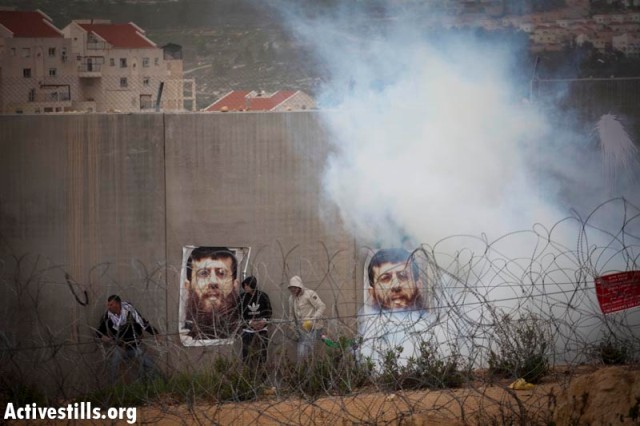
Those who made it to Bil’in joined some two hundred Palestinians, and marched from the village centre to the route of the old fence, now dismantled, where speeches were made. From there demonstrators marched to the new wall, with activists wearing Khader Adnan masks and prison service uniforms leading the way. A leader in the popular committee mentioned that while no-one in the committee is a member of Islamic Jihad, they are all in support of Adnan, who joined a demonstration in the village in 2005.
Once at the wall, several demonstrators were able to cross the barbed wire protecting it, and put up pictures of Adnan and Palestinian flags on the wall. It wasn’t long before the army started shooting tear gas and spraying the demonstration with ghastly “skunk” water, which resulted in the gradual retreat of the majority of demonstrators and the beginning of stone-throwing by the village youth. The demonstration ended after two hours in atypical cold winds and little rain, with no serious injuries or arrests. As usual, demonstrations also took place in Ni’lin, Ma’asara, Qadum, Nabi-Saleh and other villages.
[youtube]http://www.youtube.com/watch?v=M6iJGzz7oTk[/youtube]