

Ibrahim Bornat, artist and activist from Bil’in, was standing next to Mustafa Tamimi when Tamimi was shot in the face with a tear gas canister at close range by an Israeli soldier. Speaking through a translator to Ben Lorber of the Alternative Information Center, Bornat describes the moments before and after Tamimi was critically injured on Friday, December 9:
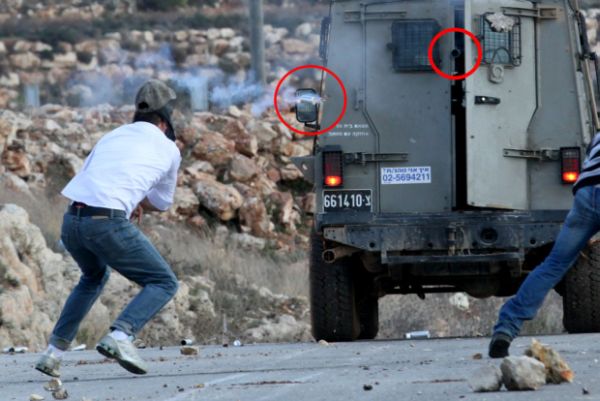
Mustafa Tamimi, a moment before he was injured. The weapon that shot him is circled in red, as is the tear gas canister that caused the fatal injury. Ibrahim Bornat can be seen in the edge of the frame. (photo: Haim Scwarczenberg)
Mustafa and I were alone, it was just the two of us, with the rest of the protesters quite far behind, and we were chasing the jeep and telling it to leave. We got separated from the rest, because the soldiers threw almost 50 tear gas canisters at once, so the whole protest was pushed back. The tear gas went over our heads and we got closer to the soldiers, shouting at them that they had thrown enough.
The jeeps turned around to leave as they were shooting gas behind us. One jeep, however, lingered and seemed to be waiting for us to get closer. As we reached the jeep, the soldier opened the door and shot two rounds of tear gas. I think I saw this soldier’s face, but Mustafa definitely saw and whoever he is, Mustafa knows best.
Mustafa pushed me down, and one canister that was aimed for me flew over my head. The second one hit Mustafa, but I didn’t know it hit him at first because I thought ‘for sure they wont shoot at us from so close.’ I thought he had just ducked down, and then I thought that maybe he had just passed out from the gas, because there was gas all around him.
I went to him, laying face down on the road, and I turned him over and pulled the cloth off his face.
Of what I can say about it, it is worse than words can say. The whole half of his face was blown off, and his eye was hanging out, and I tried to push his eye back up. I could see pieces of the inside of his head, and there was a pool of blood gathering under him. His whole body was trembling. It started from his feet, then up to his arms, then it reached his chest, and then his head, and then a gasp came out and I’m sure at that moment he died. He gasped, and let out a bunch of air, and I knew at that moment his soul had left. I have seen many people, not a few, die in front of me, and I know death. Maybe later on they revived his heart, but I knew that his soul had left.
I ran back to get people, because we were far away, but there was no ambulance around, so the people around gathered him and put him in a servee [a communal taxi] and tried to leave. The soldiers stopped the servee and tried to arrest Mustafa, but when they saw that he was on the brink of death, they began to act as if they were humanitarian, to revive his heart. But what is ‘humanitarian’, to shoot someone to kill, and then to try to help him? These were the same soldiers from the jeep that shot him. They shot him, then say they want to help him. What they really did is prevent him from leaving.
The body lay on the ground for half an hour. They wanted Mustafa’s ID, and they also wanted the ID of his mother, of another family member, and of Bassem Tamimi’s wife, because these people wanted to go out with him too… They were doing some kind of medical treatment while he was lying on the ground, but this was no hospital, and what he needed was to be taken to a hospital. He should have been flown out in that moment. There is nothing you can do for him on the street there.
I was with the family the whole night afterwards, especially with his father, who is very sick and on kidney dialysis. Mustafa’s family believed there was still some hope, so I did not want to tell them that I knew he was already dead. His father is very sick, and kept falling asleep and waking up again, and we didn’t tell him much at first, only that Mustafa had been shot but that, God willing, he would be okay. There are some things that are hard and give you no hope, and then there are some things that are hard, but there is something nice about them. Martyrdom is something that is hard, but it is also honorable, and that gave his family a lot of comfort.
I knew Mustafa as a brother in the resistance. We were close in the resistance to the occupation. Anyone who comes out with me in our resistance to the occupation is close to me, as close as my mother, brother, or father, whether they be Palestinian, Israeli, Jewish, Muslim, or international. He was free, and a person who is free fights the occupation. That’s the thing I can most say about him- he was freedom.
We defend ourselves through strength, through courage, through our right to this land, through steadfastness. The occupation, to defend itself, has to kill people. But we defend ourselves with our right. This is my philosophy.



December 12, 2011
3:01 am
Mashallah alayk ya Ibrahim. I am honored to be your sister against the occupation. I am so glad that so many people are writing about Mustafa and remembering his martyrdom. He did not die in vain.
December 12, 2011
3:27 am
While I consider the killing murder I don’t think publishing a one-sided account of what happened conducive to anything. They were engaged in rock throwing. Palestinian youth need to make a decision; either they are engaged in lightly armed rioting to protest the occupation, or in unarmed peaceful protest against the occupation. They can’t have both.
I don’t hold Israel to a double moral standard and I will not hold a double standard to Palestinian resistance.
December 12, 2011
3:36 am
You clearly do. Where exactly are the other countries where throwing a rock gets you killed because, as far as I see, outside of Arab dictatorships, most of Africa and maybe China, security forces do not retaliate to rock throwing with live ammunition or point-blank tear gas cannisters. Rather they use shields to deflect the blows and then try and arrest the culprits.
December 12, 2011
5:04 am
@Philos,
Every account is biased. As a primary witness this man’s account is important. I would consider it an omission if we would not listen to the people closest to the incident.
December 12, 2011
6:22 am
@Philos
It’s a first hand account.
Will we get an account from the Israeli army today, instead of tweets in poor taste or mentioning that he may have had a sling in his pocket or scarf over his face?
What is known, is that a young man is dead. This man was murdered, shot in the face at close range. The soldier may not have intended to kill but the jeep did slow down just to fire at these two men.
Men defending their land from theft and colonisation by religious fanatics.
Not only did the soldier break Israeli law by firing at the head at such close range, but why didn’t the armoured jeep just drive away?
And I do not doubt for one minute that the soldiers initial intention was to arrest Mustafa and that the delay indicated can be verified by those present.
December 12, 2011
8:26 am
thank you DirectRob and MarkW. It would be so good for us all if we could listen to each other and grieve the senseless losses to this conflict *together*, rather than seeing every single piece of news and making one side look good or bad. This isn’t a PR war; it’s real life, real lives; someone’s real son, brother, friend.
December 12, 2011
10:03 am
Hatherstone, you’re kidding right? The Chinese and African dictatorships don’t respond to stone throwing with brutal violence and live ammunition??? Where were you when the Olympic Torch was going around China in 2006 exactly? To this day no press are allowed in either Tibet or Xinjian provinces because of the ongoing murderous crackdown on the ethnic Tibetans and Xigurs. And don’t even get me started on Africa!
Directrob, your point is well taken. Thank you.
December 12, 2011
12:02 pm
@Philos: You misread Hatherstone’s comment. S/He is saying that unlike “Arab dictatorships, most of Africa, and maybe China,” the rest of the world doesn’t treat protesters this way.
.
That said, for you to refer to this as rioting is utterly contemptible. I will repeat again, as I’ve repeated so many times already, the army entered Nabi Saleh and began lobbing its tear gas at the protesters who were gathered there. They did this for an entire hour before anyone responded in self-defense. Yes, self-defense. Self-defense is not rioting.
.
When armed thugs enter your town and attack you with chemical weapons, you have a right to respond. For those who continue to say that Palestinians must be perfectly peaceful, especially those Israelis who “served” in occupied Palestine, go to Nabi Saleh yourself and put your money where your mouth is. Otherwise, you are no position to be criticizing a people resisting Israeli oppression.
December 12, 2011
3:03 pm
Sinjim, thanks for pointing that out. I didn’t understand Hatherstone’s comment. Sorry Hatherstone, clearly we were agreeing.
However, I didn’t say that the Palestinian’s don’t have a right to resistance nor that they should sit idly by. Clearly they do from a legal and moral standpoint. My issue is with the semantics of peaceful protest versus lightly armed resistance. The moment one resorts to violence to resist then the word peaceful must be dropped. Perhaps rioting is the wrong term, however, throwing rocks does not fall into the “peaceful protest” category. I need only remind you of Ghandi’s famous salt tax protests in which him and his followers were mercilessly beaten by the British occupation forces but none of them lashed back in anger.
To refer to stone throwing as peaceful protesting does a disservice to the Palestinian cause because hasbara trolls are quick to jump onto this clear non-sequitor.
December 12, 2011
11:54 pm
You want to have an argument about whether it’s appropriate to refer to these peaceful protests as peaceful and you’re worried about non sequiturs? Are you kidding me?
.
@Philos, there is a difference between peaceful and nonviolent. These protests always start out peaceful. The participants do not go in throwing stones or attacking anyone. It always starts out as a march, in the case of Nabi Saleh, to the well that was stolen by the settler-colonists with the aid of the Israeli government.
.
However, when the Israeli army invades these villages and starts lobbing chemical weapons at them, the protesters engage in self-defense as is their right. What is this Israeli obsession with Palestinian non-violence, a principle that almost none of you adheres to when you join the occupation force? Why on Earth shouldn’t Palestinians defend themselves against these weekly military invasions?
.
Look, if you’re going to bring in comparisons with Gandhi’s tactics, if you’re saying that Palestinians must put themselves passively and bodily in the line of danger, you need to be willing to stand right next to them, not just morally but physically as well. You can’t sit at your desk, and complain about how Palestinians are doing it wrong. That’s the real disservice to the Palestinian cause.
December 13, 2011
4:09 am
@ Sinjim, if the Palestinians resist to an invasion of their village with violence then there ought to be an expectation for casualties. For example, if I resist an attacker non-violently and receieve a severe beating that attacker has lost all moral grounds for defending his actions. “You beat him up and he didn’t try to hit you back. Shame on you, you thug.” If I resist an attacker and hit him, no matter how feebly, then I’ve given my attacker space to defend himself morally.
Witness: “You beat him up.”
Attacker: “I was only going to shove him but then he tried to hit me so I had to beat him to prevent bodily harm to myself. I regret that I lost my cool. Him losing consciousness from my beating was an exceptional incident.”
It doesn’t matter if this defense is soaked in lies and deceit because those who want to be sympathetic to the attacker will accept it.
So to reiterate my point isn’t to say that Palestinians don’t have a right to self-defense. My point is that if that self-defense is violent then there are consequences to violence. None of this is to justify the occupation or the actions of the IDF. I am trying to make a moral argument rather than an operational one.
December 13, 2011
6:11 am
This tragic death of Mustapha Tamimi should never have happened. The fact that it has done so only confirms what 63/64 years of continual confrontation have inflicted upon this small section of the planet.
Violence, in all its many shapes and guises, has become the most dominant and certainly the most visual form of coercion and reaction associated with the area in question.
The entire matter seems to go from bad to worse on an almost daily basis. Never a week goes by without some new incident claiming the life or limb of whichever unfortunate it happens to be at the time.
OK, this state of affairs is not exactly that unusual in warfare, ancient or modern. People have died and been injured in virtually all wars. A war without such casualties could hardly be classified as such. The major difference here is highlighted by the length of the struggle, it being quite the longest-running conflict within living memory.
It is proving to be a very hard nut to crack and many have been those attempting to perform that task. But, sadly, to no avail.
What is often forgotten in cracking a nut is that the majority of nuts are cracked open from the inside. They all contain within them the seeds of their own destruction.
So should it be with this one.
http://yorketowers.blogspot.com
December 13, 2011
11:29 am
@Philos: While I appreciate you walking me through the logic of non-violent protest, I already understand how it works.
.
You, like so many other anti-occupation Israelis, say that Palestinians have a right to self-defense but insist that they never use it. Why the hell not? Self-defense is moral.
.
It’s quite clear that no matter what Palestinians do, they will be criticized. If it’s not by the hasbara trolls, it’s by their Israeli sympathizers. Palestinians from Nabi Saleh, al Walajeh, Beit Ummar, Bil’in and other places don’t go out every Friday to protest in order to please you or make you, their occupiers, morally comfortable. This isn’t about you at all. They are doing this in defense of their own lives and livelihoods.
.
Like I said, you want non-violent protest? Go to Nabi Saleh and stand in the way of your army, yourself.
December 13, 2011
5:05 pm
Sinjim, you’re right. If I’m going to talk the talk then I have to walk the walk. There’s no question about that and no amount of theoretical abstractions or petulant arguments about semantics and morality will change that.