

Across the West Bank, clashes took place between Palestinians and the Israeli military. Several people were arrested and injured and at least one Palestinian was killed.
[youtube]http://www.youtube.com/watch?v=_FFA6nVb8RI[/youtube]
Clashes between Palestinians and the Israeli military erupted across the occupied territories over the weekend, from the Al-Aqsa Mosque in Jerusalem to the old city of Hebron, with scenes reminiscent of the start of the second Intifada.
It is not exactly clear what caused the clash at the Al-Aqsa Mosque because of differing reports, however, violence ensued between Israeli forces and Palestinians inside and around the compound, with teargas entering the mosque.
As news of the clash at the Muslim holy site spread, so did protests in other locations of the West Bank. Dozens were injured and one Palestinian was killed at a rally in front of the Qalandia checkpoint, the main junction separating the West Bank city of Ramallah and Jerusalem. Reports said the protester, Tal’at Ramia, was killed by live fire.
Friday also saw the annual Open Shuhada Street demonstration organized by Youth Against Settlements in downtown Hebron, calling for the reopening of the main thoroughfare in the Old City that has been closed to Palestinians since 1994. The date marks the anniversary of the massacre at the Ibrahimi Mosque that precipitated the closure, when the Jewish settler Baruch Goldstein opened fire on worshipers, killing twenty-nine and wounding over a hundred.
Friday’s demonstration comprised hundreds of people and was immediately dispersed by the Israeli military without provocation or stone throwing. Soldiers fired tear gas, stun grenades and “skunk” water directly into the crowd once they were in range, as the video I shot below clearly shows.
[youtube]http://www.youtube.com/watch?v=9D24XVi61f0&feature=youtu.be[/youtube]
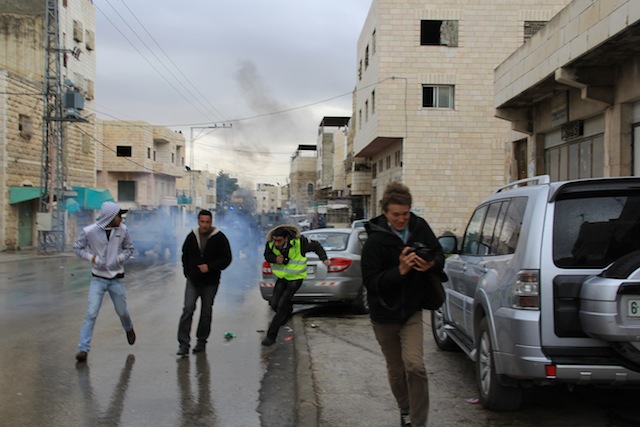
As the crowd fled, Israeli soldiers descended from all sides firing teargas at small pockets of Palestinians, forcing them indoors. The demonstrators regrouped on several occasions, throwing stones and burning tires in front of the Israeli blockade.
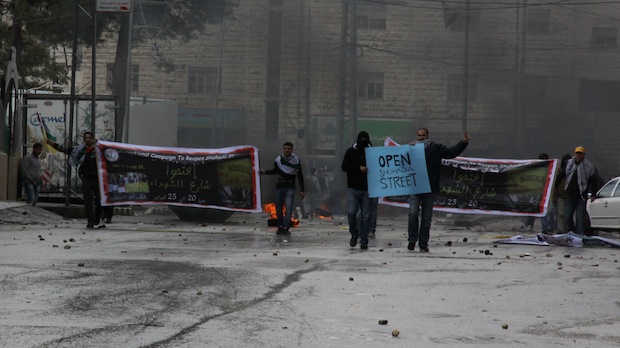
At least two Palestinians were arrested by soldiers in Hebron, including a youth activist from Ramallah, Fadi Quran. Quran was one of the organizers of the Freedom Rides campaign on November 15, 2010.
Soldiers repeatedly threw stun grenades directly at journalists and other bystanders in the vicinity, including myself on several occasions.
A second demonstration was held in front of the Qalandia checkpoint on Saturday to commemorate the death of Ramia after his funeral. Ma’an News reported clashes between soldiers and protesters, including the use of rubber-coated bullets that resulted in the injury of nine people. According to Ma’an, Prime Minister Salam Fayyad issued a statement placing blame for Ramia’s death on the Israeli military. A military spokesperson responded that a Palestinian had shot fireworks in the direction of the soldier, insinuating that the lethal use of live fire was justified for such provocation.