Analysis News

Palestinians greet Obama with popular resistance; army arrests dozens

After several days of small-scale demonstrations ahead of Obama’s visit, Palestinians organized two larger events Wednesday morning as the American president landed at Ben-Gurion Airport.

Non-violent Palestinian activist with Obama mask arrested in Hebron (Oren Ziv / Activestills)

Non-violent Palestinian activist with Obama mask arrested in Hebron (Oren Ziv / Activestills)

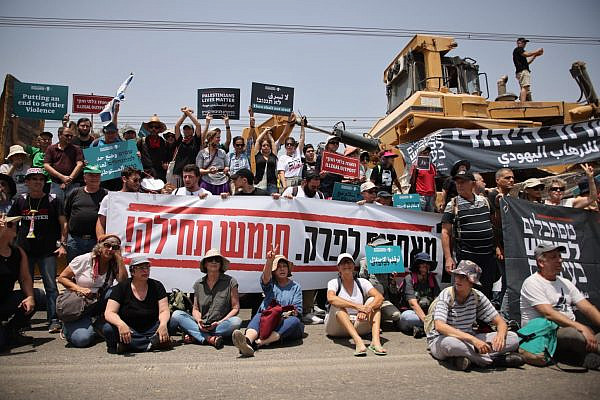
About 500 people rebuilt 15 tents on privately owned lands in the new village-outpost of “Bab Al-Shams,” located at the heart of the much controversial E-1 area, where Israel intends to build thousands of new settler houses, isolating Jerusalem from the rest of the West Bank and cutting it in two. Bab Al-Shams was originally set up a few months ago, and dismantled by Israeli police several days later. Activists in the new Bab Al-Shams held signs saying “you promised hope and change – you gave us colonies and apartheid.”

With the Israeli settlement Maale Adumim visible on the horizon, Palestinian activists erect a new protest camp in the E1 area, focusing their protest on the visit of U.S. President Barack Obama, West Bank, March 20, 2013. All Israeli settlements in the occupied Palestinian territories are illegal under international law. The action took place at the same hour Obama landed in Ben Gurion airport near Tel Aviv. Photo by: Ryan Rodrick Beiler/Activestills.org

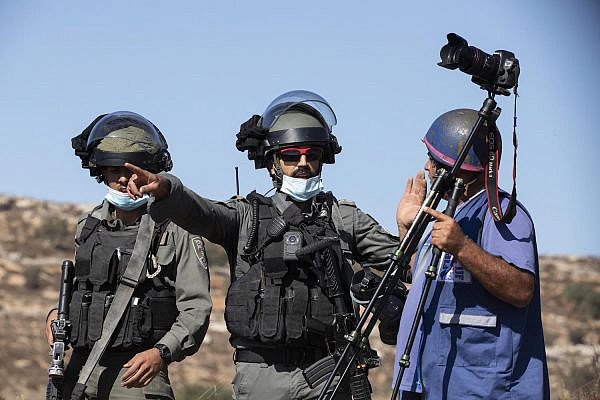
Meanwhile in Hebron, Israeli army forces arrested about 30 schoolchildren, at least five of whom were between the ages of 8 and 10 and thus under the age of criminal responsibility, according to B’Tselem. The children were accused of having participated in acts of stone throwing.

Later in the afternoon a group of some 25 Palestinians, internationals and Israelis marched on Shuhada Street in Hebron, where freedom of movement has been restricted for Palestinians, and the street has been open only to Israelis for the past 12 years. The activists, who were following up on a Saturday workshop on civil rights in the U.S., wore “I have a dream” T-shirts and masks with the faces of Obama and...

Read More
View article: AAA
Share article

Displaced Palestinians return to village after 64 years

The third generation of the displaced community of Iqrit decided that they’d had enough of waiting for authorities to allow them to return to their village lands, taking matters into their own hands. Last August, they set up their base in a room adjacent to the old church and haven’t left since.

Welcome to Iqrit. The revivers of the village (Oren Ziv / Activestills)

Welcome to Iqrit. The revivers of the village (Oren Ziv / Activestills)

In 1948, the Christian Orthodox village of Iqrit surrendered to the IDF without a fight. When soldiers ordered residents to leave for two weeks for security reasons, considering the village is extremely close to the Lebanese boarder, nobody thought twice about it. Three years later, in July 1951, when the High Court of Justice ordered the state to fulfill its promise and allow the displaced people, who were still living in temporary houses in other villages, to return to their homes and lands, the small community was thrilled. But on Christmas Eve of that year the IDF blew up the entire village, leaving only the church in place. The people of Iqrit realized that something had gone terribly, terribly wrong.

Labeeb and Marth Ashkar holding a picture of the village they were deported from in 1948 (Oren Ziv / Activestills)

Labeeb and Marth Ashkar holding a picture of the village they were deported from in 1948 (Oren Ziv / Activestills)

Since then, sixty-four years have passed. In the summer of 2012, like in all other summers since 1995, the entire displaced community organized a summer camp for their youth on village lands near the old church that they frequent on a monthly basis. They told the youngsters tales of village life and explained to them once again how they have been fighting for their right of return, a right which was guaranteed to them by courts and governments alike over the years. Iqrit is one of only two cases in Israeli history in which such promises have been made (the...

Read More
View article: AAA
Share article

Waiting for Obama: Hebron youth take cue from U.S. civil rights movement

If it had happened anywhere other than Hebron, one would have been justified in assuming that the scene unfolding was coordinated for a not-too-sophisticated film about “the conflict”. Surely somewhere out of sight there is an entire movie crew ready for the director to yell “cut!”, so that all actors on this bizarre and horrific set can trade the severity on their faces for laughter and ease during their coffee break.

Still life with horse, boy and soldiers (Haggai Matar)

Still life with horse, boy and soldiers (Haggai Matar)

But this is Hebron, and the dramatic horror is very much real. In front of us is a small landing at the top of a hill overlooking the old city, with the Cave of the Patriarchs in plain view. On the landing, a Palestinian youth guide is taking children on two-minute horse rides, one at a time. Watching the horse and its successive little riders are the kids whose turn is coming up, a group of settler girls in the same age group, and five soldiers in full combat gear.

The group of girls, encouraged by the recent arrival of the soldiers, is starting to heckle the horse riding group. “You’re ugly,” shouts one girl at another child looking her way. “You’re all heathens and I want you all to die,” laughs another 7-year-old, meaning every word. “Why are we afraid? Let’s tell the soldiers to kick them and their horse so that we can play,” calls out a third as a challenge to her friends while holding a football in her hand. No one moves. Two older women pass by and one girl spits in their general direction and half-whispers “fat whores!” Nothing happens. The soldiers stand on the side, talking to each other, and the other kids keep going on and off the horse, looking timidly at the girls. They know that they cannot possibly talk back without the soldiers intervening. In the background, loudspeakers are blasting a song into the air. “We shall overcome…” No. Seriously? Yes. This is Hebron.

Two groups watching a horse. West Bank Story (Haggai Matar)
Read More
View article: AAA
Share article

Palestinian cartoonist detained for a month as prisoner protests grow

Mohammad Saba’aneh, an important Palestinian political cartoonist, has been in prison for about a month now. Friends and supporters suspect his detention is related to the growing protests on the issue of Palestinian prisoners and the international concern over hunger strikers, including a new resolution in the European Parliament.

A recent drawing of Saba'aneh's

A recent drawing of Saba’aneh’s

Mohammad Saba’aneh (30) was arrested on February 16 while returning from a work-related trip to Jordan. After taking part in an Amman conference of the Arab-American University in Jenin (a private institute that works in coordination with the PA’s Ministry of Education and the California and Utah State Universities), where he works in the spokesperson’s office, Saba’aneh was captured by Israeli authorities at the Allenby border crossing and taken for interrogation.

The young cartoonist, whose drawings are regularly published in the Al-Hayat al-Jadida newspaper, was not allowed to see an attorney for the first three weeks of his interrogation, and so far, no official charges have been brought against him. The Ofer Military Court has prolonged his detention time after time, and an appeal against the latest addition to his detention was denied by the Military Appeals Court on Monday. Attorney Jawad Boulos, who was finally allowed to see Saba’aneh last week, told his family that he is doing well and that he is being broadly interrogated for allegedly aiding an illegal organization. Last week, soldiers raided the family’s house and arrested Saba’aneh’s brother, and confiscated computers.

Since his arrest, local and international artists and journalists have been calling for Saba’aneh’s release, claiming that his only crime is criticizing the occupation with his pen and palate of colors. The Palestinian Journalists’ Syndicate, Reporters without Borders, the Committee to Protect Journalists and several Israeli cartoonists and artists have already taken a stand against their colleague’s prolonged detention without charge, and some demonstrated outside the courthouse during the latest detention hearing. Cartoons advocating his release were published on the Cartoon Movement website, and other works of art by Israeli artists were gathered as a form of petition in the Erev-Rav website. “As Israeli artists we call for the release of Mohammad Saba’aneh,” they wrote, “his pictures of reality are not a crime – reality itself is the crime, and...

Read More
View article: AAA
Share article

Palestinians clash with IDF at demonstrations in support of hunger strikers

Hundreds of Palestinian took part today in demonstrations in solidarity  with Palestinian prisoners, specifically those administrative detainees on hunger strike. Dozens were lightly wounded from tear gas inhalation, and several from live ammunition.

Clashes outside Ofer prison (Yotam Ronen / Activestills)

Clashes outside Ofer prison (Yotam Ronen / Activestills)

The main protest today occurred outside Ofer Prison, just outside Ramallah, in support of Samer Issawi, who has not eaten since July 29, 2012, along with the rest of the Palestinians on hunger strike. Hundreds of Palestinians, including MK Ahmad Tibi, Palestinian MP Mustafa Barghouti and Islamic leader Sheikh Raed Salah gathered near Ofer at noon for a Friday prayer before marching toward the prison,some  confronting army forces with stones. Forces made extensive use of tear gas canisters, injuring many, and also shot live ammunition, sending at least two demonstrators to the hospital. A Palestinian journalist was also wounded, according to several reports.

Tear gas outside Ofer prison (Oren Ziv / Activestills)

Tear gas outside Ofer prison (Oren Ziv / Activestills)

Similar yet somewhat calmer demonstrations also took place near the Jalame checkpoint in Jenin and around the Qalandiya checkpoint between Ramallah and Jerusalem. Palestinian President Mahmoud Abbas attended a protest tent in Ramallah and gave a speech about the importance of releasing prisoners as part of the Palestinian struggle.

Scouts supporting prisoners in Jenin (Ahmad Al-Bazz / Activestills)

Scouts supporting prisoners in Jenin (Ahmad Al-Bazz / Activestills)

The popular weekly demonstrations against the wall and settlements, attended by Israelis and internationals every Friday, were dedicated to solidarity with the prisoners. In Qaddum, four people were injured from being hit by tear gas canisters, reportedly shot at a direct trajectory. In Nabi Saleh one teenage girl was injured by rubber-coated bullets. In Ma’asara demonstrators broke through the line of soldiers regularly stationed at the entrance to the village and made it to the settlement of Efrat, where confrontations broke out with local settlers and security guards. In Bil’in...

Read More
View article: AAA
Share article

Young Israeli conscientious objector sentenced to sixth consecutive prison term

Natan Blanc (19) has been in and out of prison for three months now. On November 19, Blanc informed authorities of his conscientious objection to enlist to the Israeli army due to the ongoing occupation of Palestinian territories and the constant militarization of the Israeli society which it entails.

Natan Blanc (courtesy of the family)

Natan Blanc (courtesy of the family)

Since his initial refusal to be drafted into the IDF, Natan Blanc has been sentenced six times, the last being this Sunday, each to a period of two to three weeks in jail. In accordance with military regulations, Blanc is being sentenced by medium-level officers in short disciplinary proceedings, sent to prison, then back to the induction base, and then tried again. There are no real limitations to the number of times this process can repeat itself, in what has already been described by Amnesty International and several others human rights NGOs in other cases as arbitrary sentencing. Blanc is sticking to his refusal and says he won’t consider turning to the military psychiatrist as an alternative route to his declared and principled refusal.

In the statement he released on 19.11.12 Blanc wrote the following:

I began thinking about refusing to be conscripted into the Israeli Army during the ‘Cast Lead’ operation in 2008. The wave of aggressive militarism that swept the country then, the expressions of mutual hatred, and the vacuous talk about stamping out terror and creating a deterrent effect were the primary trigger for my refusal. Today, after four years full of terror, without a political process [towards peace negotiations], and without quiet in Gaza and Sderot, it is clear that the Netanyahu government, like that of his predecessor Olmert, is not interested in finding a solution to the existing situation, but rather in preserving it. From their point of view, there is nothing wrong with our initiating a ‘Cast Lead 2′ operation every three or four years (and then 3, 4,5 and 6): we will talk of deterrence, we will kill some terrorist, we will lose some civilians on both sides, and we will prepare the ground for a new generation full of hatred on both sides. As representatives of the people, members of the cabinet have no...

Read More
View article: AAA
Share article

Palestinians erect third West Bank outpost, are attacked by IDF, settlers

In third such project in as many weeks, hundreds of Palestinians erect new neighborhood of Burin, calling it Manatir. The activists and village residents were quickly attacked by IDF soldiers and local settlers.

IDF troops surround Palestinian activists establishing the Al-Manatir outpost, February 2, 2013 (Photo: Ryan Rodrick Beiler/Activestills.org)

Update:
After hours of clashes where IDF troops reportedly shot live bullets, tear gas and rubber-coated bullets inside the village of Burin, the army completely cleared the new neighborhood of Al Manitar. At least five Palestinians were arrested throughout the day and an unknown number were injured. See pictures of Border Police dispersing activists here.

Some 300 Palestinians from the village of Burin and the popular committees against the wall and settlements set up a new neighborhood on village lands, according to reports, calling it Manatir. Israeli forces were quick to respond, sealing off the area to prevent supporters from coming in, and attacked the activists with tear gas, rubber-coated bullets and live bullets. Settlers were also attacking Palestinians in the area.

The new neighborhood, or outpost, was set up Saturday morning on privately owned lands in Burin, a village in Area B near Nablus, which has suffered greatly from settler violence in recent years. Activists on the scene told +972 that settlers have been expanding their activities on village lands, backed by soldiers, who in every instance of conflict declare the area a closed military zone and force only the Palestinians off the land – thus allowing the settlers to maintain control. The settlers of this region around Yitzhar are generally known as some of the most militant throughout the West Bank.

Villagers erected several tents and huts, but were quickly attacked by settlers who started throwing stones at them. Soon enough the army got involved as well, fighting the Palestinians back into the village and sending at least one resident to the hospital with a bullet in the leg. By the afternoon, access roads to the village were sealed off, settlers have been reported to be attacking Palestinian cars on nearby roads and the villagers and activists were trying to regroup to march back to the outpost.

Read More
View article: AAA
Share article

Police brings down Palestinian outpost, activists resist peacefully

The “Bab Al-Shams” camp, E1 area, January 12, 2013. (photo: Oren Ziv/Activestills.org)

UPDATE, 8:30 a.m.: Mass police and army forces evacuated Bab Al-Shams overnight, following a statement made by the prosecuter general stating that the outpost is an immediate threat to the security of the region. Hundreds of soldiers and police detained the dozens of activists present, who resisted the eviction non-violently, and put them on busses to Qalandiya checkpoint. The tents have remained in Bab Al-Shams, and authorities are waiting on the High Court to rule on whether or not they too can be brought down. The heart of the legal controversy is whether or not Bab Al-Shams was built on private lands (which would make the immediate eviction illegal), or on state lands. According to Haaretz, most of the lands where Bab Al-Shams was built are owned by Palestinians.

Original report from last night:

Less than two days after the new Palestinian outpost-village, Bab Al-Shams, was set up in the E1 area outside Jerusalem, Prime Minister Benjamin Netanyahu ordered authorities to evict the activists and dismantle the tents.

Following Netanyahu’s order, police forces arrived on the scene and told activists that the High Court injunction actually only protects the tents from dismantling, but does not forbid eviction of their residents. The activists, who were warned to leave before force would be used against them, vowed to stay put, stating that they would resist eviction non-violently. The state is also expected to ask the High Court to reconsider its temporary injunction, on the premise that the land where Bab Al-Shams was erected is privately owned by Palestinians, and that the village is meant to serve as a tourist attraction which teaches visitors about Bedouin culture. The court is likely to look into the case tomorrow.

Furthermore, journalists have been barred from entering Bab Al-Shams by Israeli security forces. Haaretz is planning to appeal the decision to the High Court of Justice.

Bab Al-Shams has been at the center of the news in Israel– an event which is quite out of the ordinary considering the Israeli media’s treatment of Palestinian popular non-violent resistance. Netanyahu’s swift call to action on the matter has also gained much...

Read More
View article: AAA
Share article

Palestinians build 'settlement' near Jerusalem, receive eviction orders from Border Police

In response to the Israeli government’s plans to build 4,000 housing units for Jewish settlers in the E1 area, Palestinians set up a new tent village called Bab Al-Shams (Gate of the Sun). Police attempts to dismantle the new village were thwarted by a temporary warrant issued by the High Court of Justice.

Border Police order to evict the newly built Palestinian outpost, Bab Al-Shams, in the area of E1, January 11, 2013. (photo by: Oren Ziv/Activestills.org)

Some 250 Palestinians, organized in part by the Popular Struggle Coordination Committee and activists from several villages in struggle against the wall and settlements, arrived at the area known by Israel as E1 early this morning, and started work on their new village. Activists state that the village is built entirely on private lands owned by Palestinians from the nearby town of Al-Tur.”This is a popular response to Israel’s plan to expand its settlements, especially in this area,” Muhammad Khatib of the Bil’in Popular Committee told +972.

Not long after the tents were set up, Border Police and Civil Administration forces arrived at the scene and handed out eviction notices to residences of the new outpost-village, threatening to return and demolish the erected tents shortly. Prepared in advance for such an occasion, activists petitioned against the demolitions to the High Court, which then issued a warrant delaying any eviction or demolition for six days.

Palestinians building the Bab Al-Shams tent city in the E1 area between Jerusalem and the West Bank, January 11, 2013. (photo: Activestills)

Israeli plans for construction in E1 as a response to success of the Palestinian UN bid (and partly as a message for voters in the upcoming elections) attracted much worldwide criticism, including from the United States. For the activists, this is a popular and direct response to Israeli attempts at annexing the corridor between Jerusalem and Ma’ale Adumim.

The new village is...

Read More
View article: AAA
Share article

Construction of Gush Etzion separation fence delayed due to settler objections

Six months after the Ministry of Defense announced plans to resume construction of the fence in Gush Etzion, the IDF informed settler leaders that construction will not be resumed until the route is reevaluated by government.

The Gush Etzion settlement bloc just south of Bethlehem is the location of one of the biggest gaps in the wall in Israel-Palestine. Dozens of miles of the planned route of this project, launched ten years ago following the rise in suicide attacks in Israeli cities, remain unbuilt with construction at a full halt for nearly five years. The lack of construction is due to the pause in hostilities, insufficient funds, and a political clash between government aspirations of annexation, settler pressures against the “insufficient” annexation, and U.S. (and possibly High Court) resistance to the extreme route.

Planned route of the fence in Gush Etzion. Purple and dotted red are yet unbuilt (source: B'Tselem)

Planned route of the fence in Gush Etzion. The purple and dotted red represent the section that has yet to be built. (source: B’Tselem)

However, a couple of months ago, the Ministry of Defense announced that it would resume construction in both the significant gaps in the wall’s route: Gush Etzion, and Mishor Adumim (around the controversial E1 area and Ma’ale Adumim). Alongside Palestinian and international resistance to this route, deemed illegal by the International Court of Justice, construction plans also had settlers gathering their forces for a fight.

Gush Etzion settlers, led by head of their regional council, Davidi Pearl, petitioned, demonstrated and met with Prime Miniser Netanyahu, claiming that the current route would leave parts of the Gush outside the fence (including Nokdim, home of Foreign Minister Avigdor Lieberman). According to them, this would delegitimize their “inherent” belonging to Israel, damage local ecosystems, limit expansion of settlements, damper relations with local Palestinian villagers, and is generally no longer necessary as terror attacks in the West Bank have virtually stopped.

Anti-wall Christmas demonstration in Ma'asara, south of Bethlehem, 2008 (Haggai Matar)

Anti-wall Christmas demonstration in Ma’asara,...

Read More
View article: AAA
Share article

Anti-Christian graffiti sprayed on church in destroyed Galilee village of Bir'em

The internally displaced community of Bir’em found abusive graffiti, stars of David and the word ‘revenge’ sprayed on its church, graveyard and other buildings. Yet the act of vandalism is but one of the community’s problems, as it continues its struggle for return.

Signs telling the Palestinian history of Bir'em were removed by authorities (Oren Ziv / Activestills)

Signs telling the Palestinian history of Bir’em were removed by authorities (Oren Ziv / Activestills)

Last week, several days after they celebrated Christmas, the former residents of Bir’em discovered the graffiti, as well as flammable liquid that had been poured at the entrance of the Church of Our Lady in the village, which has been mostly demolished. As reported in Haaretz, the Committee for the Uprooted of Kafar Bir’em filed an official complaint to police, but no suspects have been identified.

"Revenge" sprayed near the Church door (Photo: The Committee for the Uprooted of Kafar Birem)

“Revenge” sprayed near the Church door (Photo: The Committee for the Uprooted of Kafar Birem)

“This is the second time in the last month that something like this has happened,” says Deeb Maroun, a member of the committee. “Just three weeks ago, someone sprayed ‘revenge’ on the floor of the former school, and put racist stickers on the walls. This has never happened in all the 64 years since we were uprooted from the village, although we have seen cases of gravestone desecration in previous years. While of course you can’t be certain as to the identity of these vandals, it appears to be part of an ugly plague that has been sweeping the entire country, through Jerusalem churches, the Latrun Monastery and more.”

Church of Our Lady in Bir'em. Believers removed grafiti from its walls (Oren Ziv / Activestills)

Church of Our Lady in Bir’em. Worshipper removed the grafiti from its...

Read More
View article: AAA
Share article

Blogger offers army deal: Release information, and I'll go to prison willingly

Eishton, the blogger who was recently interrogated and asked to give up sources, is offering authorities an interesting deal: if the army releases all the information that it says is “out in the open” on soldier deaths – Eishton will confess to all charges brought in his interrogation, and will agree to sit in prison.

The interrogation of the anonymous blogger was conducted due to a series of posts he published, examining who exactly are the 126 soldiers who “died while protecting their country” between April 2011-2012, as officially pronounced on Memorial Day. Following thorough research and thanks to a leak from within the system, Eiston exposed that only three soldiers were actually killed in the line of duty, while others committed suicide, were involved in accidents or died of illness, and in many cases – did not even die in the year in question but several years before.

Following the interrogation and the journalistic interest it attracted, and after army spokespeople declared that information was out in the open, Eishton published a challenge to authorities last night on his Facebook account:

I keep being interrogated for minor technical felonies, and even if you don’t agree with the way I worked you must see the difference between the ‘felony’ I allegedly committed and the outrage and lack of information on the side of the state.

It is now Monday, 24.12.12, 21:30, seven months after Memorial Day, when you declared there were 126 fallen soldiers. Take 24 hours. If by tomorrow evening you release a list with 126 names, dates and causes of death, commit to releasing the lists regarding the fallen since 1948 within a week and release a statement by the Ministry of Defense saying that from now on you will release all lists – I shall admit to the charges brought against me and sit in prison without filing an appeal (although I am not guilty). I swear by my word.

I shall go to prison, the information goes free – seems like a fair price to me.

Update, 25.12, 23:00: So far authorities have not responded to Eishton’s offer and did not publish the full list of names and causes of death of the 126 fallen soldiers, thus failing to meet his deadline. Eishton says on his Facebook page that he continues calling upon the...

Read More
View article: AAA
Share article

Suspect in arson of asylum seeker homes reaches plea deal with no jail time

Arsonist-assister Haim Mula (center) confronting anti-racism activist (Oren Ziv / Activestills)

Arsonist-assister Haim Mula (center) confronting anti-racism activist (Oren Ziv / Activestills)

Haim Mula, a resident of the Shapira neighborhood in south Tel Aviv who was arrested last April in connection with the nighttime arson attack of several African asylum seeker homes and one kindergarten in his neighborhood, has signed a plea bargain that exempts him from jail time.

Mula, 20, was originally accused of committing the attacks himself, admitted only to having prepared the firebombs for the actual arsonist, an offense for which he is expected to receive only a few months of community service and no jail time. It will be up to the court whether to approve this fairly light punishment for Mula’s contribution to the creation of what the original indictment called “homes turned furnaces.”

The day after the Molotov cocktail attack on asylum seekers’ houses, an anti-racism demonstration was held in Shapira. Several local youths attacked demonstrators. One of them, seen in this picture in the center, turned out to be Mula, the main suspect in the arson case. The prosecution says the police have not been able to determine the identity of the actual arsonist, and that Mula refuses to cooperate and give the name of his accomplice.

Read also:

Community shaken after night of arson attacks on African refugees
Israeli arrested on suspicion of arson of asylum seekers’ homes
Asylum seekers arrested in Tel Aviv raid after authorities announce holiday reprieve


View article: AAA
Share article
© 2010 - 2013 +972 Magazine
Follow Us
Credits

+972 is an independent, blog-based web magazine. It was launched in August 2010, resulting from a merger of a number of popular English-language blogs dealing with life and politics in Israel and Palestine.

Website empowered by RSVP

Illustrations: Eran Menedl


theme_function.php-begin | 19.894288MBtheme_function.php-end | 21.7522MBmost_stuff_widget_begin | 25.310328MBmost_stuff_widget_end | 25.677776MBtwitter_widget_begin | 25.678368MBtwitter_widget_end | 25.678368MBtheme_footer_before_end | 25.680104MB