After we finished our visit to the tense West Bank city of Hebron, we made our way to Sderot, an Israeli town on the Gaza border. With me was Shira Nesher, an Israeli peace activist who used to be a guide in the Israeli IDF, during her military service. Both of us were leading a group of 36 American students and professors. The group was here to study conflict and religion and decided to do it through the dual narrative approach, which I developed with my colleagues.

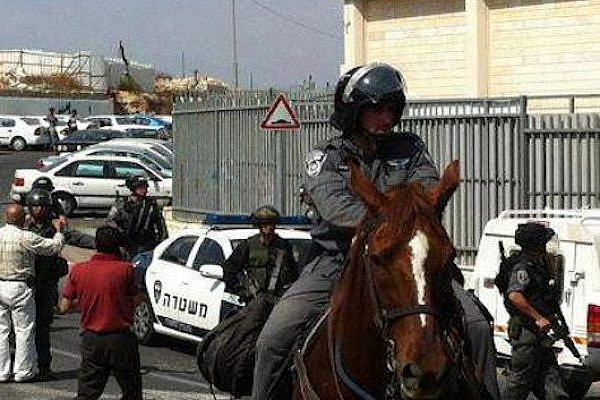
Approaching the checkpoint of Tarqumia, we didn’t expect any special incidents. Our group has passed through multiple checkpoints and being an American tour group, we had no problems. Except at Tarqumia, the checkpoint that serves as the main passage for products from Israel to the West Bank.

Our bus driver, a Jerusalemite Palestinian, was asked to park the bus and get off for extra checks. The extra checks were similar to an airport security check, which tour bus drivers don’t normally undergo. Soon after, as the only other Palestinian on the bus, I was asked to join the bus driver.

Shira, our Israeli guide, asked the soldiers about the details and reasoning behind this selective treatment. The following conversation then took place between the checkpoint head of security and Shira Nesher:

Security: We need to check Aziz and the driver. Both of you, take off  your shoes, jackets, belts, bring your bags…etc

Shira: Fine. Starts taking off her shoes and belt

Security: What do you think you are doing?

Shira: I am going through the same security checks they are going through. Is there a problem with that?

Security: What reality are you living in? You wouldn’t have done this if you were in a New York airport and the security pulled a Muslim guy in front of you for extra checking, would you?

Shira: My reality is different than your reality. These are not strangers in the airport. They are my coworkers. I didn’t ask you not to check them; I will not interfere with your work.  However, you should check me too. I don’t accept you racially profiling my colleagues. We are one team, we spend 15 hours together every day, we work together, eat together and at checkpoints we should be treated similarly. We are equal in everything we do, why not here?

Shira then underwent the same security checks that me and the bus driver had to undergo. What she did was a brilliant way to force the security officer to reconsider his actions.

She could have yelled at him and pilled tons of accusations that would have made him angrier, but she chose a different path. She decided to force him to think about the objectives and practices of his work. Why did he racially profile the Palestinians? She showed him that she considers herself equal to the Palestinians in every way, and that there is no difference between an Israeli Jew and a Palestinian.

In the Israeli-Palestinian conflict, one can lose sight of what this struggle boils down to. It is not about what solution will work at the end – one state, two states or a bi-national state. Eventually, one of these options will be implemented. But what’s more important is the relational aspect of any solution. All these potential solutions will fail if they are not built on the notion of equality and human rights.

Shira Nesher demonstrated a new way to struggle for justice, human rights and equality. She didn’t just demand better treatment of Palestinians from afar, which is an easy thing to do. Preaching ethics and morality to others is not costly. When Shira couldn’t guarantee that her Palestinian colleagues would be treated equally, she gave up her privileges in a show of equality. That’s how this struggle for human rights in Israel/Palestine can be won.

The murder of Aziz Abu Sarah’s brother had an enormous impact on him, and set him on a long political and personal journey from revenge to reconciliation. Watch him tell his story at a National Geographic Symposium.

I was ten years old when my brother Tayseer was tortured to death in an Israeli prison in 1990. Tayseer, 19 years old, was arrested from our  bedroom a year earlier on suspicion of throwing stones at Israeli cars. He refused to confess, and was therefore beaten repeatedly until he signed a confession. By then it was too late.

Tayseer’s murder was one of the most influential events in my life. He had been my closest friend and confidant, and for long time I lived refusing to accept his death. I grew up bitter and angry at those who killed him. I joined the Fatah youth movement and was extremely active as a writer and organizer in my teens. I wrote extensively against peace, negotiations and the Israelis in general. To me, Israel was represented by the soldiers who killed Tayseer, and those who stopped me every morning on my way to school. I believed I was pursuing justice, but in reality I was seeking revenge.

It was only when I decided to learn Hebrew in an Ulpan that my views changed. Though I was 18 years old, it was the first time I had sat in a room with Jewish Israelis who were not soldiers or settlers. I was able to meet Israelis invisible to average Palestinians in the West Bank and Gaza. Israelis who didn’t carry guns. Israelis who believed in the Palestinian right to self determination and freedom from occupation.

Since then, I have changed directions. I have decided to work for justice, peace and reconciliation. I have decided that it is not Israelis or Jews who I should be fighting, but rather hatred, fear, arrogance and ignorance. This didn’t mean that I compromised on seeking freedom for myself or my people. My dedication to ending the occupation has not changed. But I did change the tools that I use. I have become active in conflict resolution through education, business and nonviolence as alternatives to violence.

The restoration of hope and morality in a place savaged by conflict, oppression and injustice is a difficult mission and requires intensive work and perseverance of heart and mind. However, the alternative is bleak. I have decided to challenge the status quo. There is no reason a Jewish 18-year-old has to man a checkpoint instead of a desk at school and Palestinian 18-year-old spend his youth in prison instead of college.

The following video presents my journey in pursuing peace at a National Geographic Symposium, where I was named a 2011 National Geographic Emerging Explorer and Cultural Educator.

YouTube Preview Image