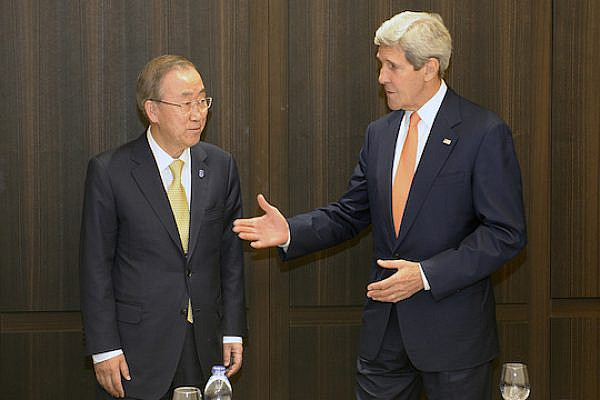
A few weeks ago, I was asked to speak at J Street’s Making History conference. The first panel they wanted me to join was about the Palestinian perspective. I was also asked to moderate a session on Palestinian citizens of Israel. I had no hesitation when I accepted both requests. I was happy that a large Jewish crowd was interested to learn about the Palestinian perspective and to pay attention to the Palestinians citizens of Israel.

American Jews hear much about Palestinians but many have not had the chance to meet them directly and ask about their views, beliefs and passions. These panels are important if we are to correct stereotypes about the Palestinian community. Even lefty Jews must not just speak about us or “learn” about us, but speak directly with us and learn about our lives from us.

Therefore, it is essential for more Palestinians to come to these kinds of events. I know that some Palestinians criticized us for speaking at J Street. However, shifting public opinion and spreading awareness about the Palestinian cause will not happen without engaging Jewish and Christian communities.

I have attended the J Street conferences for the past 3 years and have met many Jewish, Arab and international activists who work tirelessly to end the occupation. I am not always in agreement with J Street. I spoke at the panel of my disappointment at J Street’s decision not to support the September 2011 Palestinian statehood bid at the UN. Last year, I wrote about feeling that J Street wasn’t open to hearing other voices, and too focused on the two-state solution. However, I was encouraged to see some changes this year.  J Street was willing to invite speakers who do not support the two-state solution or didn’t fit neatly within their political views. For an organization that supports an open conversation within the Jewish community, it is vital that they don’t silence those who disagree with them.

J Street’s efforts are remarkable, but it is organization swimming against the current. The two-state solution is losing momentum on every side. Many Israelis see no harm in the current status quo. Palestinians are shifting toward the one-state solution and America has not been leading the peace process for over a decade. The challenges before J Street and two-state solution supporters are monumental.

Stories of Arab Christian-Muslim tensions are increasingly appearing in the news. The bottom line in many of these reports is that Christians are not welcome in Muslim or Arab countries, and they feel that they have no place there. Egypt has been at the forefront of these stories, with reports of burned churches and the persecution of Christians. These reports do touch on some elements of Christian-Muslim relations, but most are exaggerated and seek to focus on any negative aspect they can.

The Arab West Report has focused on misleading publications about Muslim-Christian relations. It’s cheif editor, Dr. Cornelis Hulsman, spoke two weeks ago to a group of students in Cairo from the Center for World Religions, Diplomacy and Conflict Resolution of George Mason University, where I work. He lamented current journalistic practices in Egypt, which do not investigate accusations of hate crimes. His organization tracks media reports on Muslim-Christian incidents, and sends investigators to verify accuracy and biases. They found that many conflicts that do not originate as faith-based get branded as religious conflicts without thorough investigation.

But perhaps what gives the impression that Christians and Muslims are in a constant struggle is the lack of positive news about Muslim-Christian relations. After the death of the Coptic Pope, Shenouda III,  The Middle East Media Research Institute (MEMRI) reported on Wagdy Ghoneim, a radical Imam preaching against Christians and the pope. The Arab West Report pointed out that numerous Muslim Imams spoke positively about the pope and of Marshall Tantawi’s decision to give Christian government employees three days off to mourn Pope Shenouda III.

A Muslim Woman giving water to Christians in Egypt (Photo: facebook)

The picture above  was posted on the Egyptian revolutionary  ”Kolena Khalid Sa’id” Facebook page. The picture shows a Muslim woman with a hijab lowering a bucket of water to Christians mourning the death of Pope Shenouda III. According to the page, she did this for several hours. This woman presents hope and the potential future of Christian-Muslim relations. Publicizing this woman’s action will rob the extremists of their legitimacy and strengthen coexistence efforts in Egypt.

George Mason University students had many other meetings with Christians and Muslims, and both sides spoke positively about  Christian-Muslim relations. The group met also with Salafi and Muslim Brotherhood leaders. Mohammad, a Salafi, surprised the class by claiming that Christians and Salafis were equally persecuted under Mubarak’s regime. He accused the former government of limiting the freedom of worship to both groups. Mohammad’s vision for Egypt includes freedom for all, with security for Christians and Muslims alike.

But Mohammad didn’t brush off existing problems, and admitted that some clerics have taken extreme positions. He pointed out a Salafi cleric who spoke against soccer, proclaiming the game as forbidden in Islam. As a response, a group of young Salafis organized a joint soccer game with Christians to protest the religious ruling. The game proved that Christians and Muslims can stand together against extremism, and that they are not natural enemies.

Christians and Muslims in the Arab world are facing a rapidly changing political environment. There will be radical groups that want to sever the relationship between Christians and Muslims. However, on both sides, many are working tirelessly and together to challenge these attempts. Christians and Muslims have lived side by side for centuries and have gone through many similar challenges. Coexistence will again triumph over any attempt to divide them.