

1,550 Palestinians are on hunger strike. Four of them have been striking for over 60 days and are at risk of death, and one passed out in court today. Thousands have been demonstrating daily in solidarity, and at least ten demonstrators were arrested outside the Ramle prison this evening – and the Israeli Prison Service is finally about to decide on its response to the prisoners’ struggle.

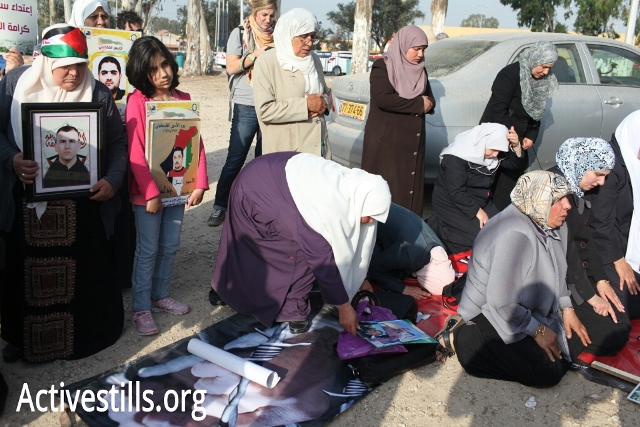
More than 200 demonstrators called for the release of Palestinian prisoners this evening (Thursday) in a protest outside the Ramle prison compound in central Israel, where many Palestinian political prisoners are held. Among the demonstrators were several mothers of Palestinian prisoners with Israeli citizenship or residency permits, who held pictures of their loved ones now behind bars. At least ten demonstrators were arrested, while several Palestinians were also arrested or injured in yet another protest outside the Ofer Prison near Ramallah. Similar demonstrations have been taking place throughout the West Bank and Gaza in recent days, strengthening the popular pressure on Israel to rethink its policy on prisoners.
The demonstrations took place on the 16th day of the prisoners’ mass hunger strike, which began on Prisoner’s Day on April 17. The Israel Prison Service (IPS) confirmed today that 1,550 prisoners (out of a population of 4,500 Palestinians defined as “security prisoners”) are on hunger strike. They have been separated from prisoners not on strike. They are drinking water, and are under medical observation. The IPS defines their present condition “satisfactory.”
However, a group of about 20 administrative prisoners have been striking for longer periods. Four of them launched their hunger strikes more than 60 days ago. They are presently hospitalized, and have been described by doctors as at risk of death. One of the four, Bilal Diab, fainted today in a High Court hearing on his and Thaer Halahleh’s appeal against their detention. The court decided to postpone ruling on the matter.
The administrative detainees are demanding an end to their detention without trial or charges. Their attorney, Jawad Boulos, recently told Haaretz that he fears that after the release of Khader Adnan and Hana Shalabi, Israel will prefer seeing detainees die behind bars than allow them to chip away at its system of administrative detention.
[youtube]http://www.youtube.com/watch?v=C4C8_dyIiHw[/youtube]
(Palestinians demonstrating near Ofer prison on May Day. Another demonstration took place today)
While administrative detainees are demanding they be released unconditionally, the majority of convicted prisoners who joined the strike recently are struggling for better conditions in prison (much like those who took part in the famous IRA hunger strike in the 1980s). Prisoners are demanding the cancelation of new restrictions placed just before the Schalit prisoner swap, which – in addition to existing discrimination between criminal and political prisoners – include an increased use of the solitary confinement of prominent leaders; a ban on Arabic newspapers, books and television; a halt to the transfer of funds from family members to prisoners, necessary for many basic food products, cigarettes and more; and an end to academic studies in Israel’s Open University, which enables distance learning.

The IPS spokesperson told +972 this evening that decisions will be reached within days on how to deal with the strike and the prisoners’ demands. “The [Prison] Service set up a team to investigate the prisoners’ demands prior to the beginning of the strike,” the spokesperson wrote. “The team’s recommendations will be submitted within days.”
Read also:
Prisoner on hunger strike faints in court; judges delay ruling
‘Empty Stomachs’ hunger strike spreads across prisons
As prisoners reach the breaking point, what will Israel do?