
Analysis News

Breaking down walls to remembering the Nakba: A week in photos - May 9-15

This week: Remembering Nakba Day on both sides of the Green Line, demonstrations against the occupation, settlements and the separation wall, social justice protests in Israel, Women of the Wall, solidarity with asylum seekers after police raids and a wall comes down in Lod.

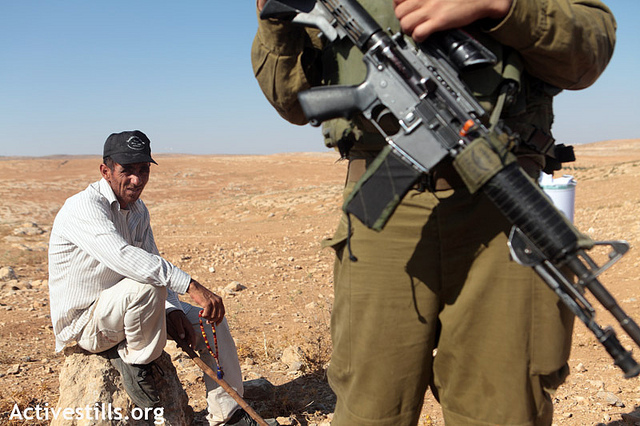
Palestinian activists confront Israeli soldiers during a march on Road 60, the main north-south route through the West Bank, in a Nakba Day protest, May 15, 2013. The Nakba, literally, the “catastrophe,” marks the massive deportation of more then 700,000 Palestinian, made refugees and driven out of what became the State of Israel in 1948. (Photo by: Ryan Rodrick Beiler/Activestills.org)


A Palestinian photographer stands during a minute of silence commemorating the Nakba as part of a ceremony that was held by Palestinian and Israeli students at the entrance to Tel Aviv University, May 13, 2013. A right-wing demonstration was held against the ceremony and protesters shouted slogans against the participants, under police surveillance. (Photo by: Yotam Ronen/Activestills.org)


Protesters push a rock in an attempt to block the road during the weekly demonstration in Kfer Qaddum, a West Bank village located east of Qalqiliya, May 10, 2013. There have been regular demonstrations in Kfer Qaddum since July, 2011, protesting the blocking of the main road east of the village, which used to link it to Nablus. (Photo by: Yotam Ronen/Activestills.org)


A Palestinian youth after being pepper sprayed in the face by Israeli forces during a demonstration against the Israeli separation wall being built around the West Bank town of Al Walaja, May 10, 2013. Once completed, the separation wall will effectively surround Al Walaja, turning it into an enclave. (Photo by: Ryan Rodrick Beiler/Activestills.org)


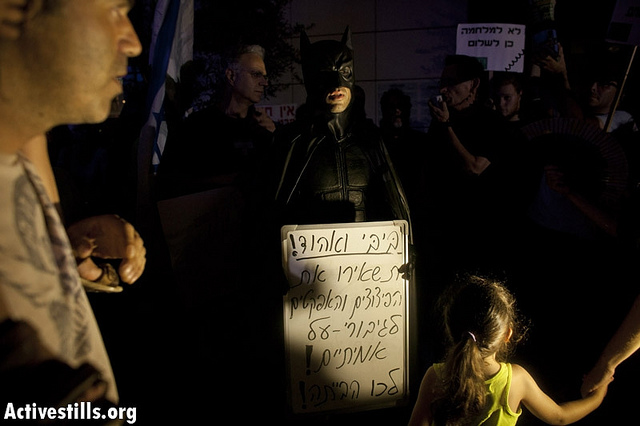
Israelis march during a protest against plans to continue the erosion of welfare stipends in Israel’s 2014 budget, in central Tel Aviv, May 11, 2013. (Photo by: Oren Ziv/Activestills.org)


Read More
View article: AAA
Share article

PHOTOS: Palestinians commemorate Nakba Day in rallies and protests

Palestinian activist Mazzen Al-Azzah confronts Israeli soldiers blocking a march toward the Green Line near the village of Husan, West Bank, May 14, 2013. Al-Azzah was later arrested and falsely accused of throwing stones and assaulting soldiers. (Photo by: Ryan Rodrick Beiler/Activestills.org)

As Noam Sheizaf’s recent headline states, “the Nakba’s memory is more present than ever in Israel.”  The Nakba, literally, “the catastrophe,” is the name given to the massive deportation of more then 700,000 Palestinians from what became the State of Israel in 1948. Sheizaf goes on to point out how efforts, such as the “Nakba law,” which authorizes the finance minister to withdraw funds from organizations commemorating the day, have backfired and effectively injected Nakba consciousness into the global discourse.

From Tel Aviv to Jerusalem and throughout the West Bank and Gaza, activists marched to assert a history which is no longer disputed by Israeli historians such as Benny Morris, who despite his shift to the right, still acknowledges that “in the case of Israel, the moment of its birth was also the moment of the destruction and wholesale displacement of Palestinian society.”

For more resources on Nakba history, visit the Zochrot (Israeli organization dedicated to raising awareness on the Nakba) website, or the website of the Palestinian NGO Badil.

Right-wing protesters wave Israeli flags as they demonstrate against a ceremony commemorating the Nakba that was held by Palestinian and Israeli students in the entrance to the Tel Aviv University. The event took place under heavy police presence, May 13, 2013. (Photo by: Oren Ziv/Activestills.org)


Palestinians march with torches through the streets of Bethlehem to commemorate the Nakba, May 14, 2013. (Photo by: Ryan Rodrick Beiler/Activestills.org)


Palestinian activists march on Road 60, the main north-south route through the West Bank, in a Nakba Day protest, May 15, 2013. (Photo by: Anne Paq/Activestills.org)
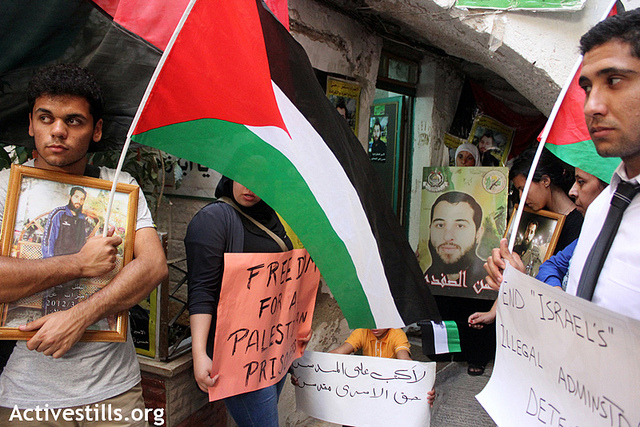
 

Palestinian activists commemorate Nakba Day by planting trees in the Ahfad Younis neighborhood of Bab Al-Shams protest village site in E1, May...

Read More
View article: AAA
Share article

From Jerusalem Day clashes to stone-throwing settlers: A week in photos - May 2-8

This week: Palestinians arrested as Israelis march (and bicycle) to Jerusalem, Israeli settlers and Palestinians throw stones, African immigrant women and children are released from prison, a graphic novel portray the popular struggle, shrink-wrapped animal rights activists ride through Tel Aviv, activists demand more Mizrahi Jews on their bills, and the Separation Wall continues to surround Al Walaja.

Israeli border policemen arrest a Palestinian man during clashes that erupted on ‘Jerusalem Day’. Damascus Gate, East Jerusalem, May 8, 2013. ‘Jerusalem Day’ is an Israeli holiday which celebrates the capture of East Jerusalem from Jordan in the Six Day War of 1967. Though Israel then annexed East Jerusalem and considers part of the State of Israel, the move was never recognized internationally and East Jerusalem, including the Old City, is still considered occupied Palestinian territory under international law. (Photo by: Anne Paq/Activestills.org)


Israeli settlers march into the Old City of Jerusalem during the ‘Jerusalem Day’ march, East Jerusalem, May 8, 2013. Earlier that day, police forces ordered Palestinian shops and stands inside the Old City to close at 15:00. In previous years, Israeli settlers had vandalized and destroyed many Palestinian shops that remained open during the march. (Photo by: Yotam Ronen/Activestills.org)


Escorted by military vehicles, Israeli settlers take over the entire northbound lane of Route 60, the main north-south route connecting the West Bank to Jerusalem, during a ‘Jerusalem Day’ event, May 8, 2013. (Photo by: Ryan Rodrick Beiler/Activestills.org)


A Palestinian man lies on the ground after Israeli policemen used pepper spray on people gathering at one of the entrances to the Al-Aqsa Mosque compound on May 7, 2013, the Old City, East Jerusalem. (Photo by guest photographer: Tali Mayer/Activestills.org)


Israeli settlers and Palestinian demonstrators throw stones at each other, after settlers marched onto the lands of the West Bank villages of Deir Jarir and Silwad where villages were protesting the construction on their land by members of the nearby Israeli settlement of...

Read More
View article: AAA
Share article

Photo collage: Israeli forces arrest dozens in Jerusalem Day clashes

Israeli forces arrest dozens at Damascus Gate during right-wing marches celebrating Jerusalem Day.

Photos by: Anne Paq, Yotam Ronen, and Oren Ziv

Dozens of Palestinians were arrested during clashes that erupted at the Old City’s Damascus Gate during a Jerusalem Day march staged by right-wing Israeli activists. Among the detainees were three photojournalists–including Activestills photographer Oren Ziv (lower left)–and an unknown number of minors, all arrested by border police, mounted policemen, and undercover forces.

Jerusalem Day is an Israeli holiday celebrating the capture of East Jerusalem from Jordan in the Six Day War of 1967. In past years, right-wing activists have marched through the Old City chanting “Death to Arabs” and “Muhammad is Dead”, prompting Israeli authorities to clear streets of Palestinians and ordering them to close their shops in the Muslim Quarter.

Though Israel annexed East Jerusalem in 1967 when it unilaterally redrew Jerusalem’s municipal boundaries, considering it to be part of the State of Israel, the move was never recognized internationally and East Jerusalem is still considered occupied Palestinian territory under international law. Moreover, Palestinians living in Jerusalem are only given residency, not full citizenship in Israel. As Mya Guarnieri points out:

View article: AAA
Share article

PHOTOS: The story of Nabi Saleh, performed by 'The Freedom Theatre'

Through the eyes of a Palestinian child, members of Jenin’s Freedom Theatre perform the story of popular struggle in Nabi Saleh.

Text and photos by Keren Manor/Activestills.org

Members of “The Freedom Theatre” perform a scene about the spring that was confiscated by the settlers of the nearby illegal settlement of “Halamish.” In December 2009, the residents of Nabi Saleh and the neighboring village of Dier Nidham started demonstrations against confiscations of their land by the Israeli army and settlers. The protests have continued to take place every week since then.

On Saturday, May 4, 2013, members of “The Freedom Theatre” performed a play based on stories and testimonies from children of the West Bank village of Nabi Saleh. The play tells the story of the village’s resistance, through the eyes of a young Palestinian child. The first show was performed in the village’s cultural center. The performance was dedicated to Mustafa and Rushdi Tamimi, two Palestinians from Nabi Saleh who were shot to death by Israeli soldiers during demonstrations against the occupation.

An actor plays a Palestinian child, telling the story of his village.


Actors during the play.


A scene portraying Israeli soldiers raiding the house of a Palestinian family in the village.


Children from the village watch the play.


A scene portraying the death of Mustafa Tamimi. Mustafa was shot in the face at close range with a tear gas canister by Israeli soldiers on December 9, 2011.


Members of “The Freedom Theater” improvising a scene with a Palestinian girl telling her story during a play.


The audience applauds the “Freedom Theater” actors...

Read More
View article: AAA
Share article

PHOTOS: Israeli army attacks event for launch of graphic novel in Budrus

The Israeli military interrupts the launch event for a new graphic novel created by the makers of the documentary film ‘Budrus.’

Text by: Jessica Devaney, Photos by: Oren Ziv/Activestills.org

Young Palestinians girls read Budrus – The Graphic Novel aloud to each other, pointing out relatives and friends they recognize on the pages.

Just Vision launched an Arabic graphic novel at the Budrus Girls School on Thursday. Created by Irene Nasser and based on the award-winning documentary, Budrus (directed by Julia Bacha), the graphic novel looks at the unarmed movement in the village through the eyes of 15-year-old Iltezam Morrar.

Starting this summer, Just Vision’s outreach team will use the graphic novel to engage Palestinian youth in discussions surrounding the significance of women’s role in the nonviolent popular struggle and to examine other contested issues like how best to build unity across political lines.

Budrus the graphic novel is available online here.

A Palestinian girl in Budrus, after receiving a copy of the graphic novel at the launch event on Thursday.


As the event wrapped up, the Israeli army arrived and began shooting tear gas into the village. The heat from the tear gas canisters started a fire in the olive groves. Youth from the village attempt to put out the fire. Since the beginning of the year, the Israeli army has maintained a near-daily presence in the village. As a result, last month Budrus residents have resumed their weekly unarmed protests.


The women of Budrus are known for the leadership they took in the village’s successful unarmed struggle against the route of the Separation Barrier. After 10 months of struggle, the residents managed to save 95 percent of their lands from confiscation. They gathered on Thursday at the Budrus Girls School to mark the launch of the Budrus – The Graphic Novel.


The Budrus youth dabke troupe performs at the graphic novel launch event.


View article: AAA
Share article

From settler reprisals to May Day marches: A week in photos April 25 - May 1

This week: May Day marches from Tel Aviv to Boston, reprisals for the stabbing death of a settler by a Palestinian, protests against domestic violence, demonstrations against settlement expansion, celebrations for hunger striker Samer Issawi, and demolitions of Palestinian properties continue.

Demonstrators march during the International Worker’s Day protest in the center of Tel Aviv May 1, 2013. (Photo by: Shiraz Grinbaum/ Activestills.org)


Activists and families of women who have been murdered by men of the family protest domestic violence in the city of Kufer Karra, April 26, 2013. Convoys of cars drove from the cities of Lakia , Lod , Ramle, and Taybe to protest in Kufer Karra against violence and murder of women. (Photo by guest photographer: Tali Mayer/Activestills.org)


Palestinian demonstrators from the West Bank villages of Deir Jarir and Silwad take cover as Israeli soldiers shoot rubber coated steel bullets during a protest against construction on their land by members of the nearby Israeli settlement of Ofra on April 26, 2013. All Israeli settlements in occupied Palestinian territory are illegal under international law. (Photo: Oren Ziv/ Activestills.org)


Palestinian youth help to clean up the celebration party of Palestinian hunger striker Samer Issawi, as it was canceled after the Israeli police blocked the entrance to the East Jerusalem neighborhood of Issawiya, preventing from some of the Palestinians who were invited to the party to enter the area. (Photo by: Oren Ziv/ Activestills.org)


A member of the Palestinian Ghaith family stands with the belongings of her family after her house was demolished by Jerusalem municipality workers in the East Jerusalem neighborhood of At-Tur on April 29, 2013. (Photo by guest photographer: Tali Mayer/ Activestills.org)


Abahlali baseMjondolo Movement South Africa, a democratic and membership based organization, held its UnFreedom Day event in Durban every year since 2006. This year UnFreedom Day was held in Cape Town for...

Read More
View article: AAA
Share article

PHOTOS: The face of Israel's discriminatory home demolition policy

Demolitions of Palestinian homes in East Jerusalem are part and parcel of Israel’s publicly stated plans to reduce and control the demography of Palestinians and non-Jews in Jerusalem. With little chance of receiving building permits, Palestinian families often decide to build anyway, hoping that maybe their home will be spared.

Israeli border police guard for the demolition of the Jaradat family home in the Al Tur neighborhood of East Jerusalem, April 24, 2013. (photo: Ryan Rodrick Beiler/Activestills.org)

On Wednesday April 24, Israeli authorities demolished three Palestinian houses in the At Tur neighborhood on the Mount of Olives in East Jerusalem. The pretext, as usual, was that the owner had built illegally, though he had spent months applying for permits from the Jerusalem Municipality and provided all requested documentation. One of the structures demolished was an addition built to house the youngest generations of the 45-member Jaradat extended family, illustrating one of the basic quandaries facing East Jerusalem Palestinians: As families grow and children get married to start families of their own, where can they live if the government will not grant them permission to build?

Neighbors watch as Israeli forces demolish part of the Jaradat family home. (photo: Ryan Rodrick Beiler/Activestills.org)

Israelis sometimes display a disturbingly blasé attitude toward the demolition of Palestinian homes. One sometimes encounters the attitude, even among self-proclaimed leftists, that “there are laws,” and since an Israeli Jew cannot build a house without permission, why should a Palestinian be able to? They might even offer examples of how their own family wanted to build and were denied permission. So if Israelis obey the law, isn’t it the Palestinians’ fault when they are punished for breaking it?

Israeli border police guard the demolition of the Jaradat family home in the At Tur neighborhood of East Jerusalem. (photo: Ryan Rodrick Beiler/Activestills.org)

This attitude may seem reasonable to foreigners as well. Most countries have zoning and building regulations that are generally respected as a necessity for maintaining orderly communities. But what these attitudes fail to grasp is the systematic discrimination faced by Palestinians under Israeli occupation, a...

Read More
View article: AAA
Share article

From hunger strikes to the Palestine Marathon: A week in photos - April 18-24

This week: Samer Issawi ends his hunger strike, Israeli authorities demolish Palestinian homes and businesses, action for animal rights, West Bank demonstrations, the Boston manhunt, settlement expansion, a new marathon in Bethlehem, and protests by young and old.

Tareq and Layla Issawi, the father and mother of Palestinian hunger striker Samer Issawi, smile with a portrait of their son in their home in the East Jerusalem neighborhood of Issawiya, two days after he signed an agreement with Israeli authorities to end his strike, April 24, 2013. Under the terms of the agreement reached late Monday, April 22, Issawi will be released to his hometown of Jerusalem after serving eight more months in jail, after 266 days of refusing food in protest against his rearrest by Israeli forces after being released in the Gilad Shalit prisoner exchange in October 2011. (Photo by: Ryan Rodrick Beiler/Activestills.org)


The owner of a restaurant, demolished a few hours earlier by the Israeli authorities, stands in front of the ruins, Makhrour Valley Beit, Jala, April 18, 2013. The restaurant was first demolished about one year ago and had just recently re-opened the previous week . (Photo by: Anne Paq/Activestills.org)


The weekly demonstration in Kfer Qaddum, a West Bank village located east of Qalqiliya, Friday, April 19, 2013. Kfer Qaddum started to organize regular demonstrations in July 2011, protesting against the blocking of the main road east of the village which used to link it to Nablus. (Photo by: Yotam Ronen/Activestills.org)


Israeli activists take part in an action against animal testing, in the city center of Tel Aviv, April 23, 2013. (Photo by: Oren Ziv/ Activestills.org)


A member of the Jaradat family stands in the remains of his home demolished by Israeli authorities in the Al Tur neighborhood of East Jerusalem, April 24, 2013. Authorities demolished an addition built for the children of the 45-member Jaradat family. Palestinians are routinely denied permission to build or add to their homes in...

Read More
View article: AAA
Share article

From prisoner protests to the Boston bombings: A week in photos - April 11-17

Activists tear down pieces of barbed wire from the separation wall surrounding the village of Rafat near Ofer military prison in commemoration of the death of Bassem Abu Rahmah (“Phil”) and Palestinian Prisoners Day, April 17, 2013, Rafat, West Bank. Bassem Abu Rahmah was hit with a tear gas canister shot directly at him at close range by Israeli army forces during a demonstration against the separation barrier in Bil’in, on April 17, 2009. (Photo by: Activestills.org)


A Palestinian girl who handcuffed herself holds the picture of her jailed uncle during a protest in support of the Palestinian prisoners in the West Bank city of Bethlehem, April 11, 2013. (Photo by: Anne Paq/Activestills.org)


Palestinian women holding framed photos and posters of imprisoned relatives during a rally commemorating ‘Palestinian Prisoners Day,’ April 17, 2013, Ramallah, West Bank. April 17 marks the annual ‘Palestinian Prisoners Day.’ It was established to remind the public of the thousands of Palestinian prisoners in Israeli jails, where they are routinely exposed to torture and other inhumane treatment. (Photo by: Anne Paq/Activestills.org)


On Palestinian Prisoners Day, Palestinians celebrate the recent release of several prisoners held in Israeli jails, Bethlehem, West Bank, April 17, 2013. (Photo by: Ryan Rodrick Beiler/Activestills.org)


Israeli activists hold a symbolic hunger strike in solidarity with Palestinian prisoners in front of Kirya military base on April 18, 2013. The activists intent to hold the strike for a week. (Photo by: Yotam Ronen/Activestills.org)


Activists put up a street photo exhibition in solidarity with ‘Palestinian Prisoners Day’, West Jerusalem, April 17, 2013. The exhibition was put up in various locations in West Jerusalem and Tel Aviv. (Photo by: Activestills.org)


People holding candles at a vigil for the victims of the Boston Marathon bombings at Boston...

Read More
View article: AAA
Share article

PHOTOS: Street exhibition confronts Israelis on Palestinian Prisoners' Day

Members of Activestills posted a public street exhibition on the streets of West Jerusalem and Tel Aviv of photos that bring attention to Palestinian Prisoners Day.

Photos by: Ahmad Al-Bazz, Shiraz Grinbaum, Keren Manor, Anne Paq, Ryan Rodrick Beiler, Yotam Ronen, and Oren Ziv

A relative hangs a photo of Haled Muheisen prior to his release from an Israeli jail on October 17, 2011, in the East Jerusalem neighborhood of Issawiya.

The following text, in Hebrew, accompanied street exhibitions of the photos from this essay which were posted in public places in West Jerusalem and Tel Aviv the night before Palestinian Prisoners Day, April 17, 2013. Images of the street exhibitions, some of them later defaced, follow below:

April 17 commemorates Palestinian Prisoners’ Day. As of February 2013, there are 4,713 Palestinian men and women held in Israeli prisons. Of these, 169 are administrative detainees, held without an indictment; 235 are minors. Since the occupation of the West Bank, East Jerusalem, and the Gaza Strip in 1967, more than 700,000 Palestinians have been imprisoned by Israel. To this day, dozens of Palestinians are taken away from their homes, workplaces, schools, and from different checkpoints on a weekly basis. Some are detained for days, some for weeks, and some imprisoned for unlimited periods of time.

The hunger strike is a protest tactic that started as an unorganized form of resistance to Israel’s use of administrative detention, torture, humiliation, and other forms of abuse that Palestinian prisoners experience in Israeli prisons.

In 2012 and 2013, nearly 2,000 Palestinian prisoners went on hunger strike, some of whom reached the military medical center after dozens of days without food. Thousands of Palestinians have joined protests outside the prisons’ walls. Protest tents, strikes, and other solidarity demonstrations with the hunger strikers in the West Bank and Israel have been brutally suppressed by Israeli forces, resulting in scores of casualties.

Samer Issawi has been on hunger strike for more than eight months, and other prisoners are joining him. They only ask for a fair trial. Their medical condition is deteriorating by the minute.

Palestinian hunger striker Samer Issawi is taken to his court hearing in the Magistrate Court in Jerusalem, February 19, 2013. Some 800 Palestinian political prisoners...

Read More
View article: AAA
Share article

From tear gas to rubber-coated steel bullets: A week in photos - April 4-10

This week: Solidarity with Palestinian prisoners, opposition to Yair Lapid, preserving Tel Aviv’s beaches, resisting the occupation’s obstacles, Tel Aviv’s ‘Slutwalk’, and the targeting of a Palestinian photographer.

A Palestinian suffers from tear gas inhalation during clashes with Israeli soldiers in the Old city of Hebron after the funeral of Maysara Abu Hamdiyeh who died two days earlier in Israeli custody, Hebron, West Bank April 4, 2013. Hamdiyeh died shortly after being transferred from prison to ‘Soroka’ hospital in late March, suffering from throat cancer which had spread to his spinal cord. Before his death, he had complained of medical neglect by the Israeli prison authorities. (Photo by: Anne Paq/Activestills.org)


Demonstrators attempt to block Road No.1 in Jerusalem during a solidarity protest with Palestinian prisoners on April 4, 2013. (Photo by: Guest photographer Tali Mayer/Activestills.org)


Palestinian youths clash with Israeli soldiers in the Old City of Hebron after the funeral of Maysara Abu Hamdiyeh who died two days earlier in Israeli custody, Hebron, West Bank April 4, 2013. Hamdiyeh died shortly after being transferred from prison to ‘Soroka’ hospital in late March, suffering from throat cancer which had spread to his spinal cord. Before his death, he had complained of medical neglect by the Israeli prison authorities. (Photo by: Anne Paq/Activestills.org)


Relatives of Amer Nasser, a 17-year-old Palestinian shot by Israeli soldiers, mourn during his funeral in the West Bank town of Anabta near Tulkarm on April 4, 2013. Amer and Naji Balbis were killed by Israeli soldiers during clashes that erupted after the death of Maisara Abu Hamdiyeh, a Palestinian prisoner, who died in Israeli custody. (Photo by: Oren Ziv/ Activestills.org)


Palestinian members of the Al Aqsa Brigade are seen at the entrance to the cemetery during the funeral of Maysara Abu Hamdiyeh who died two days earlier in Israeli custody, Hebron, West Bank April 4, 2013. (Photo by: Anne Paq/Activestills.org)


Read More
View article: AAA
Share article

PHOTOS: Israeli troops shoot Palestinian photographer in the face

WARNING: GRAPHIC IMAGES

Israeli soldiers target a Palestinian photographer who was taking pictures of them invading Aida Refugee Camp, shooting him in the face with a rubber-coated steel bullet. 

Mohammad Al-Azza rests in the hospital the morning after being shot in the face with a rubber-coated steel bullet by Israeli forces in Aida Refguee Camp. Beit Jala, West Bank, April 9, 2013. Al-Azza underwent two surgeries to remove the bullet, which lodged in his cheek below his right eye and fractured his skull. He is expected to make a full recovery. (photo by: Ryan Rodrick Beiler/Activestills.org)

At about 5:30 p.m. Monday, Israeli soldiers entered Aida Refugee Camp through a gate in the separation wall dividing Rachel’s Tomb from Bethlehem. There were no clashes at the time, and their presence in the camp was not provoked, but was itself a provocation.

Mohammad Al-Azza began photographing the advancing soldiers from the second-floor balcony of the Lajee Center, a children’s center near the camp entrance where he has long volunteered in the media unit. He was eager to use the center’s new camera, a Canon 600D with a 50-250mm zoom lens.

Israeli troops approach Aida Refugee Camp from their base behind the separation wall near Rachel’s Tomb. (photo by: Guest photographer Mohammad Al-Azza)

As he was photographing, one of the soldiers shouted at him in Arabic to “Go home!” Mohammad replied, “Why? I’m only taking pictures!” The soldiers continued shouting at him, “Go inside! Go inside!”

Mohammad replied, “No, I will not go! As you have a gun and shoot at children, I have a camera and I’m taking pictures—I do nothing to you!”

The soldiers, who became angrier continued threatening Mohammad with their guns. Mohammad decided to go inside, but continued taking photos through the window and through the doorway opened just wide enough for his camera lens to fit through.

The last photo taken by Mohammad Al-Azza before he was shot in the face by the soldier pictured. (photo by: Guest photographer Mohammad Al-Azza)

By this time, a few youth from the camp were throwing stones, while the soldiers fired rubber-coated steel bullets and tear gas grenades...

Read More
View article: AAA
Share article
© 2010 - 2013 +972 Magazine
Follow Us
Credits

+972 is an independent, blog-based web magazine. It was launched in August 2010, resulting from a merger of a number of popular English-language blogs dealing with life and politics in Israel and Palestine.

Website empowered by RSVP

Illustrations: Eran Menedl


theme_function.php-begin | 19.890424MBtheme_function.php-end | 21.748104MBmost_stuff_widget_begin | 24.46464MBmost_stuff_widget_end | 24.86164MBtwitter_widget_begin | 24.863072MBtwitter_widget_end | 24.863072MBtheme_footer_before_end | 24.86492MB